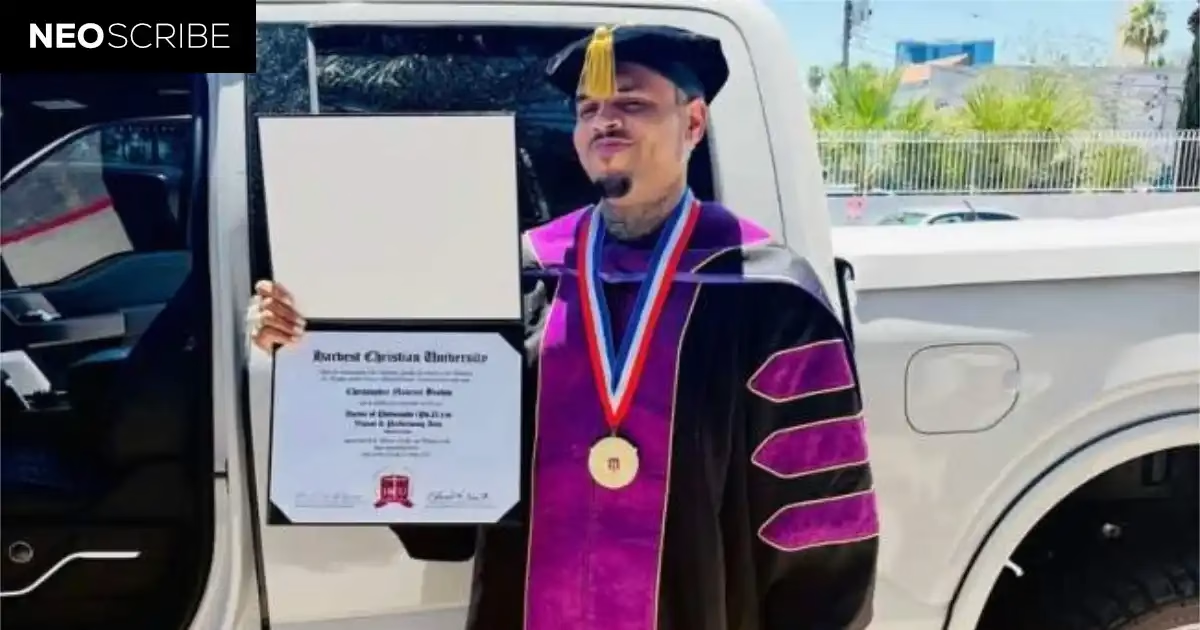
Johannesburg – Chris Brown has never been a man who does things quietly, and his latest move is no exception. On 23 May 2026, the R&B superstar took to Instagram with just four words: “I DID A THING,” alongside photographs of himself draped in ceremonial academic regalia, grinning as he accepted an honorary Doctor of Philosophy in Visual and Performing Arts. The institution behind the honour is Harvest Christian University, a private faith-based school based in Dallas, Texas. For South African fans, who have long embraced Brown as one of the defining voices of their generation, this moment lands with complicated weight. It is a celebration, a controversy, and a conversation rolled into one.
What the Degree Actually Means
The honorary degree was conferred on 23 May 2026, with Harvest Christian University citing Brown’s decades-long impact on music, entertainment, and performance culture as the basis for the recognition. Brown appeared on stage in full graduation dress, accepted a ceremonial drape around his neck, and posed with his diploma bearing his full government name. On his Instagram post, Brown simply wrote “I DID A THING,” a characteristically understated caption for what is, by any measure, a significant personal milestone.
It is important to understand what an honorary doctorate is and what it is not. It carries no academic coursework, no dissertation, and no formal research requirement. It is a symbolic recognition awarded by an institution to someone whose life’s work it wishes to celebrate. In that context, Harvest Christian University issues honorary doctoral degrees to those who have made significant impacts in their fields, particularly in music, entertainment, and humanitarian work, honouring those whose life’s work embodies the values and mission of the university.
The Numbers Behind the Name
For South Africans who may question whether Brown has earned this kind of recognition on merit alone, the commercial record speaks for itself. His influence on the local music landscape, from Afrobeats crossover tracks to township dance floors, has been measurable and sustained across two decades.
| Milestone | Detail |
|---|---|
| Latest Album Debut | No. 7 on the Billboard 200 |
| Opening Week Streams | Over 60 million on-demand streams |
| Equivalent Album Units | Approximately 65,000 in week one |
| Grammy Wins | Best R&B Album in 2012 and 2025 |
| Career Tour Gross | Nearly $300 million across his touring career |
| Billboard Top 10 Albums | 13 total chart entries |
His latest album, Brown, debuted at number seven on the Billboard 200, marking his 13th top-ten project on the chart, with the 27-track release driven largely by streaming numbers. Those are not the figures of an artist coasting on nostalgia. They are the benchmarks of someone still operating at the top of his industry.
The Controversy South Africa Cannot Ignore
No honest conversation about Chris Brown in 2026 can sidestep his personal history. Since pleading guilty to felony assault in 2009, Brown has seen tremendous success in the music industry, but his personal issues have certainly hung over his head. The backlash to the doctorate has been fierce in some quarters, with critics arguing that an institution honouring him sends a damaging message about accountability, particularly given how visible the 2009 incident remains online.
For South African women and gender-based violence advocates, this tension is not abstract. South Africa carries one of the highest rates of gender-based violence in the world, and any platform that appears to reward individuals with documented records of abuse draws legitimate scrutiny. The Complex report on the honorary degree notes that public reaction has been sharply divided, with supporters pointing to artistic legacy and critics pointing to the moral responsibility of awarding institutions.
Harvest Christian University has awarded hundreds of such honorary degrees, and does not hold accreditation from any institutional accrediting agency recognised by the United States Department of Education, despite claiming a “royal charter accreditation” on its website. That detail matters. It strips some of the ceremonial weight from the moment while also raising questions about what these types of institutions are ultimately signalling when they choose their honorees.
What This Means Going Forward for SA Fans and Culture
South African audiences have always had a complicated but deeply affectionate relationship with Chris Brown. His influence threads through kwaito, amapiano, and local R&B in ways that are difficult to overstate. Young South African artists have cited his dancing, his vocal style, and his production choices as direct inspirations. When Brown wins, many in Mzansi feel it.
Brown is also set to join Usher on a major stadium tour, with both artists performing multiple shows at venues in the Dallas-Fort Worth area as part of what is being billed as a landmark R&B event. If that tour ever extends internationally, South Africa would almost certainly be among the most vocal markets demanding a date.
The deeper question this moment poses is one that South African culture, media, and audiences must grapple with collectively: at what point does talent outrun accountability, and who gets to decide? The doctorate will not change Brown’s history. It will not erase his Grammy wins either. What it does is force yet another public reckoning with the uncomfortable space between celebrating artistry and confronting the full picture of the person behind it. For South Africa, a country still fighting daily for the dignity and safety of its women, that conversation is never just about a celebrity overseas. It is always also about the values being quietly endorsed at home.