
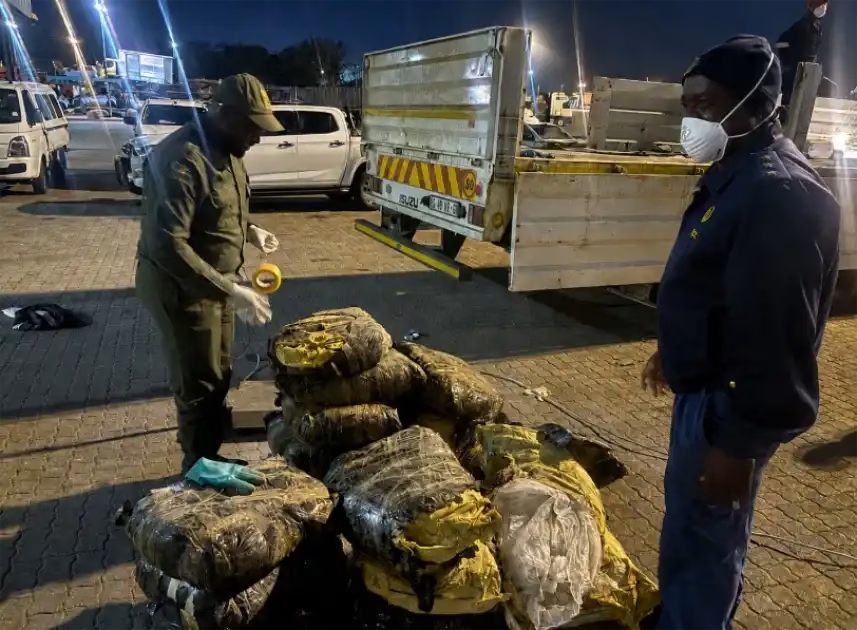
JOHANNESBURG — In a significant blow to international narcotics networks, South African law enforcement authorities arrested three suspects at the Limpopo border this week following the discovery of 713 kilograms of methaqualone with an estimated street value exceeding R1 billion. The methaqualone smuggling Limpopo operation represents one of the largest drug seizures in the province’s history and highlights the escalating battle against transnational organised crime syndicates operating across Southern Africa’s porous borders.
The arrests underscore the strategic importance of Limpopo as both a transit corridor and destination point for illicit substances moving between producing nations and consumer markets. Methaqualone, the active ingredient in mandrax, remains deeply embedded in South Africa’s drug landscape despite international efforts to curtail its production and distribution over the past four decades.
Details of the Major Drug Seizure Operation
According to preliminary reports from the South African Police Service (SAPS), the operation unfolded during routine border inspections when officials became suspicious of a commercial vehicle attempting to cross into South African territory. The vehicle, which had travelled from a neighbouring country, was subjected to enhanced screening protocols that revealed sophisticated concealment methods designed to evade detection.
Intelligence-driven policing strategies enabled authorities to act on prior information regarding increased drug trafficking activity along this particular border corridor. The 713-kilogram haul consisted of methaqualone in powder form, a precursor chemical that would have been processed into mandrax tablets for distribution across South Africa’s established drug markets.
The three suspects, whose identities have been withheld pending formal charges, are believed to be members of a larger organised crime syndicate with connections spanning multiple countries. Investigators are working to map the complete supply chain, from manufacturing facilities potentially located in South Asia to distribution networks operating within South Africa’s urban centres.
Key aspects of the seizure include:
- 713 kilograms of methaqualone powder intercepted before entering distribution channels
- Estimated street value of R1 billion once processed and distributed
- Three suspects arrested and facing charges under the Drugs and Drug Trafficking Act
- Sophisticated concealment methods indicating professional smuggling operation
- Ongoing investigation into transnational organised crime connections
Methaqualone’s Troubling History in South Africa
Methaqualone’s presence in South Africa dates back several decades, with the substance gaining particular notoriety during the apartheid era. Originally developed as a sedative-hypnotic medication in India during the 1950s, methaqualone was marketed under various brand names including Mandrax before its addictive properties and abuse potential became apparent.
South Africa emerged as one of the world’s largest consumers of mandrax, with the drug becoming deeply entrenched in certain communities. The substance is typically crushed and mixed with cannabis before being smoked, a combination colloquially known as a “white pipe.” This method of consumption creates intense euphoric effects followed by severe sedation, contributing to its popularity among users despite well-documented health risks.
International efforts to control methaqualone production led to its classification as a Schedule I substance under the United Nations Convention on Psychotropic Substances in 1984. However, illicit manufacturing operations adapted by relocating to regions with weaker regulatory oversight, particularly in South Asia where precursor chemicals remain more accessible.
According to research published by the United Nations Office on Drugs and Crime, South Africa continues to account for a disproportionate share of global mandrax consumption, with seizure data indicating persistent demand despite decades of law enforcement intervention.
Border Security Challenges in Limpopo Province
Limpopo’s extensive international borders present unique security challenges for South African authorities. The province shares boundaries with Zimbabwe, Botswana, and Mozambique, creating multiple entry points for illicit goods ranging from narcotics to contraband cigarettes and stolen vehicles.
Geographical factors compound enforcement difficulties. Remote border regions often lack comprehensive surveillance infrastructure, while riverine boundaries provide natural crossing points that are difficult to monitor continuously. Criminal networks exploit these vulnerabilities through sophisticated logistics operations that adapt rapidly to changing enforcement patterns.
| Border Crossing Point | Average Daily Traffic | Primary Trafficking Concerns | Recent Major Seizures |
|---|---|---|---|
| Beitbridge | 15,000+ vehicles | Drugs, contraband, human trafficking | Multiple incidents 2023-2024 |
| Lebombo | 8,000+ vehicles | Drugs, stolen vehicles, wildlife products | Significant drug seizures quarterly |
| Platjan/Groblersbrug | 2,500+ vehicles | Drugs, illegal immigration | Growing enforcement focus |
| Pontdrift | 1,200+ vehicles | Cross-border crime, smuggling | Increased patrols implemented |
The South African government has invested in enhanced border security measures including biometric screening systems, vehicle scanners, and improved intelligence sharing with regional partners. However, resource constraints and corruption concerns continue to undermine effectiveness in certain areas.
Border Management Authority officials acknowledge that while major seizures like the recent methaqualone smuggling Limpopo operation demonstrate improving detection capabilities, they likely represent only a fraction of illicit goods successfully crossing into South African territory.
Economic Impact and Broader Implications
The R1 billion valuation attached to the seized methaqualone reflects not only the potential street value but also the broader economic implications of drug trafficking in South Africa. Illicit drug markets generate substantial untaxed revenue streams that fuel organised crime while depriving legitimate economic sectors of capital and human resources.
Research conducted by the Institute for Security Studies indicates that drug-related crime costs the South African economy billions of rand annually through healthcare expenditure, lost productivity, law enforcement resources, and judicial system burdens. Communities affected by substance abuse experience cascading social problems including family breakdown, increased crime rates, and diminished economic opportunities.
The methaqualone trade specifically presents unique challenges due to its concentrated consumption within South Africa. Unlike cocaine or heroin, which typically transit through the country en route to other markets, mandrax is predominantly consumed domestically. This creates sustained demand that attracts criminal organisations willing to navigate enforcement risks for substantial profit margins.
Financial intelligence units have identified drug trafficking proceeds as a significant source of illicit capital that corrupts legitimate businesses through money laundering operations. The Financial Action Task Force has highlighted South Africa’s vulnerability to these schemes, prompting enhanced regulatory scrutiny of cash-intensive businesses and financial transactions.
For further context on organised crime in South Africa, readers can explore our comprehensive coverage at NeoScribe’s SA News section.
Law Enforcement Response and Future Strategies
The successful interdiction of 713 kilograms of methaqualone demonstrates the potential effectiveness of coordinated law enforcement strategies when adequately resourced and supported by actionable intelligence. SAPS officials have indicated that the operation resulted from sustained surveillance and information sharing between multiple agencies including the Directorate for Priority Crime Investigation (Hawks), Border Management Authority, and international partners.
Multi-agency task forces have become central to South Africa’s counter-narcotics strategy, recognising that drug trafficking networks operate across jurisdictional boundaries and require coordinated responses. These task forces combine resources from different agencies while leveraging specialised capabilities ranging from financial investigation to digital forensics.
Technology integration represents another critical component of evolving enforcement strategies. Advanced scanning equipment at border posts can detect concealed contraband without requiring time-consuming physical inspections of every vehicle. Biometric systems help identify known offenders attempting to cross borders using fraudulent documentation.
However, experts caution that enforcement alone cannot resolve South Africa’s drug challenges. Professor Chandré Gould, a senior researcher specialising in organised crime, emphasises the importance of demand reduction strategies including evidence-based prevention programmes and accessible treatment services for individuals struggling with substance dependencies.
International cooperation remains essential given the transnational nature of drug trafficking. South African authorities maintain partnerships with law enforcement agencies across multiple continents, sharing intelligence on trafficking routes, manufacturing facilities, and financial networks. Regional collaboration through Southern African Development Community (SADC) mechanisms facilitates coordinated responses to shared security challenges.
Community Impact and Public Health Considerations
Beyond the immediate law enforcement dimensions, the methaqualone smuggling Limpopo seizure highlights ongoing public health concerns associated with mandrax consumption in South African communities. Healthcare professionals report that mandrax addiction presents particularly complex treatment challenges due to the substance’s severe physical and psychological effects.
Long-term mandrax use causes significant neurological damage, respiratory problems, and increased risk of infectious diseases when consumption involves shared smoking apparatus. The combination with cannabis, while culturally normalised in certain contexts, intensifies health risks and complicates medical interventions.
Treatment capacity remains inadequate relative to need across much of South Africa. Public sector rehabilitation facilities face overwhelming demand, while private treatment options remain financially inaccessible for most affected individuals. This treatment gap perpetuates cycles of addiction and associated criminal behaviour as users resort to illegal activities to sustain their dependencies.
Community-based organisations working in affected areas emphasise the importance of holistic approaches that address underlying social determinants of substance abuse. Poverty, unemployment, inadequate education, and trauma all contribute to vulnerability to drug addiction, requiring interventions that extend beyond criminal justice responses.
According to data from the World Health Organization, South Africa’s substance abuse rates exceed regional averages across multiple drug categories, reflecting complex socioeconomic challenges that demand comprehensive policy responses integrating prevention, treatment, harm reduction, and enforcement strategies.
Looking Forward: Policy Implications and Reform Debates
The substantial methaqualone seizure occurs amid broader debates about South Africa’s drug policy framework and the effectiveness of predominantly punitive approaches to substance abuse issues. Some experts advocate for policy reforms that prioritise public health perspectives while maintaining robust enforcement against large-scale trafficking operations.
The three individuals arrested in connection with the Limpopo seizure face serious charges under current legislation, potentially including lengthy prison sentences if convicted. However, criminal justice practitioners note that arrests of street-level and mid-tier operatives rarely disrupt higher-level trafficking networks that adapt quickly to enforcement pressure.
Policy discussions increasingly focus on targeting the financial infrastructure supporting drug trafficking through aggressive asset forfeiture, anti-money laundering enforcement, and international cooperation to identify beneficial owners of trafficking operations. These approaches seek to make drug trafficking economically unsustainable by systematically dismantling the profit mechanisms that motivate organised crime involvement.
The recent seizure also renews attention to corruption vulnerabilities within border security and law enforcement agencies. While most officials perform their duties with integrity, criminal networks actively seek to compromise individuals with access to sensitive information or decision-making authority over inspections and prosecutions.
Government officials have committed to strengthening integrity mechanisms including lifestyle audits, financial disclosure requirements, and enhanced internal investigation capacity. However, implementation challenges persist amid resource constraints and competing institutional priorities.
As South Africa continues confronting drug trafficking challenges, the Limpopo methaqualone seizure serves as a reminder of both progress achieved and substantial work remaining. The operation demonstrates improved detection capabilities and inter-agency coordination while highlighting the persistent threat posed by transnational organised crime networks that view South Africa as both a lucrative market and strategic transit corridor.
Sustained commitment to comprehensive strategies integrating enforcement, prevention, treatment, and regional cooperation will prove essential to meaningfully reducing drug trafficking’s impact on South African communities and the broader region.

