Phumlane Dlamini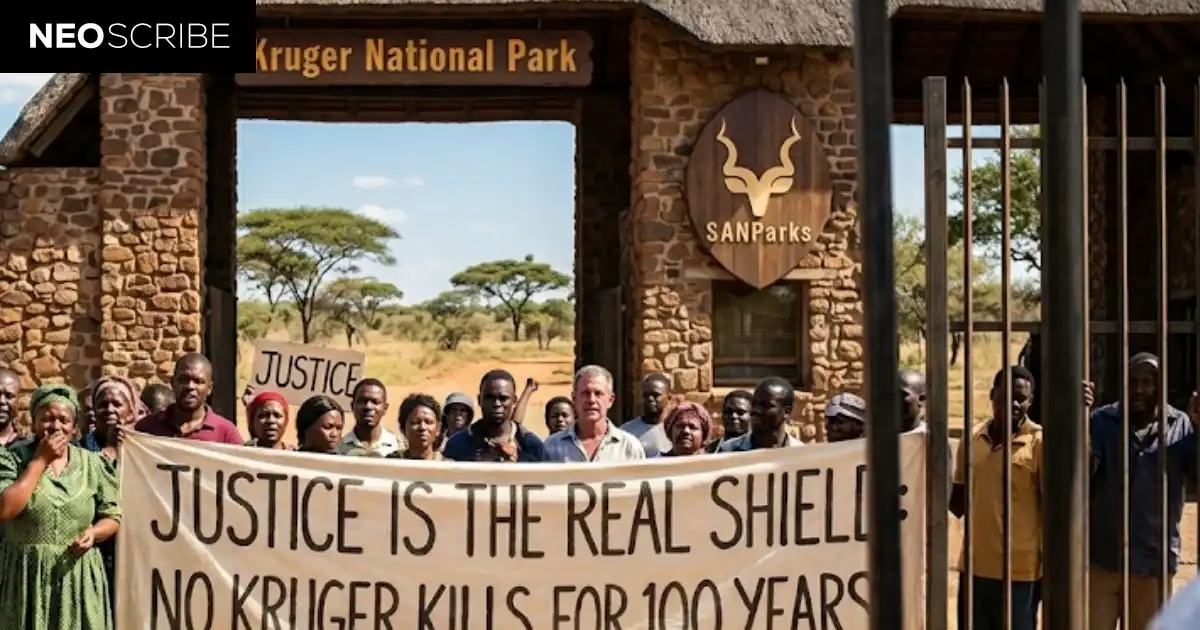
URL SLUG: kruger-national-park-murders-poachers
CONTENT: Johannesburg — The Kruger National Park, one of South Africa’s most treasured natural landmarks and a cornerstone of the country’s tourism economy, has been shaken to its core by what authorities are describing as an unprecedented act of savagery. The Kruger National Park murders of Ernst Marais, 71, and his wife Dina, 73, from Mossel Bay, have sent shockwaves through retirement communities, conservation circles, and the broader South African public. The retired couple, residents of the Fynbos Heights retirement village along the Garden Route, were on a leisure getaway to the park when they were allegedly intercepted, bound, stabbed multiple times, and their bodies thrown into a crocodile infested river near Crooks’ Corner in the remote Pafuri region. It is, by every measure, a story that should never have been written.
Kruger National Park Murders: What Happened to Ernst and Dina Marais
Ernst and Dina Marais disappeared on Wednesday, 21 May 2026, after failing to return to their overnight accommodation near the Pafuri Gate in the far northern section of the Kruger National Park. The couple had driven more than 1 800 kilometres from their coastal retirement home to spend time viewing wildlife in one of Africa’s most iconic game reserves. Their absence triggered an extensive search operation, and their bodies were ultimately recovered on Friday, 22 May, floating in the Levubu River at its confluence with the Limpopo River, an area well known for its dense population of Nile crocodiles.
According to a leaked internal security report cited by the Cape Times, the suspects tied the couple’s hands behind their backs before stabbing them repeatedly in the upper body. Their vehicle, a pickup truck, has since gone missing and is believed by investigators to have already crossed into Mozambique. A senior police source, speaking anonymously, told reporters that the couple may have stumbled upon a group of suspected rhino poachers at an elephant crossing, and were killed to prevent them from raising the alarm. Limpopo police spokesperson Lieutenant Colonel Hlulani Mashaba confirmed that cases of murder and hijacking had been opened, and that a large scale manhunt was underway.
A First in 100 Years: The Historic Weight of This Crime
South African National Parks, known as SANParks, has confirmed that this is the first time in the Kruger National Park’s century long history that tourists have been murdered inside the reserve. The park, which this year marks its 100th anniversary, spans roughly 20 000 square kilometres and receives millions of visitors annually from across South Africa and the world. That this milestone birthday should be overshadowed by the violent deaths of two elderly South Africans is a gut punch to everyone who loves this institution.
Environment Minister Willie Aucamp responded publicly to the killings, urging tourists not to abandon the park. “Our hearts go out to the family and friends of the deceased. This is terrible,” Aucamp said. He acknowledged that one incident was “one time too many” while emphasising that the park’s technological anti-poaching systems would be intensified. His broader concern was candid: if tourists stay away, he warned, criminals would effectively be handed free reign over vast, unsecured wilderness. SANParks followed up on Sunday by announcing the deployment of additional rangers and monitoring equipment across the Nxanatseni North Region where the Marais couple were killed.
The Poaching Crisis Behind the Violence: Key Statistics
The murders did not happen in a vacuum. They are the most extreme manifestation of a poaching crisis that has plagued the Kruger National Park and its surrounding border regions for well over a decade. Criminal syndicates, many with links to organised networks operating across Mozambique and into Asian markets, have long used the porous border areas near Crooks’ Corner as smuggling corridors. The Pafuri region, precisely because of its remoteness, has historically been difficult to patrol effectively.
The release of South Africa’s latest crime statistics by acting Police Minister Firoz Cachalia on the same day the bodies were discovered adds a deeply uncomfortable backdrop to this story. While the national murder rate did decrease by 9.5 percent in the fourth quarter of the 2025/2026 financial year, with 5 181 murders recorded between January and March 2026 compared to 5 727 in the same period the previous year, Cachalia was unambiguous in his assessment: “The levels of violence and criminality in South Africa remain far too high. A decrease in crime is not the same as achieving safety. The levels of crime are still unacceptably high, with an average of 58 murders per day during this quarter.”
| Indicator | 2024/2025 Q4 | 2025/2026 Q4 | Change |
|---|---|---|---|
| National murders (Jan–Mar) | 5 727 | 5 181 | Down 9.5% |
| Year on year comparison | 6 536 | 5 181 | Down 20.7% |
| Average daily murders | Approx. 64 | 58 | Down 9.4% |
| Kruger tourist murders (historical) | 0 | 2 | First ever recorded |
| SANParks additional rangers deployed | N/A | Confirmed | Nxanatseni North Region |
The broader poaching picture is equally alarming. Rhino poaching, while slightly reduced from its peak years, remains a persistent organised crime problem centred largely on the Kruger’s northern sections, precisely the terrain where Ernst and Dina Marais lost their lives. For a deeper understanding of the rhino poaching crisis and its criminal ecosystem, SANParks’ dedicated conservation resource offers essential context. The Daily Maverick’s ongoing environmental reporting has similarly documented the interplay between border insecurity and wildlife crime for years.
A Community in Mourning and a Nation Asking Hard Questions
Back in Mossel Bay, the grief has been profound. Mossel Bay councillor Mark Edgar described the couple as genuinely beloved members of their retirement community. “Their deaths came as a huge shock as they were a very pleasant couple, not just a statistic,” he said. Mayor Dirk Kotzé extended his condolences to the Marais family and used the moment to issue a rare public appeal directed at both national government and the South African Police Service. “I want to make an appeal to our National Government, SAPS, as well as other towns and institutions to do more than what is expected of us, so that the lives of our country’s residents and tourists become their first priority,” Kotzé said.
That appeal resonates far beyond the Garden Route. South Africa’s tourism sector contributes roughly 8 percent to gross domestic product and supports more than 1.5 million jobs directly. The Kruger National Park is the single most visited national park on the African continent and generates billions of rands in foreign exchange annually. News of the Kruger National Park murders has already travelled internationally, with British and American media picking up the story widely. The couple’s retirement village sits along the Garden Route, a route that sees significant volumes of international tourism. Every headline that frames Kruger as a place where tourists are murdered by poachers is a headline that threatens bookings, investor confidence, and the livelihoods of thousands of people employed in the park’s broader tourism ecosystem. This is not hyperbole. It is economic reality.
The Cross-Border Dimension: Mozambique and the Pafuri Corridor
Investigators are working on the strong assumption that the perpetrators fled across the Limpopo River into Mozambique shortly after the murders. Tyre tracks discovered near the scene were reported to be leading in the direction of the Mozambican border. SANParks confirmed that the Marais couple’s vehicle, a pickup truck, may already be across the border. This cross-border dynamic is not new. The Crooks’ Corner area at the meeting point of South Africa, Zimbabwe, and Mozambique has a long and complicated history as a lawless frontier zone, one that historically sheltered outlaws and that today provides criminal syndicates with geographic cover.
The implications for policing are serious. Cross-border pursuit requires bilateral cooperation between the South African Police Service and Mozambican authorities, coordination that has historically been inconsistent. It also raises questions about whether the international investigative frameworks that exist on paper translate into effective operational responses on the ground. For South Africans interested in related security challenges along the country’s northern borders, coverage of the broader Limpopo border security situation provides important context. SANParks has confirmed it is working with SAPS and relevant intelligence structures, but has stopped short of providing operational detail about the manhunt.
What Must Change: Security, Policy and the Future of Safe Tourism in the Kruger
The Kruger National Park murders demand more than a temporary surge in ranger deployments. They expose structural vulnerabilities that have been tolerated for too long. The Pafuri region, despite being one of the park’s most ecologically rich and visually spectacular areas, has long been identified as difficult to police effectively due to its remoteness and its proximity to unfenced border crossings. The fact that a retired couple on a standard tourist itinerary could be intercepted and killed with such apparent ease suggests that the deterrence systems currently in place are inadequate for the threat environment that actually exists in the park’s northern sections.
The government’s response must be multi-layered. Enhanced ranger presence, increased aerial surveillance, and accelerated investment in the anti-poaching technology that Minister Aucamp referenced are all necessary. But equally important is a diplomatic push to secure more effective law enforcement cooperation with Mozambique, and a serious interrogation of how organised poaching syndicates continue to operate with relative impunity across a border that South African authorities nominally control. The tourism industry, meanwhile, will be watching closely. South Africa cannot afford for the Kruger National Park, its most globally recognisable conservation asset, to become associated in the international imagination with danger rather than wonder. Ernst and Dina Marais deserved to return home from their holiday. They did not. That failure belongs to every layer of the system that was supposed to keep them safe.



 Beatrice Shongwe