 Beatrice Shongwe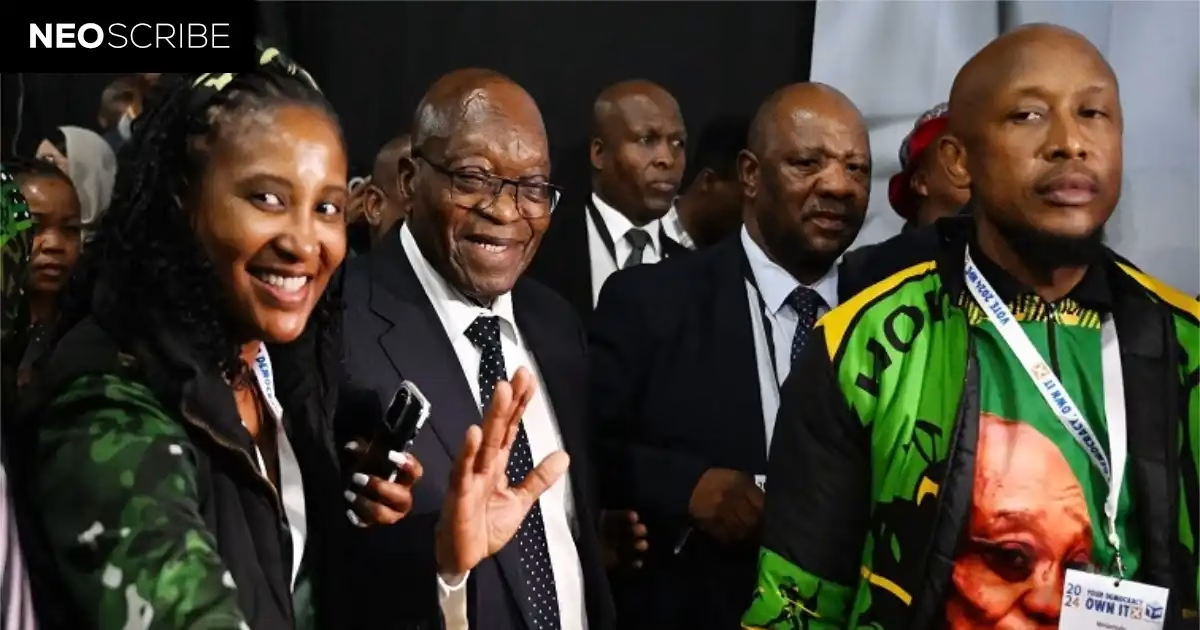
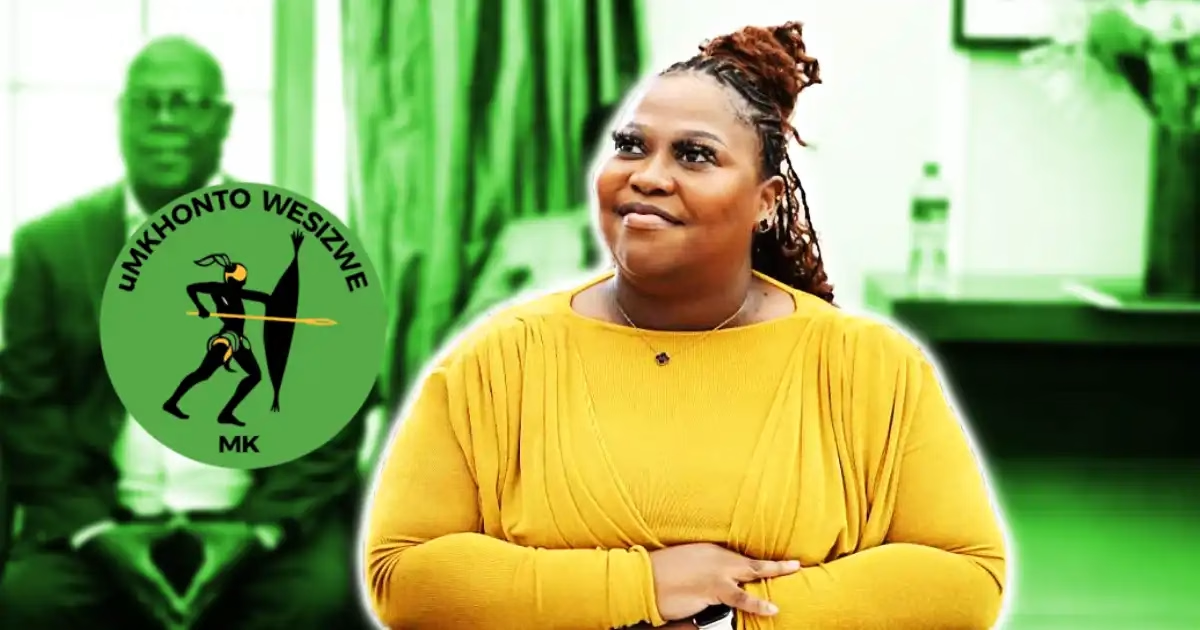
Johannesburg — Long before the Hawks arrived with a warrant of arrest, the MK Party already knew. The party’s own national disciplinary committee found Mmabatho Mokoena-Zondi guilty of extorting 60 percent of the salaries of at least three parliamentary employees, with payments made in August, September and October 2024, and recommended that she be fired. She was not fired. She was promoted. That single fact tells you almost everything you need to know about the MK Party leadership crisis gripping what is, on paper, one of South Africa’s most powerful opposition forces.
The MK Party Found Her Guilty — Then Zuma Cleared Her
The internal disciplinary process was neither quick nor casual. The first hearing was scheduled for November 2024 in Cape Town, but Mokoena said she could not attend because she was getting married. It was postponed to January 2025 in Durban, but on the final day she presented a medical certificate that the panel did not accept. Despite the delays and procedural acrobatics, the panel proceeded and reached a clear verdict: guilty, with a recommendation for expulsion.
What happened next is the real story. In a letter seen by IOL, Zuma upheld Mokoena-Zondi’s appeal against the disciplinary outcome, citing alleged irregularities in the process and stating that the expulsion directly contradicted an earlier directive under his authority that had withdrawn all charges against her and nullified disciplinary actions. In other words, the party president unilaterally erased the finding of his own disciplinary structure. According to the internal report, Mokoena did not dispute the allegations or the evidence against her, yet party spokesperson Nhlamulo Ndhlela said he had not seen the report and claimed Mokoena had been cleared. She was then elevated to chief whip of the National Assembly in February 2026, one of the most senior parliamentary positions in the party.
Mokoena-Zondi was appointed to a senior parliamentary position after a disciplinary panel found her guilty on 12 charges and recommended expulsion. Twelve charges. Not one, not two — twelve. And the response from party leadership was a promotion.
Did the Money Actually Go to Zuma’s Legal Fees?
This is the question that hangs over the entire affair, and it is one that neither the Hawks nor the MK Party have definitively answered. The Hawks allege the money was collected “under the pretext” of covering Zuma’s legal costs — the word “pretext” is doing significant work in that sentence. It implies investigators believe the justification was false: that Mokoena-Zondi used Zuma’s name to legitimise coercion, not to actually fund his legal battles.
The Hawks said the suspect allegedly deceived the employees into believing the deductions were legitimate contributions intended for the party president’s legal battles. If that is proven in court, the implication is that Zuma was not a beneficiary but rather an unwitting instrument — his name weaponised to intimidate junior employees into compliance. R233 000 is, in the context of high-profile political litigation in South Africa, a relatively modest sum. Zuma’s legal costs over the years have run into tens of millions of rands, much of it fought over at the Constitutional Court and through the National Prosecuting Authority. Whether any portion of the extorted money ever reached any legal fund, or sat in Mokoena-Zondi’s personal account, will be a central question when the matter is ventilated in the Cape Town Magistrate’s Court.
What is not in dispute is that Zuma’s name carries enormous weight within MK Party structures, and that weight was allegedly enough to make four employees hand over between half and three-fifths of their salaries every month for five months without going to the police. That speaks to a climate of fear and deference that no healthy political organisation should tolerate.
A Timeline of MK Party Chaos Since 2024
The Mokoena-Zondi saga is not an isolated incident. It is one entry in a rapidly growing ledger of dysfunction.
Key flashpoints in the MK Party leadership crisis:
- 7 secretaries-general in under a year since the party’s formation in December 2023
- 3 chief whips in the same period — Makhubele, Van Rooyen (for 24 hours), and now Mokoena-Zondi
- August 2025: An internal audit revealed R28 million in debt and bookkeeping irregularities, which the party denied amounted to corruption
- November 2025: Parliamentary leader John Hlophe fired Chief Whip Makhubele over an alleged R180 000 monthly contract linked to her husband’s firm; Zuma reversed the decision the following day and suspended Hlophe instead
- November 2025: Zuma’s own daughter, MP Duduzile Zuma-Sambudla, resigned from the party
- December 2025: Chaos erupted in the KwaZulu-Natal Legislature when MK Party members allegedly attempted to prevent the Speaker from leaving the chamber, with members seen pushing and shoving the Speaker while hurling insults, and clashes breaking out with police who entered to restore order
- 35 KZN MPLs suspended following that legislature fracas
- March 2026: Gauteng volunteers announced mass resignations, accusing senior figures of shielding individuals undermining the organisation and raising concerns about an agenda designed to weaken the party ahead of the 2026 elections
- May 2026: Spokesperson Nhlamulo Ndhlela suspended and replaced
- May 2026: Chief Whip Mokoena-Zondi arrested on fraud charges
Political analyst Zakhele Ndlovu said the inconsistencies strongly suggest that chaos reigns in the MK Party and there is no sense of direction, adding that too much drama makes a mockery of South Africa’s democracy and that lack of stability will cost the party support in the 2026 local government elections.
Is This a Leadership Problem or a Membership Problem?
The tempting answer is to blame the membership mix. The MK Party assembled itself at extraordinary speed, drawing in a coalition of former ANC stalwarts, disgruntled EFF figures, traditional leaders, community activists and political opportunists. At the centre of fallout with traditional leaders was the appointment of former EFF leaders, seen as close to Floyd Shivambu, into crucial positions in the National Assembly, provincial legislatures and regional structures, with an MK provincial legislature insider saying that half of the people in the KZN regional structures are from the EFF, people who had campaigned against the party in the May 2024 elections.
The culture clash argument has surface appeal. People trained under the ANC’s patronage networks bring those habits with them. People shaped by the EFF’s confrontational, top-down culture bring that too. When you mix those competing organisational cultures in a party that formed less than two years before a general election, instability is almost inevitable.
But the structural argument cuts deeper. The MK Party has openly stated it will not hold elective conferences, which sets it apart from even the EFF, often criticised for being tightly controlled by Julius Malema, who at least holds elective conferences. A party without democratic internal processes has no legitimate mechanism for resolving disputes, holding leaders accountable, or correcting course. When Zuma overturns a 12-charge guilty finding with a personal letter, he is not exercising leadership — he is demonstrating that the only accountability structure in the party is his personal approval. Independent political analyst Goodenough Mashego said the repeated removal and replacement of secretaries-general reflects a deeper issue, describing Zuma as the one looking for a certain calibre of leader — a pattern of autocratic control.
A founding MK member has claimed the party was initially intended as a temporary platform to pressure the ANC into reforms, with plans for eventual reconciliation, but that Zuma’s personal feud with President Cyril Ramaphosa derailed this strategy, leading to the current dysfunction. If that account has merit, the MK Party may be less a political movement with a coherent ideology and more a vehicle assembled around one man’s grievances — which would explain why it functions so erratically when that man’s personal interests and the party’s institutional interests diverge.
What This Means for South Africa’s Democracy
The MK Party received over 14 percent of the national vote in May 2024. Millions of South Africans, many of them from the country’s most economically marginalised communities, placed their faith in this party. They deserved better than a chief whip who allegedly extorted her own staff, a party president who erased a guilty finding by personal decree, and an institution that has burned through seven secretaries-general in under a year.
 Phumlane Dlamini