Phumlane Dlamini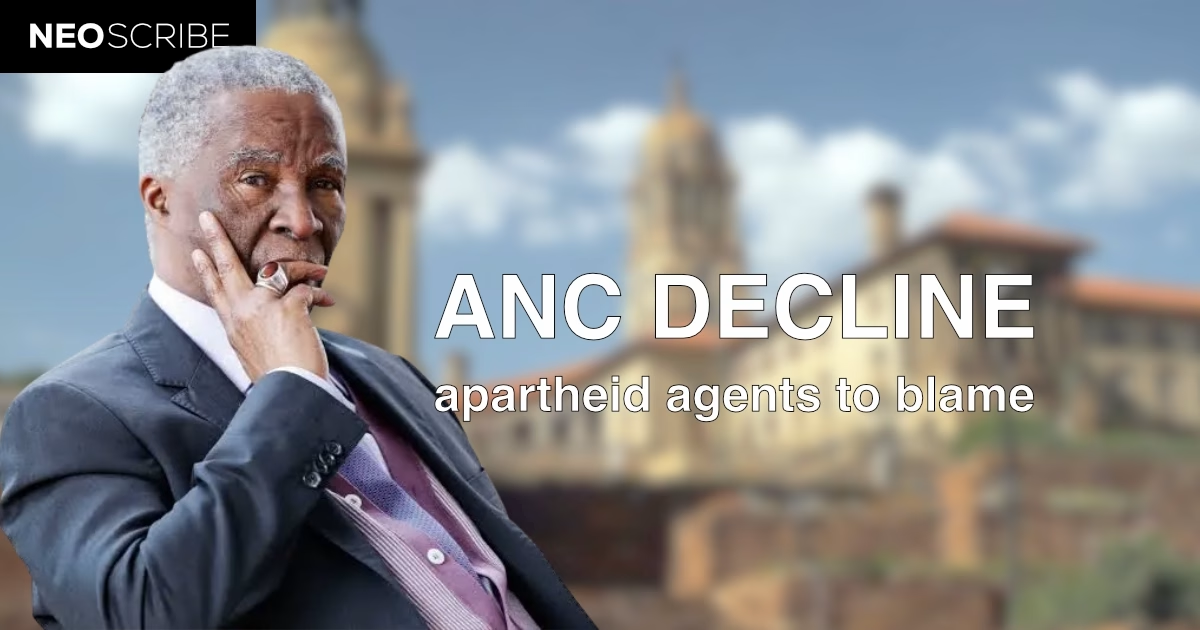
Cape Town became the stage for one of the most provocative political claims South Africa has heard in recent years, as former president Thabo Mbeki told students that ANC infiltration by apartheid era intelligence operatives is at the root of the governing party’s dramatic decline. Speaking at the 16th Thabo Mbeki Africa Day lecture at UNISA’s Parow Campus, Mbeki did not hold back, insisting that agents embedded during the apartheid era remain inside the ANC to this day, quietly doing the work of those who swore the liberation movement would never truly win.
Key Facts at a Glance:
- Mbeki made the remarks at a town hall session with high school and university students in Cape Town.
- The theme of his Africa Day lecture was “Rebuilding African Unity in an Age of Fragmentation.”
- He claims a systematic programme was put in place by the apartheid regime to infiltrate the ANC before 1994.
- He said the ANC had mechanisms to identify and remove these operatives but acknowledged that many were never found.
- The remarks came just days after Mbeki made similar claims before Parliament.
- South Africans reacted sharply on social media, with many pushing back on what they see as a convenient excuse.
- The ANC received only 40.2% of the national vote in the 2024 general election, its worst result since 1994.
ANC Infiltration: What Mbeki Actually Said and Why It Matters
Mbeki’s remarks at the Cape Town event were not made in passing. Addressing a room full of young South Africans who have grown up entirely in the post apartheid era, the former president offered them a pointed explanation for why the party that defeated apartheid has spent the past decade appearing to defeat itself. He told students that the ANC had worked very hard to identify and remove what he called “negative elements” embedded within its ranks, but added plainly that many were never found and remain active to this day.
This is not the first time Mbeki has raised the spectre of ANC infiltration. In a widely circulated interview on the African Renaissance Project podcast with former EFF MP and radio host Dr Mbuyiseni Ndlozi, Mbeki argued that the apartheid regime ran a deliberate, systematic infiltration programme targeting the ANC and the broader liberation movement in the years before the 1994 transition. He claimed that at least one high ranking infiltrator in the ANC has actively worked to distort the historical record, ensuring that blame for policy failures falls on Mbeki himself rather than on deliberate sabotage from within. It is a claim that is simultaneously self serving and deeply serious, and it deserves both scrutiny and genuine engagement.
The statement matters because it speaks directly to a question millions of South Africans are asking: why did a party that produced Nelson Mandela, Oliver Tambo and Thabo Mbeki himself descend into the state capture era, the Zuma years and the electoral collapse that followed? Mbeki’s answer is essentially that an invisible enemy is to blame. Critics say the answer lies closer to home, in the ANC’s own choices and failures of accountability.
The Electoral Collapse That Demands an Explanation
The numbers surrounding the ANC’s decline are stark and cannot be wished away regardless of where one places the blame. When Nelson Mandela led the party to its first democratic victory in 1994, the ANC secured 62.7% of the national vote on a wave of liberation euphoria and moral authority. By 2004, under Mbeki’s own leadership, the party reached its all time peak of nearly 70%. But from that high point, a slow and then accelerating unravelling began.
By 2019, the ANC had slipped to 57.5%, already a worrying trend. Then in May 2024, South African voters delivered a verdict that shook the political establishment: the ANC received just 40.2% of the vote, losing its parliamentary majority for the first time in 30 years of democratic governance. It was, as political analysts have noted, a 17 percentage point collapse in a single election cycle, described by the Journal of Democracy as a historic and dramatic shift in South African politics.
The result forced the ANC into a Government of National Unity with the Democratic Alliance and several smaller parties, an arrangement that would have been unthinkable a decade earlier. For Mbeki, this collapse is in part the fruit of a decades long infiltration project. For many analysts and ordinary South Africans, it is the consequence of unbridled corruption, state capture under Zuma, catastrophic load shedding, and a party that lost its moral compass.
ANC Vote Share: A Three Decade Statistical Decline
To fully grasp what Mbeki is speaking to, it is necessary to examine the arc of the ANC’s electoral performance in cold statistical terms. The data below illustrates a party that once commanded an overwhelming mandate and has steadily surrendered it.
| Election Year | ANC Vote Share | Context |
|---|---|---|
| 1994 | 62.7% | First democratic election, Mandela era |
| 1999 | 66.4% | Mbeki first term, strong mandate |
| 2004 | 69.7% | Mbeki second term, highest ever share |
| 2009 | 65.9% | Zuma takes over from Mbeki |
| 2014 | 62.2% | Zuma re elected despite scandal |
| 2019 | 57.5% | Ramaphosa era begins, declining trust |
| 2024 | 40.2% | Historic loss of majority, GNU formed |
What the table illustrates is that the ANC’s decline did not begin under Zuma, though it accelerated sharply during his tenure and in its aftermath. The downward trend from 2004 to 2024 represents a 29.5 percentage point fall over two decades. Whether apartheid era infiltration accounts for any meaningful portion of that collapse is a claim that would require evidence far more concrete than what Mbeki has so far presented publicly. What is not in dispute is that the decline is real, profound and structurally threatening to the party’s future.
South Africans Push Back on the Infiltration Narrative
Mbeki’s claims have not been received with universal sympathy, even among those who retain respect for his governance record during South Africa’s early democratic years. On social media platforms and in public commentary, many South Africans have been blunt in their rejection of what they view as blame shifting. The core criticism is this: if infiltrators were responsible for the ANC’s failures, where was the evidence, and why was action never taken in the decades the party held unchallenged power?
It is a fair question. The ANC governed with an absolute parliamentary majority from 1994 until 2024. It controlled the national intelligence services. It had access to the resources of the state to investigate, expose and prosecute anyone found to be working against the democratic order. If apartheid era agents were truly destroying the party from within, the ANC had thirty years and enormous institutional power to root them out. The fact that this was apparently never achieved, if Mbeki’s account is accurate, raises uncomfortable questions not about the infiltrators but about the ANC’s own competence and political will.
Wendy Pekeur from the Ubuntu Rural Women and Youth movement offered a different kind of pushback on the same day Mbeki spoke in Cape Town. Responding to demonstrations at St George’s Cathedral against the treatment of undocumented migrants, Pekeur argued that South Africans are not poor because of migrants but because of a capitalist system that places profit above people. It was a reminder that the explanations South Africans reach for when confronted by failure are many and varied, and rarely simple.
What This Means for South Africa’s Political Future
The broader significance of Mbeki’s remarks goes beyond the specific claim about apartheid era agents. It speaks to a larger crisis of narrative within the ANC itself. A party that cannot agree on why it failed cannot credibly articulate a path to renewal. If the official story is that outside forces are responsible, then internal reform becomes unnecessary. If the real story is one of self inflicted wounds through corruption, cadre deployment and institutional capture, then the ANC faces a far more painful but ultimately more honest reckoning.
South Africa needs that honest reckoning. The country faces an unemployment rate that consistently ranks among the highest in the world, persistent inequality, a collapsing public health system, crumbling infrastructure and a young population that is increasingly alienated from formal politics. These are not problems created by apartheid era infiltrators hiding inside Luthuli House. They are the product of thirty years of governance choices, some good, many catastrophically bad. As the ANC itself has acknowledged in internal discussion documents, the organisation has always understood the weight of its responsibility to the people.
Mbeki remains an influential and intellectually formidable figure, and his diagnosis of the ANC’s problems has serious roots in the real history of South African intelligence operations during and after the transition. Operation Vula, the Broederbond’s deep state networks and the documented penetration of liberation movements by apartheid security structures are all historical facts. The question is whether that history, real as it is, can bear the explanatory weight Mbeki is now placing on it. For younger South Africans asking hard questions about corruption, unemployment and a future that feels increasingly precarious, the answer to that question carries enormous political stakes.
The 16th Thabo Mbeki Africa Day lecture was meant to be about African unity in an age of fragmentation. But in a Q&A with students searching for answers, it became something more immediate: a former president wrestling in public with the legacy of a party he helped build, and offering an explanation that many South Africans find deeply unsatisfying. Whether Mbeki’s infiltration thesis is vindicated by history or dismissed as political revisionism, the debate it has reignited about accountability, responsibility and the ANC’s future is one South Africa cannot afford to avoid. For more on the structural challenges facing South African democracy, see our coverage of the 2024 Government of National Unity and what it means for governance going forward.

 Beatrice Shongwe