
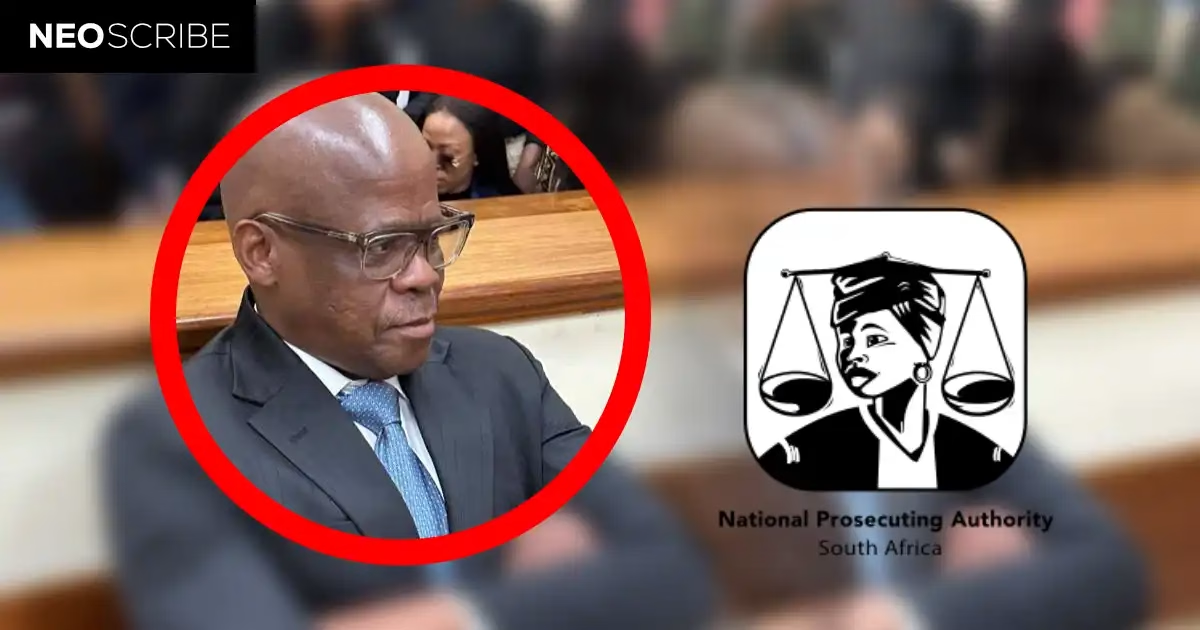
Kwaggafontein, Mpumalanga — The National Prosecuting Authority has launched an unprecedented formal offensive against the judiciary, filing a complaint against Chief Magistrate Tuletu Tonjeni with the Magistrates Commission over her handling of the high-profile extortion and money laundering case involving Mpumalanga taxi boss Joe “Ferrari” Sibanyoni. The NPA complaint against Chief Magistrate Tonjeni marks one of the most striking confrontations between South Africa’s prosecutorial authority and the magistracy in recent memory, arriving at a moment when public trust in the criminal justice system is already fragile.
Key Facts at a Glance
- On 18 May 2026, Chief Magistrate Tonjeni struck the extortion case against Sibanyoni and three co-accused off the court roll after State prosecutor Mkhuseli Ntaba failed to appear.
- Tonjeni also convicted Ntaba of contempt of court and authorised a warrant for his arrest.
- The NPA filed a formal complaint against Tonjeni with the Magistrates Commission on 26 May 2026.
- Sibanyoni and co-accused Mvimbi Masilela, Philemon Msiza, and Bafana Sindane face charges of extorting more than R2.2 million in protection fees from a Mpumalanga mining businessman between 2022 and 2025.
- The NPA has simultaneously filed an application for leave to appeal the contempt of court conviction and the arrest warrant against prosecutor Ntaba.
- NDPP Advocate Andy Mothibi has appointed a senior legal team to advise on reinstating the case against Sibanyoni and his co-accused.
- Parliament’s Portfolio Committee on Justice has called the collapse of proceedings a gross betrayal of South Africa’s constitutional mandate.
NPA Complaint Against Chief Magistrate Tonjeni: What Happened in Court
The crisis began not with an explosive confrontation but with an absence. On 18 May 2026, Chief Magistrate Tonjeni presided over the bail application of Joe Sibanyoni, Bafana Sindane, Mvimbi Masilela, and Philemon Msiza, accused of a serious organised crime operation in Mpumalanga. When the State prosecutor failed to appear, the situation rapidly deteriorated. Rather than granting a postponement or exploring alternatives, Tonjeni took the dramatic step of striking the matter off the court roll entirely and then, in a remarkable escalation, issued a contempt of court conviction against the absent prosecutor and authorised a warrant for his arrest.
The circumstances of the prosecutor’s absence are directly relevant to the NPA’s grievance. NPA spokesperson Kaizer Kganyago said the authority had gone through transcripts of all matters Tonjeni presided over on 15 and 18 May, and based on that review, determined it was prudent to lodge a formal complaint. The NPA’s position is that the prosecutor had previously communicated his unavailability on that specific date due to other commitments, which raises a fundamental question about whether Tonjeni’s response was proportionate or procedurally sound.
The NPA holds the firm view that the conduct reflected in the proceedings raises serious institutional concerns relating to judicial decorum, procedural fairness and the proper administration of justice. These are not minor technical complaints. They go to the heart of whether a court of law acted within its mandate when it effectively dismissed a serious criminal case against four accused individuals at a single hearing.
How the Sibanyoni Case Unravelled in Kwaggafontein
Understanding the gravity of the NPA’s move requires understanding who Joe “Ferrari” Sibanyoni is and why the stakes in this matter extend far beyond a single bail hearing. Sibanyoni is one of Mpumalanga’s most influential taxi industry leaders, particularly in areas like Kwaggafontein and the broader Nkangala region. He entered the industry as a taxi driver in 1985 and bought his first taxi in 1995. Over the decades, he assembled a business empire that includes not just taxis but mining, construction, information technology and real estate.
According to the state, a Mpumalanga businessman whose name is being withheld paid over R2.2 million to Sibanyoni between 2022 and 2025 as a protection fee. The charge sheet alleges that the accused unlawfully and intentionally exerted pressure and instilled fear in the mine operator, threatening to shut down his business if he refused to comply. Despite the collapse of proceedings, the NPA confirmed the matter could still be reinstated with written authorisation from the Director of Public Prosecutions in Mpumalanga.
The accused had notable legal firepower on their side. Sibanyoni’s legal representative was Shaun Abrahams, the former National Director of Public Prosecutions, who argued that the State’s case was “weak to non-existent” and maintained that the relationship between Sibanyoni and the complainant was based on legitimate business dealings rather than extortion. Abrahams had also opposed any postponement and pushed for bail proceedings to be finalised quickly. The failure of the State prosecutor to appear on 18 May effectively handed the defence a decisive procedural victory.
The Institutional Fallout: A Statistical View of the Crisis
The confrontation between the NPA and Chief Magistrate Tonjeni does not exist in isolation. It reflects broader systemic dysfunction that South African justice observers have documented for years. The following table contextualises the key institutional actions and their timelines in this matter:
| Date | Event | Institution Involved |
|---|---|---|
| May 2022 – 2025 | Alleged extortion of R2.2 million from mining businessman | Accused party (Sibanyoni et al.) |
| November 2025 | Businessman lays formal charges with SAPS | South African Police Service |
| 12 May 2026 | Sibanyoni, Masilela and Msiza arrested by Special Task Force | SAPS / NPA |
| 13 May 2026 | Sibanyoni appears in Kwaggafontein Magistrate’s Court | Kwaggafontein Magistrate’s Court |
| 16 May 2026 | Bafana Sindane hands himself over to police | SAPS |
| 15 and 18 May 2026 | Contentious court proceedings under Magistrate Tonjeni | Kwaggafontein Magistrate’s Court |
| 18 May 2026 | Case struck off roll; prosecutor convicted of contempt | Tonjeni / Kwaggafontein Court |
| 22 May 2026 | NPA files notice for leave to appeal; Ntaba suspended | NPA Mpumalanga / NDPP |
| 26 May 2026 | Formal complaint filed with Magistrates Commission | NPA / DPP Mpumalanga |
The Portfolio Committee on Justice and Constitutional Development issued a scathing critique of the Mpumalanga prosecutor who was convicted of contempt of court in the Kwaggafontein Magistrate’s Court. Committee chairperson Xola Nqola labelled Ntaba’s conduct a gross betrayal of the constitutional mandate and warned that Parliament would examine whether such administrative failures represent an isolated incident or a symptom of deeper institutional neglect. The political pressure coming from multiple directions suggests this case has already transcended the boundaries of a single criminal matter.
The Appeal Process and What Reinstatement Means for Justice
The NPA is pursuing its challenge on two parallel tracks simultaneously. On Friday, the NPA in Mpumalanga filed an application for leave to appeal the two orders. Those orders are the contempt of court conviction against prosecutor Ntaba and the authorisation of the warrant for his arrest. By filing the appeal notice, the NPA has automatically suspended both orders pending the outcome of the appeal process. This means Ntaba cannot currently be arrested under the warrant Tonjeni issued.
The NPA confirmed last week that it had begun the process of reinstating the case against Sibanyoni, Mvimbi Daniel Masilela, Philemon Msiza and Bafana Sindane. Reinstatement of a case struck off the roll in South Africa requires written authorisation from the Director of Public Prosecutions at the relevant division. The Mpumalanga DPP, Sonja Josiah Ntuli, has already demonstrated willingness to act decisively in this matter by personally signing off on the appeal application. That this has moved so quickly signals that the prosecutorial leadership views the collapse of the Sibanyoni case as not merely an embarrassment but a threat to institutional authority.
South Africans following the broader fight against organised crime and taxi industry violence will be watching the reinstatement process carefully. The South African taxi industry has for decades been associated with allegations of criminal enforcement structures, and the Sibanyoni case was seen as one of the most significant attempts to prosecute alleged protection racket activity within that sector.
Magistrates Commission Complaint: Implications for Judicial Accountability
Filing a formal complaint with the Magistrates Commission is a serious and deliberate act. The Commission is the body tasked with investigating misconduct by magistrates in South Africa and has the power to recommend sanctions ranging from reprimands to removal from office. The NPA’s decision to use this mechanism signals that it views the problems in Tonjeni’s conduct as warranting not just an appeal on procedural grounds but a separate accountability process focused on judicial behaviour.
NPA spokesperson Kganyago noted that the complaint against Tonjeni could have far-reaching implications for the criminal justice system, with NDPP Advocate Mothibi stating that this process would go a long way in protecting the image of the magistracy and setting the record straight. That framing is important. The NPA is not merely trying to win a legal argument on appeal; it is making a public statement about standards of conduct that it expects judicial officers to maintain, particularly in high-profile organised crime matters where procedural shortcuts carry enormous public consequence.
The distinction between the appeal process and the Magistrates Commission complaint is also legally significant. An appeal challenges the orders themselves and whether they were legally correct. A misconduct complaint evaluates the process by which those orders were made and whether the magistrate’s conduct during proceedings was proper. Both can succeed or fail independently of each other. The NPA pursuing both simultaneously reflects a determination to ensure accountability at every available level.
What This Means for South Africa’s Fight Against Organised Crime
The Sibanyoni saga is about much more than one bail hearing that went wrong. It is a test of whether South Africa’s criminal justice architecture can withstand pressure, procedural failures and the influence of powerful accused persons. Investigators are probing whether the case may be linked to wider criminal activity within the taxi industry, which has long faced allegations of violence, intimidation and organised enforcement structures. If the reinstatement of the case succeeds and proceedings resume, the evidentiary picture that emerges in court will be closely watched.
There is also the uncomfortable reality that the original collapse of the case was triggered not by a clever legal manoeuvre from the defence but by the State’s own failure. Prosecutor Ntaba’s absence, whatever the reasons, hands critics of the NPA ammunition to argue that the institution’s internal discipline is as much a problem as any external obstacle. The NPA’s rapid and forceful response — suspending Ntaba, appealing the orders, and now filing a Magistrates Commission complaint — suggests leadership is acutely aware that the optics of the case require urgent repair.
For ordinary South Africans, and particularly for residents of Mpumalanga who have lived with allegations of extortion and intimidation linked to powerful business figures, the question is straightforward: will the system hold? The NPA’s aggressive pushback against Chief Magistrate Tonjeni, however legally complex its details, sends a signal that prosecutors are unwilling to accept a permanent defeat on procedural grounds in a matter of this magnitude. Whether that signal translates into a successful prosecution remains to be seen, but the institutional fight is now very much alive.

