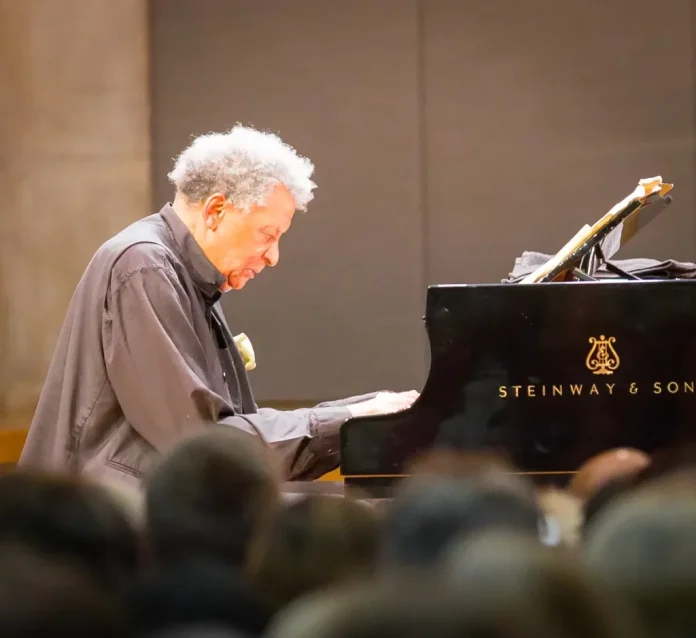
To the world’s jazz stages, he was Abdullah Ibrahim. To the streets of Cape Town’s District Six and the smoky clubs of 1950s South Africa, he was Dollar Brand — a nickname borrowed, as legend has it, from a popular cigarette brand of the era. On Instagram he had no verified handle to speak of, preferring to let his music do the talking. On his official website at abdullahibrahim.co.za, there were no hashtags, no reels, no viral moments. Just the piano, and the decades. His fans called him simply The Maestro. Nelson Mandela called him South Africa’s Mozart. And on 15 June 2026, the world lost him.
“People assert that Africans were abducted as slaves. But we were never slaves. We were enslaved.” Those words, attributed to Abdullah Ibrahim across various interviews throughout his life, capture everything about the man: the precision, the defiance, the refusal to let anyone else write the story of who he was or where he came from. Abdullah Ibrahim passed away on 15 June 2026, a bebop-inspired jazz musician who had his first musical successes in the mid-1950s, who became Abdullah Ibrahim when converting to Islam in 1968, and whose deep religious spirituality was an essential ingredient to his music across more than 70 records and a career of unparalleled breadth.
His death brings to a close a remarkable career spanning more than seven decades that saw Ibrahim become one of the most influential figures in global jazz, renowned for blending jazz with the rich musical traditions of South Africa. He was 91. He died peacefully. And he died, his family said, with South Africa in his heart.
https://www.youtube.com/watch?v=2FCrl3BWo1I&list=RD2FCrl3BWo1I&start_radio=1
Early Life & Background
Abdullah Ibrahim was born in 1934 in Cape Town and baptized Adolph Johannes Brand. His early musical memories were of traditional African Khoi-san songs and the Christian hymns, gospel tunes and spirituals that he heard from his grandmother, who was pianist for the local African Methodist Episcopalian church, and his mother, who led the choir. Before he ever touched a concert grand piano on a European stage, his ears were already full of the world.
The Cape Town of his childhood was a melting pot of cultural influences, and the young Dollar Brand, as he became known, was exposed to American jazz, township jive, Cape Malay music, as well as to classical music. Out of this blend of the secular and the religious, the traditional and the modern, developed the distinctive style, harmonies and musical vocabulary that are inimitably his own. He began piano lessons at the age of seven and made his professional debut at fifteen. He was an avid consumer of jazz records brought by American sailors, and was playing jazz professionally by his mid-teens.
The Cape Town he grew up in was already under the boot of racial classification. The apartheid state was being systematically assembled around him, and the neighbourhood of District Six — that extraordinary, chaotic, beautiful community of Coloured, Malay, Indian, African and white residents living cheek by jowl — was being targeted for destruction. Ibrahim absorbed all of it: the joy, the injustice, the music, the fury. It all went into the piano.
Abdullah Ibrahim Dollar Brand: Career Journey and Major Milestones
Ibrahim began his professional career in the mid-1950s and formed the Jazz Epistles alongside saxophonist Kippie Moeketsi, trumpeter Hugh Masekela, trombonist Jonas Gwanga, bassist Johnny Gertze and drummer Makaya Ntshoko, recording their first album, Jazz Epistle, Verse 1, in 1959. That group, luminous with talent, represented the flowering of a distinctly South African jazz voice at precisely the moment the apartheid state was trying to silence it.
In 1962, with apartheid at its peak, the Dollar Brand Trio, along with vocalist Sathima Bea Benjamin, left South Africa and accepted a three-year contract at the Club Africana in Zurich. Exile was not chosen lightly. It was a matter of survival for the music, if not always the musician. But it was in Europe that the world caught up with Dollar Brand. During a long visit to Europe, he caught the attention of Duke Ellington — a turning point in his career that led to numerous appearances in the USA. When Duke Ellington notices you, the world listens.
He converted to Islam in 1968, adopted the name Abdullah Ibrahim, and relocated to New York, where he immersed himself in the city’s ferocious jazz ecosystem while never losing the Cape Town coastal sound that made him singular. His composition Mannenberg became the anthem for the fight against apartheid in South Africa — a piece of music so loaded with political and emotional meaning that it was reportedly played at political rallies, at funerals, at celebrations of resistance. It was not composed as a protest song. It simply became one, because it told the truth about a place and its people so completely that there was no other way to hear it.
Key career milestones include:
- 1959: Co-founds the Jazz Epistles with Hugh Masekela, Kippie Moeketsi and others
- 1962: Leaves South Africa for Europe; signed at Club Africana, Zurich
- 1963: Duke Ellington discovers him in Switzerland and produces his first international recording
- 1974: Mannenberg is recorded and becomes South Africa’s unofficial anthem of resistance
- 1999: Releases African Suite, reworking his compositions with the Youth Orchestra, arranged by Daniel Schnyder
- 2007: Receives the South African Music Lifetime Achievement Award at Sun City
- 2009: Wins Best Male Artist at the MTN South African Music Awards for Senzo; receives Honorary Doctorate from the University of the Witwatersrand
- 2026: Delivers his final South African public performance at the Cape Town International Jazz Festival in March
- 15 June 2026: Dies peacefully in Germany at the age of 91
Ibrahim’s more than 70 records received numerous prestigious awards. His deep spirituality, solemn dignity and soul was also captured in the documentary films A Brother with Perfect Timing in 1987 and A Struggle for Love in 2005.
Personal Life, Relationships & Controversy
Six years after meeting Beatrice “Sathima Bea” Benjamin, a South African soprano and composer, in 1959, Abdullah Ibrahim married her in 1965. Their union was one of the great musical partnerships in South African history — two exiles, two artists, two people shaped by the same extraordinary city, navigating the world together from New York and beyond. Sathima Bea Benjamin became a celebrated jazz vocalist in her own right, and their daughter Jean Grae would grow into one of hip hop’s most respected lyricists, bridging continents and genres in a way that seems, in retrospect, entirely inevitable given her parentage.
Sathima Bea Benjamin passed away in 2013, a loss that Ibrahim carried publicly with characteristic dignity and privately with the depth that only those closest to him could see. His later partner, Dr Marina Umari, was at his side when he died. “Abdullah passed away peacefully with South Africa and its people in his heart. His love for his country never wavered, no matter where in the world he found himself,” she said.
Ibrahim was not without controversy in the traditional celebrity sense — he did not do tabloid feuds or social media spats. His provocations were intellectual and political. He spoke openly about African identity, about the violence of colonialism, about what it meant to be a Coloured man in apartheid South Africa while the state tried to classify your humanity. He personified the special brand of multiple identities and belief systems, consolidated and transmitted over generations among a variety of descendants in the urban settings at the Cape. His spirituality was not only a source of resilience but also defiance, his humanity political without any need for ideology.
Public Image & Cultural Identity
Abdullah Ibrahim dressed simply. He spoke with measured precision. He prayed. He practised. He had no interest in celebrity in the conventional sense, and celebrity had the good sense to pursue him anyway. His music reflects many of the musical influences of his childhood in the multicultural port areas of Cape Town, ranging from traditional African songs to the gospel of the AME Church and ragas, to more modern jazz and other Western styles. That breadth was his public image — a man who contained multitudes and refused to be reduced.
He received the Order of Ikhamanga from South African President Jacob Zuma, one of the country’s highest honours for contribution to arts and culture. He performed at the Montreux Jazz Festival multiple times across four decades, at the North Sea Jazz Festival, in Berlin, Paris, Canada, Japan — every major city in the world had Ibrahim on its stages at some point. Yet he never stopped being from Cape Town. The accent, the references, the music: all of it stayed rooted.
His digital presence was minimal by design. No major verified social media accounts. No carefully curated personal brand. His official website remained one of the most elegant and understated in South African music, a direct reflection of the man himself.
Legacy & Why Abdullah Ibrahim Is a Big Deal
Nelson Mandela admired Abdullah Ibrahim’s music and called him “South Africa’s Mozart” — and that comparison, however enormous, only begins to capture the scale of his influence. Ibrahim did not simply play jazz. He used jazz as a vessel for Cape Town’s entire cultural identity: its Malay influences, its church harmonies, its street rhythms, its political fury, its coastal melancholy. He invented Cape Jazz as a recognised genre, and then spent seven decades proving why it deserved to exist.
As a defiant public intellectual, Ibrahim placed his work within his unique worldviews, personifying the special brand of multiple identities and belief systems consolidated and transmitted over generations among the descendants of Cape Town’s extraordinarily mixed urban community. In doing so, he gave millions of South Africans — particularly Coloured and Cape Malay communities so often erased or overlooked in the country’s racial narratives — a mirror that showed them as beautiful, complex, and worthy of the world’s attention.
Why is Abdullah Ibrahim a big deal? Because he sat down at a piano in apartheid South Africa and played music so truthful and so beautiful that Duke Ellington flew him to New York, Nelson Mandela named him South Africa’s Mozart, and audiences in Japan, Germany, France and Brazil wept at his concerts. Because Mannenberg became a freedom song without ever being written as one. Because for 91 years he simply told the truth through music, and the world had no choice but to listen.
His final South African public performance took place at the Cape Town International Jazz Festival in March 2026, where audiences witnessed one last masterclass from a musician whose artistry and innovation helped shape the global jazz landscape. The Cape Town International Jazz Festival noted that “his legacy lives on through the generations of musicians he inspired and the timeless body of work he leaves behind.”
Giving Back: Humanitarian Work
Ibrahim used his platform with quiet consistency. He supported music education initiatives throughout his career, mentoring young South African musicians and advocating for the preservation and teaching of jazz as a living tradition. His return performances in South Africa were often opportunities to engage with younger generations of musicians, holding workshops and master classes that gave emerging talent access to a mind shaped by Duke Ellington, Thelonious Monk, Islamic philosophy, and the streets of District Six.
Throughout his career, he used his platform to advocate for unity and equality, making him not only a musical icon but also a beacon of hope for many. He did not do this through press releases or charity galas. He did it through the music, and through the quiet, consistent act of showing up: for younger musicians, for his culture, for his country, even from exile.
No formal foundation bearing his name has been publicly confirmed, though his life’s work — particularly the composition, recording and teaching of Cape Jazz as a living tradition — constitutes perhaps the most sustained cultural humanitarian project in South African music history.
Quick Facts
| Full Name | Adolph Johannes Brand |
| Known As | Abdullah Ibrahim; Dollar Brand |
| Date of Birth | 9 October 1934 |
| Date of Death | 15 June 2026 (aged 91) |
| Place of Birth | Cape Town, South Africa |
| Nationality | South African |
| Profession | Pianist, composer, bandleader |
| Instruments | Piano, soprano saxophone, cello |
| Social Media | No major verified accounts; official site: abdullahibrahim.co.za |
| Languages | Afrikaans, English, Arabic (Islamic practice) |
| Spouse | Sathima Bea Benjamin (m. 1965; d. 2013) |
| Partner | Dr Marina Umari (later life) |
| Children | Two, including rapper and artist Jean Grae |
| Years Active | 1955 to 2026 |
| Net Worth | Estimated $1.5 to $5 million (various sources, 2023 to 2025) |
| Awards | Order of Ikhamanga; SA Music Lifetime Achievement Award (2007); Honorary Doctorate, Wits (2009); MTN SAMA Best Male Artist (2009) |
| Final Performance | Cape Town International Jazz Festival, March 2026 |
Ibrahim crafted a magnificent new culture for South Africa — one built not from ideology or policy but from the notes he drew from a piano, night after night, decade after decade, on stages from Johannesburg to Tokyo. He carried Cape Town’s most complex and beautiful self to every corner of the world, and the world always leaned in closer to hear it. As for our connection to the music he made, you can explore more of South Africa’s extraordinary cultural legacy in NeoScribe’s arts and biography coverage.
“Abdullah passed away peacefully with South Africa and its people in his heart.” Perhaps the real question his life leaves us with is not what Abdullah Ibrahim achieved — but whether we, the country that produced him, were ever truly worthy of him. And whether we will be wise enough, this time, to nurture the next one before we lose them too.