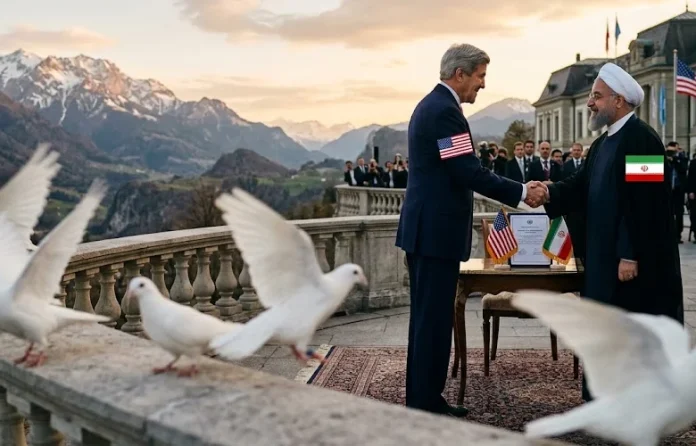
Johannesburg — South Africans battered by months of soaring petrol and diesel costs woke up on Monday, 15 June 2026, to news that could finally turn the tide. The US Iran peace deal, announced by President Donald Trump over the weekend and confirmed by Tehran, promises to reopen the Strait of Hormuz and end the naval blockade that has throttled global oil supplies since late February. For a country that imports every drop of its crude oil and roughly 81% of its refined fuel, this agreement is not merely a distant diplomatic development — it is a direct intervention in the daily financial lives of millions of South Africans.
Key facts at a glance:
- The US Iran peace deal was announced on 14 June 2026 and is set to be formally signed in Switzerland on Friday, 19 June
- Trump confirmed the Strait of Hormuz will reopen upon the signing of the agreement, ending the US naval blockade of Iran
- Global oil prices fell sharply on the news, with Brent crude down 4% and US West Texas Intermediate futures down 4.8%
- Current indications show petrol and diesel in South Africa could come down by around R2 to R3 in July
- South Africa imports all its crude oil and 81% of its petrol, diesel and paraffin consumption, making the country acutely vulnerable to Middle East supply disruptions
- The war began on 28 February 2026 when the US and Israel launched coordinated strikes across Iran
- Negotiations were mediated by Pakistan and Qatar, with both sides reaching agreement on ending conflict, reopening the Strait, addressing Iran’s nuclear programme and easing sanctions
The US Iran Peace Deal: What Was Agreed and How We Got Here
The Strait of Hormuz crisis began on 28 February 2026. Before the conflict, roughly 25% of the world’s seaborne oil trade and 20% of global liquefied natural gas passed through the narrow waterway. The Iranian Revolutionary Guard Corps issued warnings forbidding passage, boarded and attacked merchant ships, and laid sea mines, prompting shipping firms to suspend operations entirely. The resulting supply shock sent Brent crude surging above $100 per barrel, triggering cascading fuel price increases across the world — with South Africa among the hardest hit.
The road to the US Iran peace deal was neither swift nor smooth. Talks mediated by Pakistan and Qatar advanced a memorandum of understanding covering the end of the conflict, the reopening of the Strait, Iran’s nuclear programme and enriched uranium, and the easing of US sanctions. Trump declared the deal complete on Truth Social, writing: “Ships of the World, start your engines. Let the oil flow!” The official signing ceremony is scheduled for Friday, 19 June, in Switzerland, with both sides expected to sign electronically. Iranian Deputy Foreign Minister Kazem Gharibabadi confirmed the agreement from Tehran’s side, though Lebanese observers remain cautious about full implementation.
South Africa’s Fuel Crisis: Why This Deal Matters So Much
No country in sub-Saharan Africa felt the sting of the Strait of Hormuz closure more acutely than South Africa. The supply of crude oil to the world had been reduced by about 7.5% to 10.1% by March 2026 in what the World Bank described as the largest oil market disruption in history. In the case of South Africa, which imports all its oil and 81% of its petrol, diesel and paraffin consumption, the effects were felt mainly through price increases, forcing the government to subsidise petrol and diesel.
Those subsidies have not been costless. At a time when the South African government is under acute fiscal pressure, diverting billions of rand toward fuel relief has strained an already constrained national budget. Ordinary South Africans have been squeezed from every direction — higher petrol prices pushed up transport costs, food prices, and manufacturing input costs simultaneously. For the estimated 15 million South Africans living in poverty, the fuel price shock of 2026 has been the defining economic event of the year, eroding real incomes and driving more households into distress. The US Iran peace deal therefore carries enormous social as well as economic significance for this country.
Oil Price Impact: Data and Market Reaction
Markets moved with exceptional speed once the US Iran peace deal was confirmed. Asian equities rose sharply, with Japan’s Nikkei 225 gaining 5.4% to hit a record high and South Korea’s Kospi climbing 5%, while Brent crude fell 4% on expectations that oil could soon flow more freely through the Middle East.
A sustained 4% to 5% decline in crude prices typically flows through to retail fuel prices within 4 to 8 weeks, reducing headline consumer price inflation directly. Beyond direct fuel costs, lower crude prices reduce the input cost burden for manufacturers, logistics operators, and agricultural producers, applying secondary downward pressure on prices across the economy. For South Africa, this transmission mechanism is particularly important given the Reserve Bank’s ongoing battle against inflation and the rand’s sensitivity to global risk sentiment.
What the Strait of Hormuz Reopening Means for the Rand and the Economy
The reopening of the Strait of Hormuz will not only reduce South Africa’s import bill — it will ease pressure on the rand. Throughout the conflict, elevated oil prices widened South Africa’s current account deficit and weighed on the currency, which in turn amplified domestic fuel price increases. A sustained reduction in crude prices has the potential to partially reverse this dynamic, giving the South African Reserve Bank more room to consider interest rate relief.
A recovery to 60% to 70% of pre-war Iranian export capacity could shift the global supply-demand balance back into surplus territory, providing the foundation for sustained lower crude prices through the second half of 2026. If that materialises, South Africa stands to benefit not just from a one-month fuel price cut, but from a sustained structural easing in energy costs — the single biggest imported inflation driver the country faces. As covered previously on NeoScribe, the R6 billion government private leasing scandal has already stretched state finances, making any reduction in fuel subsidy obligations a welcome development for the fiscus.
Risks: Will the US Iran Peace Deal Hold?
Caution is warranted. One of the most important nuances in this situation is the difference between a peace framework being announced and being signed, ratified, and implemented. As of mid-June 2026, the agreement remained unsigned, with formal signing anticipated around June 19. Markets moved aggressively on expectation rather than confirmation — a historically dangerous position for energy assets.
Israel’s position adds a further layer of complexity. Israel was not a party to the negotiations and has consistently sought to maintain military pressure on Iran throughout the conflict. A separate question concerns Lebanon, where Lebanese citizens remain sceptical despite the US Iran ceasefire announcement, with some communities expressing doubt that the agreement will end Israeli military activity in their country. If Israel resumes strikes on Iranian targets after the deal is signed, Tehran could argue that the conditions of the agreement have not been met, creating grounds for reimposing Strait restrictions. South Africa must track these developments closely. The country’s energy security depends on it.
South Africa’s Broader Lesson: Energy Independence Cannot Wait
The 2026 Iran war has exposed a structural vulnerability that South Africa’s policymakers can no longer afford to ignore. South Africa imports all its crude oil and 81% of its petrol, diesel and paraffin — a dependency that leaves the entire economy hostage to conflicts in which South Africa has no voice and no leverage. While the US Iran peace deal offers immediate relief, the underlying vulnerability remains.
The episode should accelerate South Africa’s long-delayed energy diversification agenda. Greater investment in domestic renewable energy, strategic fuel reserves, and diversified import partnerships are not optional extras — they are national security imperatives. The SACR campaign recently demonstrated that ordinary South Africans are willing to fund systemic accountability battles. The same civic energy, directed at energy policy reform, could prove equally transformative. For now, the immediate news is cautiously good: the US Iran peace deal is done, oil is flowing, and South Africa’s motorists may finally see meaningful fuel price relief when they pull into the forecourt in July.