Phumlane Dlamini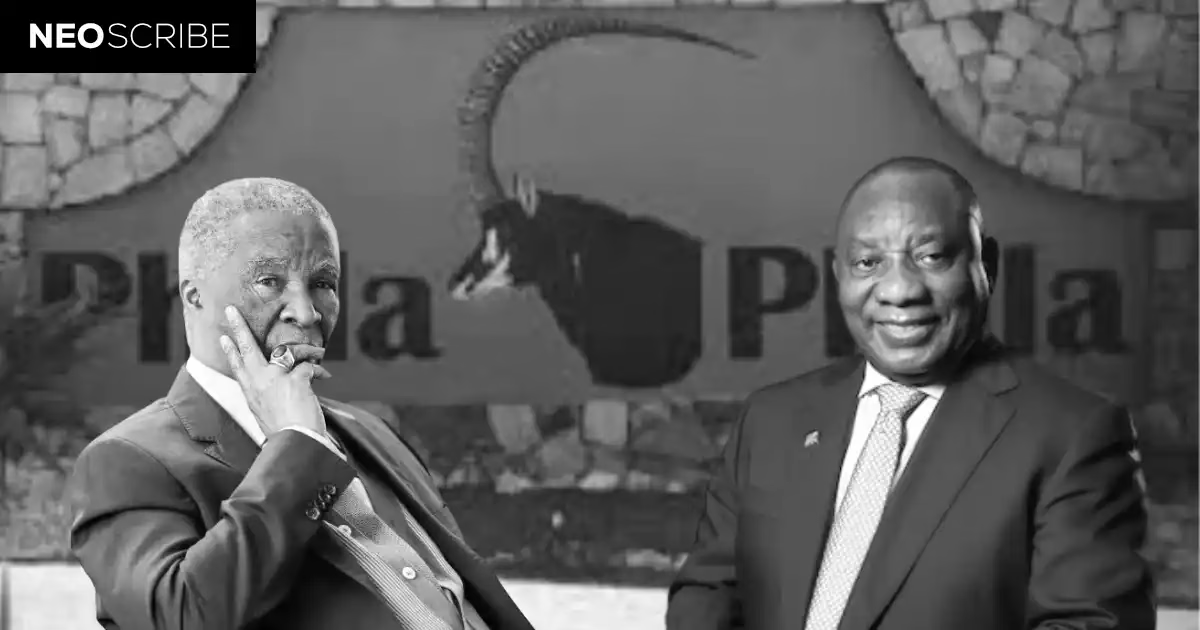
CONTENT: Johannesburg — The Phala Phala impeachment process has plunged South African politics into its deepest crisis in years, with former president Thabo Mbeki publicly drawing a sharp line between President Cyril Ramaphosa’s personal conduct and ANC party business, while the ruling party has embarrassingly failed to meet parliament’s own deadline to constitute the impeachment committee.
Mbeki’s intervention, made in his typically blunt and methodical style, carries enormous weight. This is not an ordinary critic speaking. This is a former head of state and one of the ANC’s most intellectually formidable figures openly rebuking his own party for becoming entangled in what he insists is a purely private commercial dispute.
Mbeki Draws the Line on Phala Phala Impeachment and ANC Accountability
Mbeki’s core argument is deceptively simple but politically explosive. Ramaphosa, he contends, is a businessman who breeds and sells wildlife and cattle. The transaction at the centre of the Phala Phala impeachment saga — a $580 000 (approximately R9.6 million) cash payment for 20 buffalo from Sudanese businessman Hazim Mustafa — was a private commercial deal conducted on a private farm in Limpopo, not an act of governance or party leadership.
Mbeki went further, pointedly questioning why the ANC has made the scandal its own problem at all. His rhetorical jab — that perhaps ANC members are in business partnership with Ramaphosa and therefore feel compelled to protect him — is exactly the kind of uncomfortable observation that lands like a grenade in Luthuli House.
Key Facts: The Phala Phala Scandal and What Led Here
Understanding the current crisis requires knowing the sequence of events that brought South Africa to this point:
- In February 2020, approximately $580 000 in cash was hidden after being stolen from Ramaphosa’s Phala Phala game farm in Limpopo.
- The theft was allegedly covered up and never reported to the South African Police Service at the time.
- A Section 89 independent panel, led by former Chief Justice Sandile Ngcobo, found prima facie evidence that Ramaphosa had a case to answer.
- In 2022, parliament’s ANC majority voted to block adoption of the panel’s report, effectively shielding Ramaphosa from an impeachment inquiry.
- Mbeki wrote to then ANC deputy president Paul Mashatile in early 2023, criticising the party’s use of its majority to bury the process.
- The Constitutional Court ruled in May 2026 that the Section 89 report must go back to parliament, reopening the impeachment path.
- Ramaphosa has since launched a fresh judicial review of the panel report, a move the EFF has condemned as using the courts to dodge accountability.
Constitutional Court Ruling Revives the Process
The Constitutional Court’s decision to send the Section 89 report back to parliament represents a landmark moment. The apex court effectively agreed with the position Mbeki had been articulating since 2022 — that the ANC’s parliamentary majority acted improperly when it buried the report.
Speaker Thoko Didiza moved swiftly, directing parliament to constitute a 31-member impeachment committee to consider the report. The DA, MK Party and EFF all submitted their nominees ahead of the May 22 deadline. The ANC, holder of nine seats on that committee, did not.
According to the Sunday Times, internal ANC conflict between chief whip Mdumiseni Ntuli and secretary-general Fikile Mbalula over who should represent the party has paralysed the process. Ntuli reportedly favours MPs with experience on previous ad hoc committees, while Mbalula is pushing for newer loyalists including Doris Mpapane, Donald Selamolela and Boyce Maneli. The resolution of the standoff reportedly now rests with the ANC’s top seven officials.
ANC Internal Tensions Threaten Parliamentary Process
The missed deadline is not merely an administrative embarrassment. It is a window into the structural dysfunction at the heart of the ANC’s current leadership. South Africans who are watching the cost of living rise, service delivery collapse, and unemployment remain stubbornly high deserve better than a governing party unable to agree on a list of names for a constitutionally mandated committee.
An insider quoted in reports on the matter issued a stark warning that delays prevent the committee from convening, electing a chairperson, or adopting a programme — and that this is not in the public interest. That is a diplomatic understatement. It is a democratic failure.
The ANC’s internal paralysis on the Phala Phala impeachment issue exposes a deeper truth: the party is caught between its constitutional obligations, its instinct to protect its leader, and the rare but significant dissenting voice of a former president who refuses to be silenced.
What Mbeki’s Intervention Really Means for South Africa
Mbeki’s comments are analytically significant beyond the immediate drama. By insisting that parliament must do what the Constitutional Court has ordered, he is reinforcing the rule of law over political loyalty. His critique of the ANC’s use of its majority to “do a wrong thing” in 2022 is now validated by the highest court in the country.
For South Africans, this matters enormously. The Section 89 process is one of the most serious constitutional mechanisms available to hold a sitting president accountable. Its integrity directly reflects the health of South African democracy. If the ruling party continues to obstruct or delay through internal squabbling, it undermines public confidence in parliament as an independent institution.
The political pressure on Ramaphosa is now coming from multiple directions simultaneously: the Constitutional Court, the opposition, civil society, and now, pointedly, one of the ANC’s most respected elder statesmen. Whether the 31-member impeachment committee ultimately finds sufficient grounds to recommend removal from office is a separate and complex question. But the process must be allowed to run its course.
What Happens Next With the Phala Phala Impeachment Committee
Mbalula has indicated the ANC’s list of nominees will be submitted to parliament “in the coming week.” Once all parties have submitted names, the committee can be constituted, a chairperson elected, and a programme of work adopted. The committee will then examine the Ngcobo panel’s report and hear evidence before making a recommendation to the full National Assembly.
Ramaphosa’s parallel judicial review bid adds another layer of legal complexity. If a court grants an interdict halting the parliamentary process while that review proceeds, it could delay the impeachment committee’s work indefinitely. The EFF has already signalled it will fight any such attempt vigorously.
For ordinary South Africans, the Phala Phala impeachment saga is a test of whether the constitutional architecture built in 1996 actually works when the most powerful person in the country is the one being held to account. Mbeki, for all his own complicated political legacy, appears to believe it can. The ANC’s hesitation suggests its members are not so sure.

 Beatrice Shongwe