
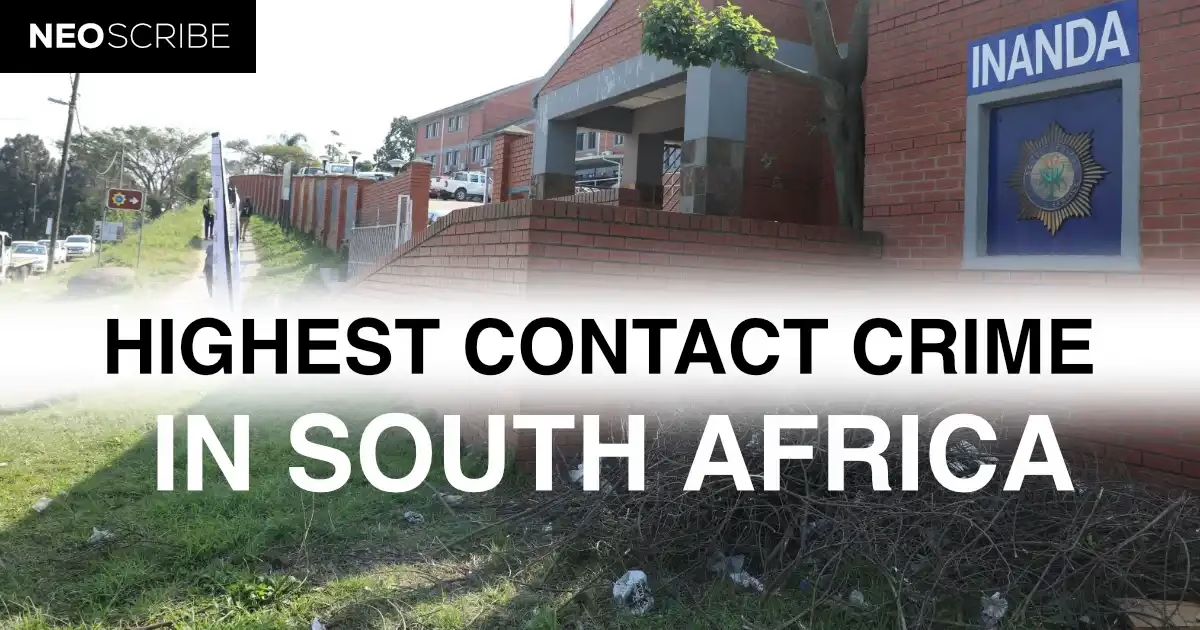
For yet another year, Inanda police station in KwaZulu-Natal has claimed the dubious distinction of recording the highest contact crime statistics in South Africa. The latest crime figures for 2026 confirm what has become a tragic pattern: certain communities in this country are trapped in cycles of violence so entrenched that policing appears almost ceremonial. Inanda’s repeat appearance at the top of the crime charts is not just a statistic—it is a policy failure, a social crisis, and a mirror held up to the deep inequalities that continue to define post-apartheid South Africa.
A Grim Title That Won’t Go Away
Inanda, a sprawling township north of Durban, consistently ranks among the most dangerous police precincts in the country. Contact crimes—murder, attempted murder, assault with intent to cause grievous bodily harm, common assault, and robbery with aggravating circumstances—are offences where perpetrators have direct physical contact with victims. These are not abstract crimes. They are intimate, brutal, and devastatingly common in places like Inanda.
The 2026 statistics reveal that Inanda recorded thousands of contact crime cases, far outpacing urban hotspots like Johannesburg Central, Cape Town Central, and Durban Central. What makes this particularly alarming is not the novelty of the data, but its monotonous regularity. Inanda has topped or featured prominently in these rankings for over a decade. This is not a crime spike—it is a permanent condition, and it demands we ask uncomfortable questions about state capacity, resource allocation, and political will.
According to international crime analysis, areas with persistently high contact crime rates are typically characterised by unemployment, inadequate infrastructure, poor education outcomes, and weak rule of law. Inanda ticks every one of these boxes. The station serves a community where formal employment is scarce, where schools are under-resourced, and where gang activity and vigilantism fill the vacuum left by ineffective policing.
The Social Architecture of Violence
Understanding why Inanda remains so dangerous requires more than crime statistics. It requires a forensic look at the social conditions that breed violence. The township is home to over half a million people, many living in informal settlements with little access to basic services. Unemployment among young men is estimated to exceed 50%, creating fertile ground for gang recruitment and survivalist crime.
Alcohol and drug abuse are rampant, domestic violence is endemic, and disputes over limited resources—whether land, romantic partners, or petty cash—regularly escalate into fatal confrontations. The normalisation of violence is perhaps the most insidious factor. In communities where death and injury are common, where grievances are settled with weapons rather than dialogue, violence becomes a learned behaviour passed from one generation to the next.
Gender-based violence is a particularly stark feature of Inanda’s crime profile. Women in the area face extraordinary risk, not only from strangers but from intimate partners. The intersection of patriarchy, poverty, and substance abuse creates a powder keg. Yet resources for victim support, trauma counselling, and women’s shelters remain woefully inadequate. For those tracking gender violence trends in South African news, Inanda represents the sharp end of a national catastrophe.
Policing Failure in the Province’s Deadliest Districts
It is impossible to divorce Inanda’s crime crisis from the broader malaise affecting policing in KwaZulu-Natal. The province consistently records some of the highest murder and assault rates in the country, and its police stations are among the most under-resourced and demoralised. Inanda police station itself has been plagued by allegations of corruption, poor leadership, inadequate staffing, and a lack of vehicles and equipment.
Visible policing—the cornerstone of crime prevention—is sporadic at best. Officers are stretched thin, and community trust in the police is frayed. Many residents have resorted to forming street committees and hiring private security, an indictment of state failure. The South African Police Service has repeatedly promised interventions, increased patrols, and specialised units. Yet the results speak for themselves. Year after year, the numbers barely shift.
There is also the question of political accountability. The KZN government and national leadership have known about Inanda’s status for years, yet there is little evidence of a strategic, sustained intervention. Crime prevention requires more than rhetoric—it demands investment in social infrastructure, job creation programmes, youth development, and a police service that is both competent and trustworthy. None of these have materialised at the scale required.
What It Will Take to Turn the Tide
Turning Inanda around will not happen overnight, nor will it happen through policing alone. What is needed is a multi-sectoral, long-term strategy that treats crime as a symptom of deeper social dysfunction. That means economic opportunities for young people, functioning schools that offer real pathways out of poverty, substance abuse programmes, mental health services, and community-driven conflict resolution mechanisms.
It also means re-imagining policing. Officers need better training, better pay, better equipment, and leadership that holds them accountable while protecting them from political interference. Community policing forums must be empowered and genuinely representative, not tokenistic. And crucially, there must be consequences for officials who fail to act or who are complicit in the breakdown of law and order.
For South Africans watching from other provinces, Inanda is not an isolated case. It is a warning. High contact crime rates are symptomatic of systemic failures that, left unchecked, can metastasise. The concentration of violence in specific areas allows those in safer suburbs to ignore the crisis, but inequality and violence are corrosive forces that eventually touch everyone.
The 2026 crime statistics are not just numbers on a spreadsheet. They represent lives cut short, families shattered, communities terrorised. Inanda’s position at the top of the list is a national shame. The question is whether South Africa has the political courage and social solidarity to do what is necessary to change it.

