 Beatrice Shongwe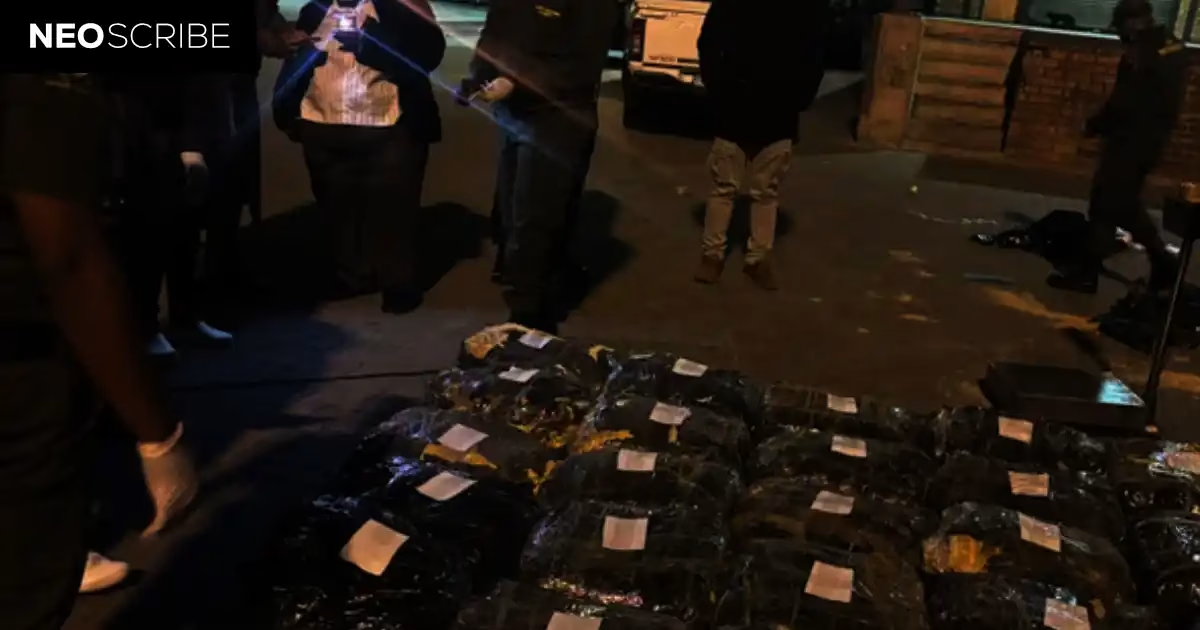
Musina, Limpopo — South Africa recorded one of its most alarming single drug seizures in recent memory on Tuesday, 27 May 2026, when the Border Management Authority (BMA) intercepted a truck at the Beitbridge border post carrying nearly R1 billion worth of a mandrax precursor substance. The Shocking R1 billion Beitbridge drug bust, which resulted in three arrests, has once again thrown a harsh spotlight on the vulnerability of South Africa’s northern land borders to transnational narcotics trafficking and the sophisticated criminal networks exploiting the region’s busy trade corridors.
Key facts about the Beitbridge drug bust:
- The truck was travelling from Malawi and was intercepted during a stop-and-search operation at the Beitbridge Port of Entry
- A non-intrusive cargo scanner detected suspicious substances before officials conducted a physical search lasting approximately eight hours
- Officials recovered approximately 713 000 grams (713 kilograms) of methaqualone, commonly known as ABBA, which is a primary precursor chemical used in the manufacturing of Mandrax tablets
- The estimated street value of the consignment is R998 200 000, making it one of the largest single drug hauls ever recorded at a South African border post
- The SAPS K-9 Unit and the Hawks (Directorate for Priority Crime Investigation) were activated to assist with processing the scene and conducting further investigations
- Three suspects were arrested and detained at the Musina Police Station, with court appearances imminent on drug trafficking charges
- BMA Commissioner Dr Michael Masiapato has announced a personal operational visit to the Beitbridge Port of Entry to review security protocols
Beitbridge Drug Bust: How the Record Seizure Unfolded
The operation began when the truck, reportedly originating in Malawi, entered the Beitbridge Port of Entry and was selected for a stop-and-search procedure. BMA officials subjected the vehicle to a non-intrusive inspection using the port’s cargo scanner, a piece of technology that has become central to the authority’s interception strategy. The scanner flagged the presence of suspicious substances concealed within the truck’s cargo.
What followed was a gruelling, methodical physical search of the vehicle that stretched over approximately eight hours, as officials worked through the consignment layer by layer. When the search concluded, they had uncovered approximately 713 kilograms of methaqualone (ABBA), the raw chemical building block for Mandrax. The Hawks and the SAPS K-9 Unit were brought in immediately to secure the crime scene, confirm the substance’s identity, and begin the criminal investigation that will ultimately determine how far the trafficking network extends.
BMA Commissioner Dr Michael Masiapato was unequivocal in his response, stating that the interception sends an unambiguous message that South Africa’s borders will not serve as a safe passage for organised criminal activity. He praised the professionalism of border officials and the intelligence-driven operational model that made the seizure possible, while confirming that authorities are now working to establish the substance’s intended destination and whether those arrested are linked to a broader transnational network.
What Methaqualone and Mandrax Mean for South African Communities
Mandrax, colloquially known as “buttons” on South African streets, has been one of the country’s most destructive and enduring drug problems for decades. The substance is overwhelmingly concentrated in certain urban and peri-urban communities, particularly in the Western Cape, where it is commonly smoked with cannabis in a practice known locally as “witpyp.” According to UNODC data on drug trends in southern Africa, South Africa remains one of the primary destination and transit markets for methaqualone trafficking within the African continent.
The significance of the Beitbridge drug bust lies not just in its scale but in what it tells us about supply chains. Methaqualone as a raw precursor is sourced primarily from chemical manufacturers operating in parts of Asia and then routed through Eastern and Southern African transit corridors before being processed into Mandrax tablets, typically within South Africa itself. A 713-kilogram haul of the raw substance, at R998 million in estimated street value, would represent hundreds of millions of individual tablet doses once processed and distributed. The downstream damage to communities — through addiction, crime, and the economic drain of healthcare costs — would be incalculable.
A Growing Pattern: The Statistics Behind Border Seizures
The Beitbridge drug bust is extraordinary in scale, but it does not exist in isolation. It is the latest in a pattern of escalating seizures at South Africa’s busiest land port of entry, which processes millions of travellers and thousands of commercial vehicles annually. The BMA has recorded a string of significant interceptions in recent months, painting a picture of persistent and organised smuggling pressure at this critical crossing.
| Date | Commodity Seized | Estimated Value | Outcome |
|---|---|---|---|
| May 2026 | Methaqualone (Mandrax precursor) | R998 200 000 | 3 arrested, Hawks investigating |
| April 2026 | Bulk mining explosives, cap fuse, detonator fuse | R1 000 000 | Driver arrested, SAPS/SARS involved |
| December 2025 | Non-perishable food, car batteries, Hyundai truck | R921 000 | Goods impounded, no arrests confirmed |
| January 2025 | Illicit Remington Gold cigarettes | R14 000 000 | 44-year-old foreign national arrested |
| April 2026 (ZIMRA) | Marijuana (from SA into Zimbabwe) | Undisclosed | Driver handed to ZRP CID Narcotics |
The table illustrates that Beitbridge is not just a corridor for one type of illicit goods. Drugs, explosives, cigarettes, and foodstuffs all move through this border illegally, suggesting that multiple criminal syndicates regard the port as an exploitable vulnerability. The cumulative value of seizures over the past 12 months at this one crossing alone runs into hundreds of millions of rand, raising serious questions about what authorities are not catching.
The BMA’s Operational Response and Technology Deployment
The BMA has made no secret of its investment in advanced scanning and surveillance technology as its primary tool for interdicting smuggling at high-volume ports. The non-intrusive cargo scanner that initially flagged the suspicious consignment in this week’s Beitbridge drug bust represents a significant upgrade from the manual search processes that characterised border security for much of the past two decades. According to the BMA, advanced surveillance technology including drones has also been deployed at Beitbridge to cover operationally vulnerable sections of the perimeter where physical crossing attempts are made.
Commissioner Masiapato’s decision to conduct a personal operational visit to the Beitbridge Port of Entry in the wake of this seizure is a signal that the authority is treating the current moment as a critical juncture. The planned Port Management Committee meeting will bring together SAPS, the South African National Defence Force (SANDF), SARS, and traffic management authorities in a coordinated review of border protocols. This kind of multi-agency coordination is exactly what security analysts have long argued is necessary to make a meaningful dent in the transnational crime networks that have embedded themselves in the Southern African trade corridor.
However, technology and coordination alone are not sufficient. The Beitbridge border is one of the highest-volume land ports in Africa, and the commercial imperative to keep goods and people moving creates inherent tension with the security imperative to search thoroughly. The eight-hour physical search that produced this record seizure is not a procedure that can be applied to every truck without grinding regional trade to a halt. Smarter risk profiling, enhanced intelligence sharing between countries in the region, and greater investment in human capital at the border all remain essential complements to the technological tools now in place.
Undocumented Migration: The Parallel Security Crisis at Beitbridge
The drug bust is only one dimension of the security challenge at Beitbridge this week. The BMA has simultaneously been dealing with an alarming volume of undocumented foreign nationals being transported into South Africa through the same corridor. On 22 May, Limpopo officials stopped two minibuses on the N1 bypass travelling from Zimbabwe to Gauteng, finding that 48 of the 50 passengers had no valid passports. Both vehicles were impounded for operating licence violations and the undocumented passengers were escorted back to Beitbridge for deportation.
Four days earlier, on 18 May, Limpopo Traffic Police in Polokwane intercepted a bus travelling from Malawi to Johannesburg that had been certified to carry 70 passengers but was transporting 90, with a passenger list containing only 25 names. This is a pattern that the BMA describes as a major and growing concern within its inland operations. For South Africans already exercised about the scale of undocumented migration and its effects on public services, employment, and social cohesion, these incidents represent a daily reminder that the border is permeable in multiple directions and to multiple threats.
The convergence of drug trafficking and irregular migration at the same border post is not coincidental. Criminal networks that specialise in moving people illegally frequently diversify into moving contraband, and the same routes, vehicles, and intermediaries are often used for both. South Africa’s ongoing debate about border security and immigration policy gains renewed urgency with every incident at Beitbridge, particularly as the government grapples with the tension between maintaining open and efficient trade borders and protecting the country from organised crime.
What This Means Going Forward for South Africa
The near-R1 billion Beitbridge drug bust is a landmark moment, but the true measure of its significance will be determined by what happens in the weeks and months ahead. If the Hawks’ investigation succeeds in unravelling the syndicate behind this consignment, identifying the buyers waiting inside South Africa, and disrupting the processing and distribution networks they feed into, then this seizure will have genuinely weakened an organised crime structure that has been poisoning South African communities. If, however, the three arrested suspects are low-level couriers with no knowledge of the broader network, the seizure will be a tactical win without strategic impact.
South Africa’s drug problem is ultimately a demand-side challenge as much as a supply-side one, and no amount of border enforcement can substitute for the social investment, rehabilitation infrastructure, and community development that would reduce the market for substances like Mandrax in the first place. What the BMA has demonstrated this week is that with the right technology, the right training, and the right intelligence, even the most sophisticated concealment methods can be defeated. That is a foundation to build on. The challenge now is to extend that capability, share intelligence across the Southern African Development Community (SADC) region, and ensure that the political will exists to pursue not just the couriers but the kingpins who organise and finance these operations from a distance.
South Africa deserves borders it can be proud of not just because of the drugs and contraband they keep out, but because of the rule of law, sovereignty, and community protection they represent.


 Phumlane Dlamini