
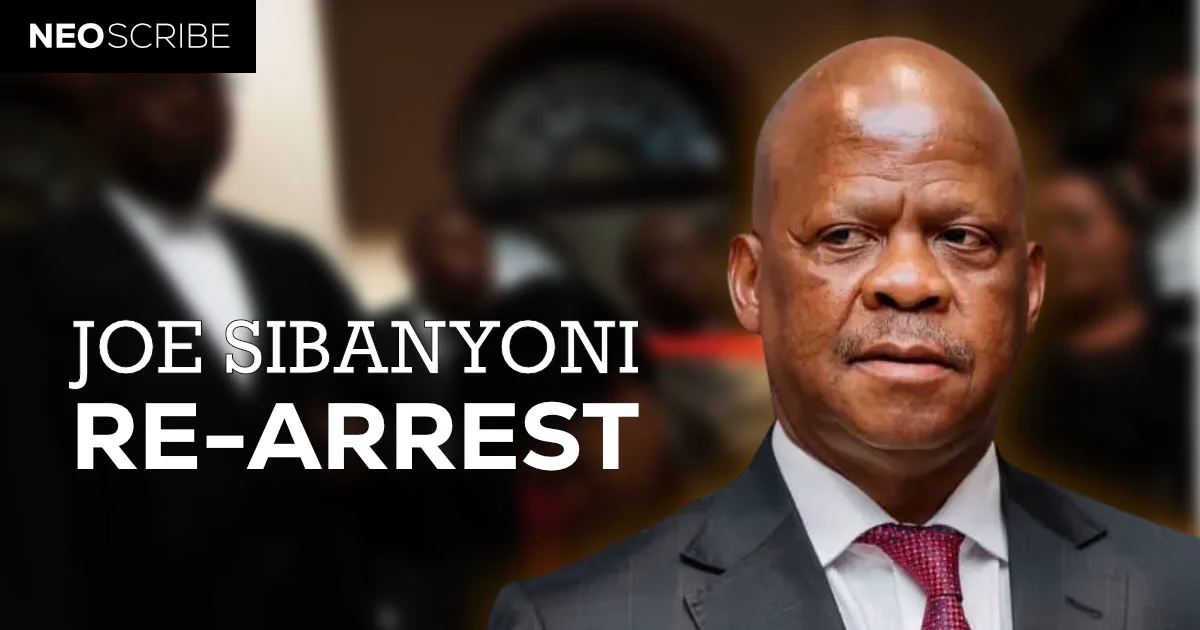
CONTENT: Mbombela — Mpumalanga taxi industry powerhouse Joe “Ferrari” Sibanyoni has escalated his legal battle dramatically, filing an urgent High Court application to prevent police from arresting him just as the Joe Ferrari Sibanyoni arrest saga reaches a critical turning point. The move, filed in the High Court in Mbombela on Wednesday alongside co-accused Oupa Johannes “Bafana” Sindane, signals that South Africa’s most closely watched taxi boss intends to fight his return to the dock at every possible juncture.
Key Facts at a Glance
- Joe “Ferrari” Sibanyoni and co-accused Oupa Johannes “Bafana” Sindane filed an urgent High Court application in Mbombela on 28 May 2026.
- The pair seeks to suspend and set aside J50 warrants of arrest and wants an interdict preventing police and the NPA from arresting them while the matter is before court.
- The warrants relate to a re-enrolled extortion and money laundering case that was previously struck off the roll at Kwaggafontein Magistrate’s Court.
- Sibanyoni and his co-accused face allegations of extorting more than R2.2 million in protection fees from a Nkangala district mining entrepreneur between 2022 and 2025.
- The accused are represented by former National Director of Public Prosecutions Shaun Abrahams.
- The case was originally struck off the roll after state prosecutor Mkhuseli Ntaba failed to appear in court and was subsequently found guilty of contempt of court.
- The NPA confirmed it would re-enrol the matter, describing the accused as being “out on technicalities, not on the merits.”
- Sibanyoni is executive chairman of Santaco’s investment arm, making the case significant far beyond the criminal justice sphere.
Joe Ferrari Sibanyoni Arrest Warrant: What the Court Application Argues
At the heart of Wednesday’s urgent application is a constitutional challenge. Sibanyoni and Sindane are asking the Mbombela High Court to declare that the J50 warrants of arrest issued against them were obtained irregularly and are therefore unconstitutional. They are simultaneously seeking an interdict to prevent both the South African Police Service and the National Prosecuting Authority from executing those warrants while the legal challenge remains before the court.
The legal strategy represents a calculated deployment of constitutional safeguards, and it is one that has precedent in South African law. J50 warrants, also referred to as bench warrants or warrants of arrest in pending matters, can be challenged on procedural grounds where an accused believes due process was not followed. By framing the application in constitutional terms, Sibanyoni’s legal team — led by former NDPP Shaun Abrahams — is positioning the challenge at the highest possible level of legal argumentation, making it harder for a court to dismiss on narrow technical grounds alone.
The urgency of the application is directly linked to the NPA’s decision to re-enrol the extortion and money laundering charges at the Delmas Magistrate’s Court, with proceedings scheduled for Thursday, 29 May 2026. The accused were required to hand themselves over at the Delmas police station, a condition that the urgent application now seeks to suspend pending a court ruling.
The Tangled Legal History Behind the Re-enrolment
The road to Wednesday’s urgent application has been anything but straightforward, and it reveals serious institutional dysfunction within the criminal justice system. The case first made headlines in May 2026 when Sibanyoni, along with co-accused Mvimbi Daniel Masilela and Philemon Makhaya Msiza, was arrested by the Special Task Force in Pretoria on 12 May and appeared at the Kwaggafontein Magistrate’s Court the following day. A bail application process began but was quickly derailed by an unprecedented sequence of events on the prosecution side.
On 18 May 2026, state prosecutor Mkhuseli Ntaba failed to appear in court despite the Chief Magistrate having specifically ordered his attendance. Defence advocate Abrahams labelled Ntaba’s conduct unprofessional and immediately moved a contempt of court application. The presiding magistrate agreed, convicted Ntaba in absentia for contempt and issued a warrant for his arrest. The case was then struck off the roll entirely, technically freeing Sibanyoni and his co-accused pending re-enrolment. The NPA responded swiftly, announcing it would re-enrol the matter and separately launching its own urgent application to appeal the severity of the sanctions imposed on Ntaba, who the authority claimed had received credible death threats explaining his absence.
The episode exposed the profound vulnerability of high-profile prosecutions in South Africa to disruption, whether by internal failures or external intimidation. As the NPA’s spokesperson Kaiser Kganyago stated publicly, the accused were “outside on technicalities” and not on the merits of the case — a pointed signal that the authority had no intention of abandoning the prosecution.
Extortion Allegations: The R2.2 Million Protection Fee Claims
The substance of the case against Sibanyoni and his co-accused is serious. According to the NPA Mpumalanga spokesperson Monica Nyuswa, the state alleges that between 2022 and 2025, Sibanyoni and his associates unlawfully demanded more than R2.2 million in so-called protection fees from a mining businessman operating in the Nkangala district of Mpumalanga. The complainant was allegedly threatened that his business operations would be shut down if he refused to pay, a classic hallmark of organised extortion.
It is further alleged that once the complainant transferred the funds, the money was moved through multiple bank accounts in a structured manner designed to obscure its origin, giving rise to two separate counts of money laundering in addition to the primary extortion charge. Defence advocate Abrahams has argued in earlier proceedings that the state’s case is “weak to non-existent,” maintaining that the relationship between Sibanyoni and the complainant was based on a legitimate commercial arrangement rather than coercion.
The following table sets out a statistical and analytical overview of the case’s key dimensions:
| Element | Detail |
|---|---|
| Period of alleged extortion | 2022 to 2025 |
| Amount allegedly extorted | Over R2.2 million |
| Nature of alleged threat | Shutdown of complainant’s business operations |
| Charges faced | Extortion + 2 counts of money laundering |
| Number of accused | 4 (Sibanyoni, Sindane, Msiza, Masilela) |
| Original arrest date | 12 May 2026 (Special Task Force, Pretoria) |
| Case status (18 May) | Struck off roll — prosecutor failed to appear |
| Re-enrolment jurisdiction | Delmas Magistrate’s Court |
| Current legal challenge | Urgent High Court application, Mbombela |
| Defence lead | Shaun Abrahams (former NDPP) |
The calibre of legal representation alone signals that this case will be contested with significant resources. Abrahams’ knowledge of the inner workings of the NPA gives the defence a structural advantage that ordinary accused persons could never access.
What the Case Means for the Taxi Industry and Santaco
The Joe Ferrari Sibanyoni arrest is not merely a criminal justice story. Its ramifications extend into the heart of organised labour, the transport sector and the broader South African economy. Sibanyoni serves as executive chairman of the investment arm of the South African National Taxi Council (Santaco), the umbrella body that represents the minibus taxi industry — a sector that moves an estimated 15 million commuters daily and generates billions of rands in economic activity.
Santaco’s national spokesperson Rebecca Phala acknowledged the organisation is closely monitoring developments while being careful to separate the council’s institutional work from Sibanyoni’s personal legal battles. Phala noted that the investment arm operates with multiple directors, meaning operational continuity is not entirely dependent on Sibanyoni’s personal availability. Santaco also held its national elective conference in recent days, underscoring that the organisation intends to project stability regardless of the outcome of Sibanyoni’s case.
Yet the optics are damaging for an industry that has long battled perceptions of violence, lawlessness and criminal infiltration. Sibanyoni’s business empire reportedly extends well beyond taxis into logistics, property, construction, mining, IT and real estate — a diversification that has made him one of the most powerful figures in black-owned business in Mpumalanga. That a figure of such standing is facing extortion and money laundering charges reinforces concerns about the penetration of organised crime into legitimate business structures, a challenge that South African law enforcement has struggled to address consistently.
What Happens Next: The NPA’s Position and the Road to Trial
The NPA has made its position unambiguous. Despite the procedural chaos of the past two weeks, the authority is determined to see Sibanyoni and his co-accused stand trial on the substantive charges. The re-enrolment of the case at Delmas Magistrate’s Court on Thursday, 29 May, represents the NPA’s formal recommitment to prosecution. Whether the Mbombela High Court grants Sibanyoni’s urgent application to halt the execution of the arrest warrants will determine whether that process proceeds on schedule.
If the High Court declines the urgent application, Sibanyoni and Sindane will be required to hand themselves over at the Delmas police station, effectively re-entering the formal bail process and bringing the matter back before a magistrate. A new bail hearing would then need to determine conditions of release while the trial is prepared. If the court grants even a temporary interdict, the state will face further delays and will need to oppose the constitutional arguments raised by the defence before the matter can proceed.
South Africans watching this case should understand that what is at stake is not only the guilt or innocence of one prominent individual. The case is testing whether the criminal justice system can withstand sustained legal pressure from well-resourced accused persons, whether prosecutors can operate without fear of intimidation, and whether accountability applies equally regardless of economic stature or political connection. For a country still grappling with the legacy of state capture and the uneven application of the rule of law, the outcome of the Joe Ferrari Sibanyoni arrest proceedings carries consequences that go far beyond Mpumalanga.
The NPA has committed publicly to pursuing the case on its merits. How effectively it does so in the face of this latest legal manoeuvre will be one of the most closely watched developments in South African criminal justice in the coming weeks.

