
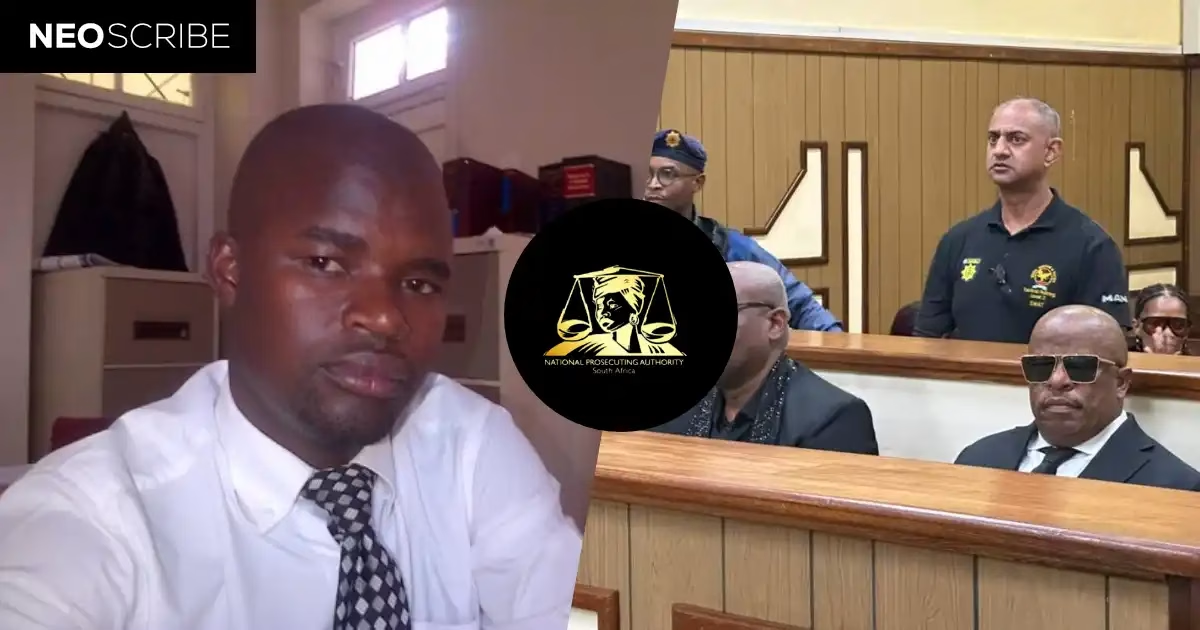
CONTENT: Kwaggafontein, Mpumalanga — A state prosecutor named Mkhuseli Ntaba has become the centre of one of the most alarming judicial collapses in recent South African legal history, after his failure to appear in court on 18 May 2026 caused a high-profile extortion case to implode and a warrant to be issued for his own arrest. The incident has exposed deep vulnerabilities within the National Prosecuting Authority at a time when South Africa can least afford institutional failures in its fight against organised crime.
The Mkhuseli Ntaba No-Show That Derailed a Major Case
Taxi boss Joe “Ferrari” Sibanyoni and his co-accused — Mvimbi Masilela, Philemon Msiza, and Bafana Sindane — had faced charges of extortion and money laundering, with the state alleging they demanded more than R2 million in protection fees from a Mpumalanga mining businessman between 2022 and 2025. The case was poised to continue with bail proceedings at the Kwaggafontein Magistrates’ Court when the unthinkable happened.
Magistrate Tuletu Tonjeni told the court that she had been informed just before 9am that Ntaba had contacted the control prosecutor to say he was in transit, without providing any estimated time of arrival. “He would have been here by now if he had an interest to be here or to comply with the order that was made,” Tonjeni said before authorising a warrant for his arrest and striking the matter off the roll.
Key facts about the Mkhuseli Ntaba incident:
- On Friday, 15 May 2026, Ntaba had already informed the court that he would be unavailable on Monday, citing other court commitments. Magistrate Tonjeni overruled this and specifically ordered him to appear anyway.
- Shortly after the matter was struck from the roll, the NPA announced it would institute disciplinary action and suspended Ntaba pending investigation.
- Reports emerged that Ntaba had received death threats ahead of his required court appearance.
- On 22 May 2026, the NPA filed an application for leave to appeal against Magistrate Tonjeni’s orders, seeking to overturn the contempt finding and arrest warrant against Ntaba.
Threats or Dereliction? The Disturbing Truth Emerges
Sources revealed that Ntaba had actually been en route to the Kwaggafontein court when he made a sudden about-turn after receiving threats. He reportedly reported those threats to the Mpumalanga Director of Public Prosecutions before turning back. A replacement prosecutor was found and dispatched, but was informed mid-journey that the matter had already been struck off the roll.
NPA spokesperson Kaizer Kganyago confirmed to SABC News that Ntaba told his employers he stayed away after receiving threats, and that he had been located and was cooperating with the investigation. This sequence of events paints a picture far more complex than simple dereliction of duty — one where a state advocate felt his life was genuinely at risk simply for doing his job.
As the hours passed after Ntaba’s no-show, a disturbing picture began to emerge of the circumstances surrounding the disappearance of a prosecutor. The NPA acted swiftly in announcing his suspension, but the optics of a high-profile organised crime case collapsing because a state official feared for his life sent shockwaves far beyond the courtroom.
The NPA’s Institutional Crisis
| Development | Date | Significance |
|---|---|---|
| Ntaba flags scheduling conflict | 15 May 2026 | Court overrules, orders attendance |
| Ntaba fails to appear; case struck off roll | 18 May 2026 | Sibanyoni and co-accused temporarily freed |
| NPA suspends Ntaba; arrest warrant issued | 18 May 2026 | Contempt of court finding |
| NPA files leave to appeal magistrate’s orders | 22 May 2026 | Seeks to overturn contempt ruling |
| Department of Justice drafts prosecutor safety policy | Expected June 2026 | Triggered by murders and Ntaba incident |
DA MP Advocate Glynnis Breytenbach sharply criticised the failure, demanding a full public explanation. She also exposed a structural wound: the NPA’s decision to offer early retirement packages saw 47 experienced advocates leave the institution in April 2026 alone, bleeding the organisation of institutional knowledge precisely when it is being asked to fight deeply entrenched cartels.
The Sibanyoni case does not exist in isolation. Sibanyoni’s name has repeatedly surfaced at the Madlanga Commission, which is probing allegations of criminal infiltration into policing, political, and judicial arenas. He has been linked to alleged members of the “Big Five” cartel and survived an assassination attempt in 2022. Prosecuting individuals of this profile without adequate protection for state advocates is a systemic failure that cannot be dismissed as an administrative inconvenience.
Prosecutor Safety: A Policy Long Overdue
The Department of Justice and Constitutional Development is expected to table a draft policy on the protection of prosecutors by the end of June 2026, following several murders of state advocates and the Ntaba incident. The issue of prosecutor protection had been raised in the departmental bargaining chamber, where the department and recognised trade unions deliberate on labour-related issues, but the Public Servants Association expressed frustration that the draft policy had not been tabled as initially promised.
South Africa has lost prosecutors to targeted killings before. Regional court prosecutor Brown was shot and killed outside her home in Gqeberha on 31 July 2025, and another regional court prosecutor, Elona Sombulula, was also shot and killed. These are not isolated incidents but part of a pattern that demands urgent state intervention. A prosecutor who fears for their life while handling organised crime cases is a prosecutor who cannot do their job — and a justice system that cannot protect its own officers is one that will progressively fail all South Africans.
The NPA’s broader capacity challenges deserve serious public attention. Decades of underfunding, political interference, and now a haemorrhage of experienced staff have left the institution stretched dangerously thin in cases that require exactly the kind of experienced, resilient advocacy that cannot be conjured overnight.
What Happens Next for the Sibanyoni Case
The NPA has stated it intends to re-enrol the extortion and money laundering charges against Sibanyoni and his co-accused. A team led by a senior counsel will advise on the legal approach needed to reinstate the matter, given the complex procedural circumstances created by the striking of the case.
The Mpumalanga Director of Public Prosecutions must legally justify the reinstatement of the case, while Ntaba simultaneously faces his own parallel arrest warrant and a disciplinary process. The NPA’s appeal against Magistrate Tonjeni’s orders adds yet another layer of legal complexity to what was already a fraught prosecution.
For ordinary South Africans watching from the outside, this episode underscores an uncomfortable truth about the state of justice in the country. When accused persons with alleged cartel links can effectively walk free because the system around them buckles under pressure — whether through fear, capacity failure, or both — public confidence in the rule of law takes a serious blow. The Mkhuseli Ntaba saga is not merely a story about one prosecutor’s absence. It is a story about whether South Africa’s justice institutions are genuinely equipped to hold powerful criminals to account. Learn more about organised crime and judicial integrity in South Africa and follow developments at the African News Agency for updates on the new prosecutor safety policy.

