
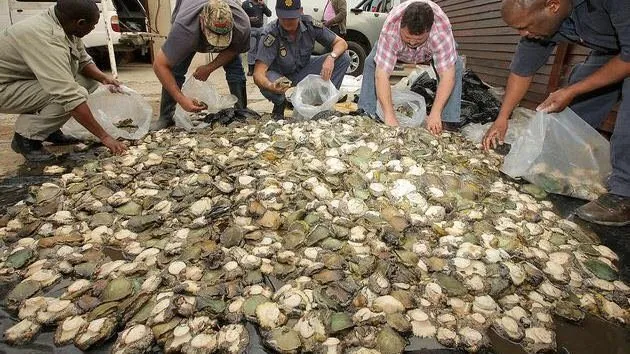
CAPE TOWN – Law enforcement authorities have arrested 12 suspects in connection with abalone poaching Cape Town operations, marking another critical intervention in the ongoing battle against the illegal perlemoen trade that continues to threaten South Africa’s marine biodiversity and coastal communities.
The arrests, conducted by a joint operation involving South African Police Services (SAPS), the Department of Forestry, Fisheries and the Environment, and local marine protection units, represent one of the most significant enforcement actions against organised poaching syndicates in recent months. The operation underscores the persistent challenges facing marine conservation efforts along the Western Cape coastline, where abalone poaching has decimated natural populations over the past two decades.
The Scale of South Africa’s Abalone Crisis
Abalone, locally known as perlemoen, has become one of South Africa’s most critically endangered marine resources. The species Haliotis midae faces severe population collapse due to decades of intensive poaching driven by insatiable demand in Asian markets, particularly China, where the delicacy can fetch extraordinary prices.
According to Reuters reporting on South Africa’s marine crisis, illegal abalone harvesting has evolved from opportunistic collection by local communities into a sophisticated transnational criminal enterprise involving organised crime syndicates, corrupt officials, and international smuggling networks.
The economic implications are staggering. Industry experts estimate that illegal abalone trade in South Africa exceeds R600 million annually, with most product destined for Hong Kong and mainland China through complex smuggling routes. This illicit economy operates entirely outside legitimate channels, depriving coastal communities of sustainable livelihoods and the state of substantial tax revenue.
| Year | Legal Abalone Harvest (tons) | Estimated Illegal Harvest (tons) | Number of Arrests |
|---|---|---|---|
| 2020 | 96 | 856 | 427 |
| 2021 | 85 | 923 | 389 |
| 2022 | 75 | 1,047 | 512 |
| 2023 | 68 | 1,156 | 586 |
Operational Details of the Latest Bust
While specific operational details remain limited pending ongoing investigations, law enforcement sources indicate that the 12 suspects were apprehended during coordinated raids across multiple locations in the Cape Town metropolitan area. Intelligence-driven operations targeted known collection points and processing facilities where poached abalone is typically prepared for smuggling.
The suspects face charges under the Marine Living Resources Act, which carries substantial penalties including imprisonment of up to ten years for serious offences. Authorities have not yet disclosed the quantity of abalone seized during the operation, nor have they confirmed whether additional arrests are anticipated as investigations continue.
Marine protection officers emphasise that such operations require meticulous planning and coordination. Poaching syndicates employ sophisticated counter-surveillance techniques, utilise encrypted communications, and often operate during adverse weather conditions when enforcement patrols are limited. The criminal networks have also demonstrated willingness to use violence against law enforcement, making interventions inherently dangerous.
For more information on law enforcement operations in the Western Cape, visit our comprehensive coverage at NeoScribe’s South African News section.
Environmental and Economic Consequences
The ecological impact of abalone poaching Cape Town operations extends far beyond the target species. Abalone plays a crucial role in maintaining healthy kelp forest ecosystems along South Africa’s coastline. As herbivorous grazers, these molluscs help regulate algal growth and maintain biodiversity in these underwater forests, which serve as nursery habitats for numerous commercially important fish species.
Marine biologists warn that abalone population collapse triggers cascading effects throughout coastal ecosystems. Research published by BBC’s environment correspondents highlights how overgrazing by sea urchins – natural competitors of abalone – has led to “urchin barrens” where diverse kelp forests transform into biological deserts.
The economic consequences for legitimate fishing communities are equally severe. Legal abalone ranching operations struggle to compete with illegal product that floods markets at artificially suppressed prices. Small-scale fishers who historically supplemented income through controlled harvesting now find themselves criminalised when attempting to access traditional marine resources.
- Abalone populations have declined by an estimated 95% since commercial exploitation began
- Illegal harvesting generates approximately R600 million annually in black market revenue
- Over 3,000 people work in the illegal abalone trade along the Western Cape coast
- Legal abalone farming employs fewer than 500 workers in regulated facilities
- International trafficking routes connect South African poachers to Asian organised crime networks
The Challenge of Enforcement and Prosecution
Despite regular arrests and seizures, prosecution of abalone poaching Cape Town cases faces significant obstacles. The criminal justice system struggles with case backlogs, inadequate sentencing that fails to deter repeat offenders, and corruption that sometimes compromises investigations before reaching trial.
Legal experts note that many arrested poachers are low-level operatives – often unemployed community members recruited for collection activities – while syndicate leaders and financiers remain largely untouched. This dynamic ensures continuous recruitment of new poachers even as arrests accumulate, creating a revolving door that undermines enforcement efforts.
According to Al Jazeera’s investigative reporting on environmental crime in Africa, successful prosecution requires international cooperation to dismantle entire supply chains. However, jurisdictional complexities and resource limitations hamper such comprehensive approaches.
Sentencing guidelines have evolved in recent years to reflect the seriousness of organised poaching. Courts increasingly impose substantial prison terms and asset forfeiture orders, yet implementation remains inconsistent. Defence attorneys frequently exploit procedural technicalities, resulting in case dismissals or reduced charges that diminish deterrent effects.
Community Perspectives and Alternative Livelihoods
The abalone crisis presents complex socio-economic dimensions that enforcement alone cannot resolve. In historically disadvantaged coastal communities around Cape Town, poaching represents one of few available income sources in areas with chronic unemployment exceeding 40%.
Community activists argue that criminalisation without economic alternatives perpetuates cycles of poverty and crime. They advocate for expanded access to marine resources through community-based management programmes that could provide sustainable livelihoods while rebuilding abalone populations.
Some conservation initiatives show promise. Co-management arrangements between government agencies and traditional fishing communities have demonstrated potential in pilot programmes. These approaches combine traditional ecological knowledge with scientific monitoring, creating stakeholder buy-in for resource protection while ensuring equitable benefit distribution.
However, scaling such programmes faces political and financial obstacles. Critics contend that decades of mismanagement and exclusionary policies have eroded trust between coastal communities and authorities, making collaborative approaches difficult to implement effectively.
Future Outlook and Policy Recommendations
Addressing South Africa’s abalone poaching crisis requires multifaceted strategies that extend beyond law enforcement. Marine conservation experts recommend comprehensive policy reforms including:
- Strengthened international cooperation to disrupt Asian market demand and trafficking networks
- Increased investment in marine protected area surveillance using technology like drones and acoustic monitoring
- Development of viable alternative livelihoods for coastal communities dependent on poaching income
- Reform of quota allocation systems to increase community participation in legal abalone industry
- Enhanced penalties targeting syndicate financiers rather than low-level collectors
- Expansion of abalone ranching and aquaculture to create legitimate employment opportunities
The latest arrests of 12 suspects in abalone poaching Cape Town operations represent important tactical victories, but strategic success requires sustained commitment to ecological restoration, economic transformation, and social justice in coastal communities. Only through integrated approaches addressing root causes can South Africa hope to preserve its marine heritage for future generations.
As investigations continue into this latest poaching incident, law enforcement authorities emphasise their determination to dismantle criminal networks threatening marine biodiversity. Whether such resolve translates into meaningful progress depends on resources, political will, and community cooperation in the challenging years ahead.

