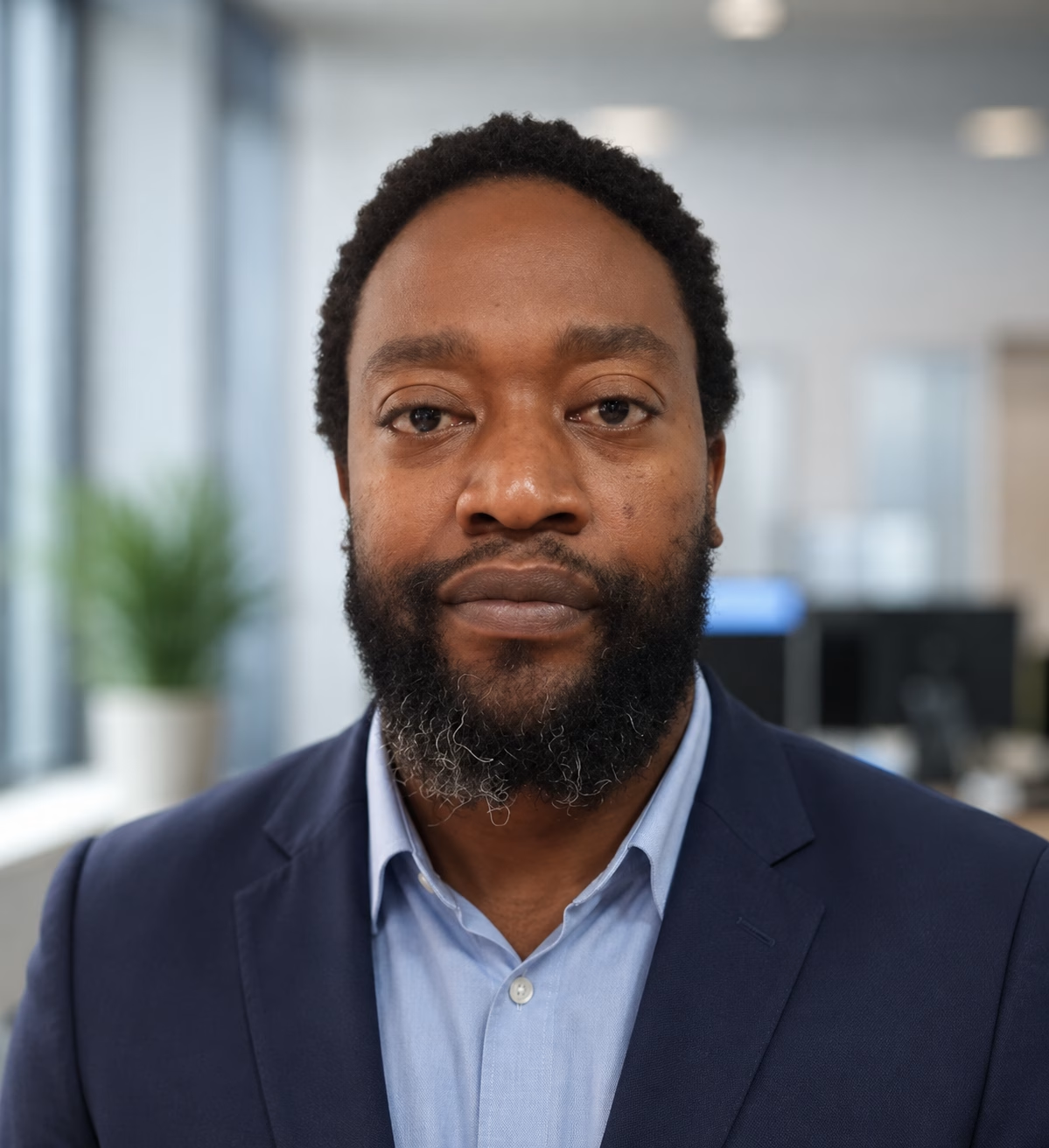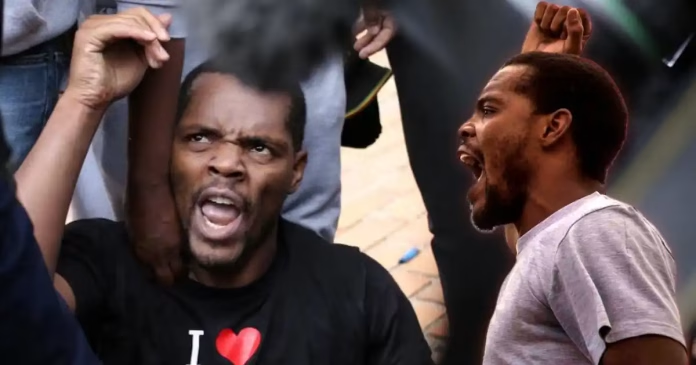
To some, he is the young man with a keffiyeh around his neck who made South Africa’s government blink. To others, he is a cautionary tale about the gap between brilliance and judgement. On Facebook, where many of his most incendiary battles were fought, he went by @mcebofreedom.dlamini — and that middle name, Freedom, tells you everything about how he sees himself. The press has called him a firebrand, a provocateur, and, after December 2020, a man capable of remorse. His supporters called him a revolutionary. His critics called him something they couldn’t print.
Mcebo Dlamini is one of the most polarising figures to emerge from post-apartheid South African student politics. As the president of the Wits University Students’ Representative Council and a frontline leader of the seismic #FeesMustFall movement in 2015, he helped force a conversation that changed the country’s higher education landscape forever. But the Mcebo Dlamini biography is not a simple hero’s journey. It is a jagged, complicated story of conviction, controversy, reinvention, and the kind of second act that nobody predicted — including, perhaps, Dlamini himself.
Early Life & Background
Mcebo Dlamini was born on 17 December 1986 in Mbabane, eSwatini, to South African parents, and holds dual citizenship of eSwatini and South Africa. His mother, the late Witness Nkosingiphile Dlamini, was from KwaZulu-Natal. Growing up between two countries gave Dlamini a particular vantage point on identity and belonging — themes that would come to define both his activism and his controversies.
Details about his early schooling remain sparse in the public record, but what is clear is that Dlamini emerged as intellectually ambitious and politically aware from a young age. He eventually enrolled at the University of the Witwatersrand — Wits — one of South Africa’s most prestigious institutions and historically a crucible of political ferment. He pursued an LLB, a law degree, at Wits, placing himself at the intersection of legal knowledge and political agitation.
Even as a student, Dlamini displayed a flair for self-mythology. His Facebook profile at one stage listed two additional degrees — one in Nuclear Physics, another in Actuarial Science. He claimed the University of Pretoria had personally recruited him to study Nuclear Physics, and that it was a secret. These claims were later shown to be false, but they revealed something important about Dlamini: he understood the power of narrative, even when that narrative was his own invention. The false credentials did not cost him his followers. If anything, they seemed irrelevant to a campus community that cared more about what he stood for than what certificates he could produce.
The hunger for belonging also expressed itself in more dramatic fashion. While a student at Wits, he claimed to be the grandson of the late ANC stalwart Walter Sisulu, introducing himself as Mcebo Olyate Sisulu and describing himself as a lovechild of Zwelakhe Sisulu and a Swazi princess. The Sisulu family was swift to respond. Max Sisulu, brother of Zwelakhe, said plainly: “My family knows nothing of a Mcebo.” When confronted by journalists from Wits Vuvuzela, Dlamini admitted: “My name is Mcebo Freedom Dlamini. That’s my stage name [Mcebo Sisulu] — that’s the name I decided to call myself when I’m excited.” Asked directly whether he was a Sisulu, he said: “I’m not.”
It was a strange, revealing episode — the act of a young man so desperate to root himself in the liberation struggle’s lineage that he borrowed a surname that was not his to take.
Mcebo Dlamini Biography: The FeesMustFall Earthquake
Whatever the complications of his personal narrative, Mcebo Dlamini’s place in the history of South African student activism is not in dispute. He was one of the leaders of the massive #FeesMustFall protests in South Africa, which led to the introduction of free tertiary education for the poor in the country.
The year was 2015. The South African government had proposed a fee increase for tertiary education, and students across the country — many of them first-generation university attendees, many of them still carrying the economic wounds of apartheid’s long aftermath — said no. At Wits, Dlamini was the face of that refusal. As SRC president, he addressed crowds with an intensity that cameras could not look away from. His most quoted line from that period cut straight to the bone: “The ANC must stop being arrogant and implement free higher education for the poor. We also demand that the ANC recalls Higher Education Minister Dr Blade Nzimande.”
Tears streamed down his face, according to TimesLive, when the government finally announced a zero percent fee increase. It was a rare unguarded moment for a man who usually performed public emotion with theatrical intent.
Mcebo Dlamini MacG Interview
The movement went beyond Wits. Students at institutions across South Africa joined what became a generational reckoning with the broken promises of democratic South Africa. Dlamini, with his ability to articulate a sense of historic grievance and his gift for the galvanising phrase, became one of the protest’s most recognisable voices nationally. He wrote in News24 in 2017: “The #FeesMustFall moment was the most catalytic moment in how young people demonstrated their power and ability to stand up for what they believe in. They were able to get the entire nation to speak about what it means to be black in South Africa post-1994.”
That is the version of the Mcebo Dlamini biography that his supporters carry with them. But the story did not stay clean.

Also in 2015, Dlamini made a string of comments on Facebook professing admiration for Adolf Hitler. He gained notoriety following remarks praising Hitler for killing white people, as opposed to other leaders who, he argued, had killed only black people. Dlamini defended his comments following outcry from South African Jews, claiming: “The same thing Hitler was doing to the Jews, they are doing to the Palestinians.” Numerous complaints were lodged with the Human Rights Commission following his inflammatory and antisemitic remarks.
The backlash was severe. He was suspended from the SRC presidency in 2015 because of the racist remarks, supporting Hitler, and misconduct. The following year, the university expelled him from his position as SRC president entirely.
Then came the arrests. The law student was arrested facing a range of charges including assault, public violence, theft, and malicious damage to property, all linked to student protests at the University of the Witwatersrand in 2016. He was denied bail, a decision that triggered further protests on campus. Over the following four years, Dlamini faced a drawn-out court battle in the Johannesburg Magistrate’s Court.
On 9 March 2020, Dlamini was found guilty of public violence and handed a sentence of seven years and six months, with five years being suspended. His remaining two-year sentence was also suspended, meaning he would avoid jail time. He had pleaded guilty. As a result of the conviction, the embattled LLB graduate would no longer be allowed to pursue his legal career.
He did not disappear. In August 2019, before the verdict, he embarked on a 56.6km walk from Wits to the Union Buildings in Pretoria to ask President Cyril Ramaphosa to release student activists arrested during the #FeesMustFall protests. The gesture was theatrical in the way all of Dlamini’s public actions tend to be — but it was also genuine. He had not forgotten the movement that made him, even when that movement’s most visible figure had become its most complicated one.
Personal Life, Relationships & Controversy
The Mcebo Dlamini biography offers very little in the way of a conventional personal life narrative. Dlamini has kept romantic relationships and family matters tightly guarded, and no confirmed long-term partner or children appear in the public record as of 2026. What the public record offers instead is a portrait of a man whose personal identity has been the site of some of his most consequential battles.
The Sisulu claim — examined in detail above — was not just an embarrassing episode. It revealed a man navigating the complex psychology of ambition, identity, and a profound desire to be seen as part of the liberation movement’s DNA. That he invented the connection rather than earning it through his own considerable achievements says something worth sitting with.
The Hitler remarks were the defining controversy. In December 2020, Dlamini issued a formal apology to the SA Jewish Board of Deputies, acknowledging: “In 2015 I uttered statements about Jews and Israelis that were not only provocative but also extremely offensive. It is only in retrospect that I began to appreciate how much my statements were both ill-advised and to a certain extent dangerous because they ignored the kind of trauma that they caused.” He also attended a facilitated educational engagement at the Johannesburg Holocaust & Genocide Centre. The SAJBD vice-president Zev Krengel noted that “the sincerity with which he acknowledged the hurt that he caused our community was palpable.”
Whether the apology reflected genuine transformation or pragmatic career management ahead of his political ambitions is a question that South Africans debated at the time. What was notable was that he made the apology at all — a step that many in his position, insulated by ideological peer groups, choose not to take.
His political home has been the ANC, though reports over the years noted visible EFF sympathies, a fluidity that reflects the ideological restlessness of his generation. He told the SA Jewish Report he was willing to move past the controversy as he wanted to pursue his political career with the African National Congress Youth League.
Public Image & Cultural Identity
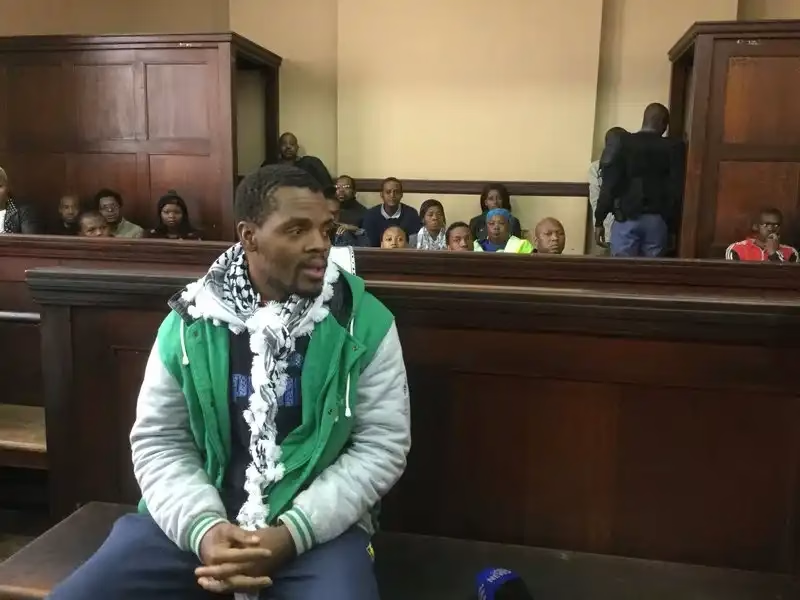
Few figures of his generation have been as visually distinctive as Mcebo Dlamini at his peak. The white keffiyeh he wore during his 2016 court appearances was not accidental — it announced his solidarity with the Palestinian cause to every camera in the courtroom. His green jacket, his natural ease in front of a crowd, his tendency toward grand declarative statements: all of it added up to a public image carefully constructed around the archetype of the student revolutionary.
He writes, he speaks, and he engages in the register of someone who has thought seriously about political philosophy while also being willing to reduce complexity to a slogan when the moment demands it. That tension — between intellectual depth and rhetorical excess — runs through almost everything the public knows about him.
His Facebook handle, @mcebofreedom.dlamini, and his public writing output reveal someone deeply invested in the question of what it means to be young, black, and politically conscious in democratic South Africa. He invokes historical references freely, from the liberation struggle to international anti-colonial movements, and positions himself as part of that continuum.
His relationship with brand deals and endorsements is not part of the public record. Dlamini’s currency has always been political, not commercial. His name carries weight in activist circles, in university common rooms, and in spaces where the question of economic transformation is still raw and unresolved.
Legacy & Why Mcebo Dlamini Is a Big Deal
Here is the uncomfortable truth about the Mcebo Dlamini biography: the thing he is most responsible for, he cannot fully claim in uncomplicated terms. The #FeesMustFall movement, which he helped lead, produced a genuine policy shift. It led directly to a national conversation about and eventual introduction of free tertiary education for the poor in South Africa, a structural change that has materially benefited tens of thousands of students from low-income backgrounds. That is not a small thing. That is a legacy worth acknowledging, even while holding the controversy in the same hand.
His willingness to be arrested, to face a four-year legal battle, to walk 56.6 kilometres to make a point about political prisoners, and to do all of it without the safety net of establishment backing — that speaks to a form of commitment that is easy to dismiss but difficult to replicate.
And then there is the reinvention. In January 2026, Orlando Pirates FC announced that Dlamini had been appointed to the role of chief administrator, one of the most prominent football clubs in the country. According to a source quoted by Soccer Laduma: “He has brought a different dimension to the club. You can see during games how much the players respect him.” From campus barricades to the offices of the Buccaneers — it is either the most South African story imaginable or a parable about how fast a political generation can move on from its own fire.
What Mcebo Dlamini represents, at his most significant, is the specific fury and specific hope of post-apartheid South African youth — a generation that grew up with political freedom but economic constraint, that inherited both the language of liberation and the reality of inequality, and that decided, at least for a moment in 2015, to make that contradiction impossible to ignore.
Giving Back: Humanitarian Work
Dlamini’s public advocacy has been consistent on the question of free education, which he has framed not as a policy preference but as a moral imperative. As recently as 2017, he stated: “Whatever happens, we will never shift our eyes from our objectives and we are still advocating for free education, very strongly.” He has spoken publicly about the meaning of the FeesMustFall movement for young black South Africans as a generational act of emancipation.
His walk from Wits to the Union Buildings in 2019 was explicitly an act of advocacy for fellow activists who had been imprisoned during the protests. He also contributed a public letter to News24 encouraging matriculants to persevere, framing education as the mechanism for breaking what he called generational chains of oppression. As of 2026, no formal charitable foundation in Dlamini’s name has been publicly confirmed, though his public record consistently positions free and accessible education as the cause closest to his convictions.
Quick Facts
| Name | Description |
|---|---|
| Full name | Mcebo Freedom Dlamini |
| Date of birth | 17 December 1986 |
| Birthplace | Mbabane, eSwatini (Swaziland) |
| Nationality | South African / eSwatini (dual citizen) |
| Profession | Activist, politician, sports administrator |
| Known aliases | Mcebo Freedom; formerly used “Mcebo Sisulu” (self-described “stage name”) |
| Social media | Facebook: @mcebofreedom.dlamini |
| Languages | Zulu, English, Swati (reported) |
| Education | LLB, University of the Witwatersrand |
| Political affiliation | African National Congress |
| Known for | #FeesMustFall leadership; Wits SRC presidency |
| Legal record | Guilty plea: public violence (2020); suspended sentence |
| Current role | Chief Administrator, Orlando Pirates FC (appointed January 2026) |
| Net worth | Not publicly confirmed; no credible estimate available as of 2026 |
| Marital status / children | Not publicly confirmed |
| Favourite foods | Not on public record |
Mcebo Dlamini is, above all else, a mirror. Hold him up and South Africa sees itself: the brilliance and the contradiction, the righteous anger and the troubling detour, the capacity for genuine remorse and the hunger for reinvention. He helped change who gets access to a university education in this country. He also said things that caused profound harm and, eventually, faced them. He lost his right to practise law and found a new seat at one of the country’s most iconic football clubs. Whatever your verdict on the man, the arc of his life forces a question worth sitting with long after you have put this article down.
What does it say about South Africa that its most electric voices so often carry the heaviest contradictions — and what does it say about all of us that we keep watching?
Read More