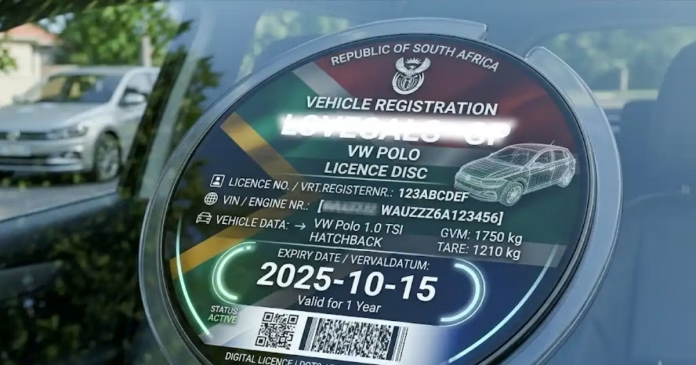
Pretoria is on the verge of a road transport revolution that will affect every registered vehicle owner in the country. South Africa’s digital licence disc is moving from concept to reality, with the Road Traffic Management Corporation confirming plans to replace the familiar windscreen sticker with an electronic system underpinned by number plate recognition technology. Combined with President Cyril Ramaphosa’s 2026 State of the Nation Address commitment to introduce digitalised driver’s licences, the country’s entire vehicle licensing architecture is set to be transformed within the next few years.
Key Facts:
- The RTMC is planning to move away from physical vehicle licence discs toward an electronic disc system using number plate recognition
- President Ramaphosa confirmed digital driving licences as part of South Africa’s broader digital transformation agenda in his February 2026 SONA
- The digital driving licence system is currently in prototype phase, with public rollout tied to the MyMzansi platform
- Smart Driving Licence Testing Centres have already opened in Atteridgeville, Denlyn, Maponya Mall, Centurion, Protea Glen, Midrand and Mohlakeng
- Driving licence card validity has been extended from five years to eight years as an interim reform
- Licence renewal costs range from approximately R250 to R350 depending on the province
- The country’s only physical licence card printer broke down in early 2025, creating a backlog of nearly 750,000 outstanding cards
Digital Licence Disc South Africa: What the RTMC Is Planning
The plan to scrap the physical vehicle licence disc from South African windscreens represents a fundamental rethinking of how compliance is verified on public roads. Rather than relying on a paper sticker that expires annually and must be manually inspected, the RTMC intends to shift toward an electronic regime in which number plate recognition technology does the verification work automatically. Under this model, cameras and scanning equipment at roadblocks and enforcement points would read a vehicle’s number plate in real time and instantly check its licence status against the national eNaTIS database, without any physical disc needing to be present.
This shift has been welcomed by road safety advocates who have argued for years that the physical disc system is outdated, fraud-prone, and costly to administer. Road safety expert Rob Handfield-Jones, managing director of Driving.co.za, has been among the most vocal voices calling for the end of physical licensing documents, pointing out that every vehicle already has a unique Vehicle Identification Number and every driver already carries biometric identifiers, making the continued reliance on paper and plastic an unnecessary bottleneck. The RTMC’s own online renewal platform has been processing more than 50,000 transactions monthly, signalling that South African motorists are already comfortable with digital licensing interactions.
Why the Old System Has Failed South African Drivers
The timing of the digital licence disc push is not coincidental. It comes after years of systemic failure in the physical licensing infrastructure that has left millions of South African drivers in legal limbo through no fault of their own. The country operated with a single driving licence card printing machine for more than two decades, and when that machine broke down in early 2025, it triggered a backlog of close to 748,000 unprinted cards that left drivers unable to prove their legal right to operate a vehicle. The Department of Transport scrambled to provide temporary licences and confirmation letters, but the crisis exposed just how fragile the entire physical system had become.
Beyond the printer crisis, fraud has long undermined confidence in physical licensing. Duplicate cards, tampered discs and forged documents have circulated in South African traffic for years, costing both law enforcement credibility and insurance companies billions in fraudulent claims. A digital system linked directly and in real time to the eNaTIS database would make fraud of this nature functionally impossible, since there would be no physical document to forge or duplicate. The Department of Transport has acknowledged these challenges as central motivations for the transition to digital.
Comparing the Old and New Licensing Systems
The scale of change between South Africa’s current physical licensing model and the proposed digital system is significant across almost every dimension that matters to ordinary motorists.
| Feature | Physical System | Digital System |
|---|---|---|
| Licence disc | Paper sticker on windscreen | Electronic, verified via number plate recognition |
| Driving licence | Plastic card renewed every 5 years | Digital credential, 8-year validity |
| Renewal process | In-person queue at DLTC | Online via eNaTIS, with DLTC visits reduced |
| Verification method | Manual inspection by traffic officer | Automated real-time database check |
| Fraud vulnerability | High (duplicate cards, tampered discs) | Low (biometric link, encrypted database) |
| Turnaround time | Up to 21 working days historically | Smart DLTCs processing renewals in 10 minutes |
| Lost card solution | Physical replacement required | Digital temporary downloadable via eNaTIS app |
The data makes a compelling case. South Africa’s road safety record has shown meaningful improvement in recent years, with Easter 2025 recording the lowest crash and fatality numbers in three years, including a 45.6% drop in deaths compared to 2024. Modernising the verification infrastructure can only reinforce that trend by ensuring that enforcement is faster, more accurate, and harder to circumvent.
Smart DLTCs and the MyMzansi Connection
The physical infrastructure supporting the digital transition is already being built. Gauteng has led the rollout of smart Driving Licence Testing Centres, with new facilities now operational in Atteridgeville, Denlyn at Maponya Mall, Centurion, Protea Glen, Midrand and the Mohlakeng area. These centres represent a fundamental upgrade on the traditional DLTC model. They offer fully online and cashless services, licence renewals can be completed in as little as 10 minutes, and they are directly integrated into the eNaTIS system, meaning that approvals and updates happen in real time rather than after days of administrative processing.
The digital driving licence itself, currently in prototype phase, is being developed by the Digital Service Unit in collaboration with the Department of Transport, using open-source digital public goods to keep costs manageable and the system interoperable. The planned rollout is tied to the broader MyMzansi platform, the government’s ambitious single-entry digital services application that aims to give South Africans one-stop access to a wide range of government functions from their smartphones. When both systems go live simultaneously, a South African driver could theoretically renew their vehicle licence, access their digital driving credential, and check their traffic fine status through a single application.
What Every South African Driver Should Do Now
While the full digital licence disc system is not yet in operation, the transition is clearly underway and drivers who act early will be far better positioned than those who wait. The most immediate practical priority is ensuring that all vehicle licences and driving licence cards are up to date. Driving with an expired disc or licence card carries fines and, critically, can void motor vehicle insurance cover in the event of an accident. Renewal costs currently range from R250 to R350 for most standard driver’s licence renewals, depending on the province.
Motorists should also register on the eNaTIS online portal at online.natis.gov.za, where they can view the status of all vehicles registered in their name, track renewal due dates, and book appointments at smart DLTCs without needing to queue in person. South Africans who have been affected by the licence card backlog from the 2025 printer crisis are entitled to apply for a driving licence confirmation letter from the RTMC at no charge. As South Africa moves toward a fully digital licensing environment, staying informed and proactively engaged with the eNaTIS system is the single most important thing any driver can do. You can follow updates on the latest South African transport and road safety developments as they unfold.