
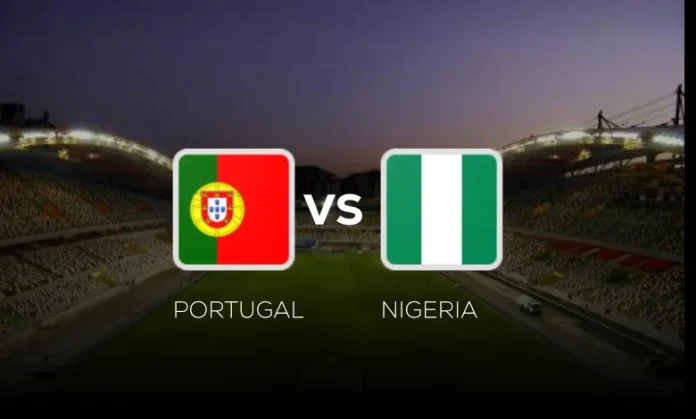
Leiria, Portugal — The stage is set for one of the most anticipated pre-tournament friendlies of the year as Portugal vs Nigeria takes centre stage tonight at the Estádio Dr. Magalhães Pessoa in Leiria. With the 2026 FIFA World Cup kicking off tomorrow in North America, this final warm-up match carries enormous weight, and African football fans are watching closely as Nigeria prepares to test themselves against one of the tournament favourites.
- Date: Wednesday, 10 June 2026, kick-off at 21:45 SAST
- Venue: Estádio Dr. Magalhães Pessoa, Leiria, Portugal
- Portugal’s World Cup opener: vs DR Congo on 17 June
- Nigeria did not qualify for the 2026 World Cup (lost on penalties to DR Congo)
- Last meeting: Portugal beat Nigeria 4-0 in a 2022 World Cup warm-up
- Portugal’s recent form: Won 3 of last 5 matches, including a 2-1 win over Chile
- Nigeria’s recent form: Unbeaten in last 6 matches, including a 3-0 win over Jamaica and a 2-2 draw with Poland
Portugal vs Nigeria: The Stakes for Roberto Martínez’s World Cup Contenders
Portugal head into the 2026 FIFA World Cup as a serious contender, carrying significant momentum following their 2025 UEFA Nations League triumph. For manager Roberto Martínez, this Portugal vs Nigeria clash is the last opportunity to fine-tune his squad before competitive football resumes. Portugal are placed in Group K alongside Congo DR, Uzbekistan and Colombia, entering the match looking to sharpen their World Cup preparations by building on a 2-1 win over Chile last Friday.
The Seléccião are loaded with talent at virtually every position. The team received a massive boost as a Paris Saint-Germain quartet — Nuno Mendes, João Neves, Vitinha, and Gonçalo Ramos — joined the camp following their recent Champions League duties. The confirmed lineup reads like a who’s who of European football: Diogo Costa; Dalot, Gonçalo Inácio, Ruben Dias, Semedo; Vitinha, João Neves, Francisco Trincão, Bruno Fernandes, Pedro Neto; Cristiano Ronaldo. For South African fans who follow the Champions League closely, the quality on display is breathtaking.
Nigeria’s Super Eagles Prove Their Worth Despite World Cup Heartbreak
There is a painful subplot to this Portugal vs Nigeria match that resonates deeply across the African continent. Although the Super Eagles famously missed out on World Cup qualification following a penalty shootout defeat to the DR Congo, they remain a formidable side. That elimination stung a nation of football-mad supporters and sparked intense debate about the future of Nigerian football.
Nigeria enters the match under the guidance of manager Éric Chelle, unbeaten in their last six matches. For this fixture, they are notably without stars Victor Osimhen and Ademola Lookman, rested after their club seasons, as well as Samson Tijani and Alhassan Yusuf, absent due to visa issues. Yet Nigeria’s depth has proven impressive. On 30 May they won 3-0 against Jamaica in the Unity Cup, and on 3 June they drew 2-2 with Poland. Even without their biggest names, the Super Eagles are refusing to roll over, making this tie far more competitive than many expect.
Head-to-Head Record and Match Statistics
Portugal and Nigeria have met only twice before, and the history favours the Europeans heavily. Their sole senior men’s encounter came in November 2022, also as a World Cup warm-up, and the result was emphatic. Portugal ran out 4-0 winners in Lisbon, with Bruno Fernandes scoring twice in the first half before late goals from Gonçalo Ramos and João Mário.
| Stat | Portugal | Nigeria |
|---|---|---|
| Last 5 match wins | 3 | 3 |
| Last 5 draws | 1 | 2 |
| Goals scored (recent run) | 4 | 11 |
| Unbeaten run | 8 home matches | 6 matches |
| Head-to-Head (men’s) | 1 win | 0 wins |
| Previous meeting scoreline | 4-0 | — |
Portugal scores an average of 4 goals when playing at home, while Nigeria scores 1.36 goals on average when playing away. These numbers tell a story of an attacking Portuguese team that punishes opponents at the Estádio Dr. Magalhães Pessoa. Still, Nigeria’s unbeaten run of six games is no statistical accident — it reflects a team that has found competitive resilience even amid structural challenges.
Ronaldo’s Final Chance to Prove Himself Before the World Cup
No preview of Portugal vs Nigeria is complete without addressing the elephant in the room: Cristiano Ronaldo. At 41, this World Cup in the United States is almost certainly his last. Roberto Martínez has confirmed that Ronaldo is not thinking about his Portugal future beyond the World Cup. The iconic forward, who starts tonight in Leiria, carries the weight of a nation’s dreams — and the scrutiny of a global audience watching to see whether age has diminished his famous instincts.
For South African football followers, Ronaldo’s story resonates. South Africa knows what it means to host a World Cup and feel the weight of continental expectation. There is something poignant about watching one of the sport’s greatest ever players making what is likely his final bid for the one trophy that has eluded him. The Portugal vs Nigeria friendly is, in that sense, far more than a routine warm-up — it is the opening chapter of what promises to be a dramatic farewell narrative, one that South Africans who experienced World Cup emotion firsthand since 2010 understand intimately.
What This Match Means for African Football’s Global Standing
From a broader African football perspective, Nigeria’s participation in tonight’s fixture matters enormously. The Super Eagles may not be in the World Cup, but playing Portugal at this intensity sends a clear message to African football stakeholders: the continent’s clubs and national teams are closing the gap at every level.
South African football supporters will watch with more than passing interest. Bafana Bafana’s own World Cup aspirations remain alive for future cycles, and watching how a well-organised African side like Nigeria copes against a UEFA Nations League champion provides tactical lessons the South African Football Association (SAFA) and its coaches cannot afford to ignore. Nigeria’s pressing game, physical presence and depth in wide areas are qualities South African coaches at all levels are working to develop. The more African teams compete at the highest level — even in friendlies — the better the continental footballing ecosystem becomes for everyone, Bafana Bafana included.

