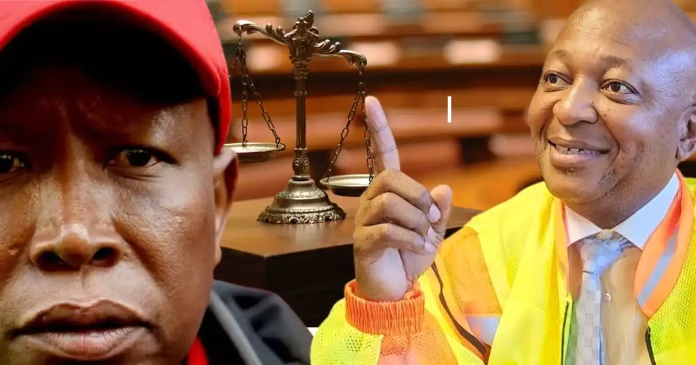
Johannesburg’s South Gauteng High Court handed Julius Malema an embarrassing early setback on Tuesday when his R1 million Malema Kunene defamation case was struck off the court roll, not on its merits, but because of an administrative blunder by the EFF leader’s own legal team. The case, rooted in explosive allegations made on a nationally broadcast podcast, now faces re-enrolment while Patriotic Alliance deputy president Kenny Kunene walks away from court with a costs order in his favour and no intention of retracting a single word.
Key Facts:
- Malema launched a R1 million defamation lawsuit against Kunene over statements made during a February 19, 2026 episode of Podcast and Chill with MacG
- Kunene alleged that Malema made late-night visits to the farm of late taxi boss Jothan “Mswazi” Msibi, gifting him R80,000 in cash and expensive whiskey
- Kunene also alleged that Malema lived in the backroom of tobacco businessman Adriano Mazzotti’s property
- Malema argues the statements link him to the so-called “Big Five” drug cartel and amount to criminal allegations designed to destroy his reputation
- Judge Leonard Twala struck the case off the roll after Malema’s legal team failed to upload heads of argument to the CaseLines online court management system on time
- Malema’s team is now seeking to re-enrol the matter after fixing the procedural issue
- Kunene was awarded costs on scale B and declared himself “on top of the world”
- Kunene has confirmed he will not retract the statements and views the striking as vindication
The Malema Kunene Defamation Case: What Kunene Said on MacG’s Podcast
The Malema Kunene defamation case has its origins in a February 19, 2026 appearance by Kunene on the wildly popular Podcast and Chill with MacG, a platform that has repeatedly become a flashpoint for South African political controversy. During the interview, Kunene made a series of claims about Malema’s alleged relationship with the late taxi industry figure Jothan Zanemvula Msibi, widely known as “Mswazi,” who died in January 2024 and who has been publicly associated with what witnesses before the Madlanga Commission have described as a criminal network linked to the “Big Five” cartel.
According to Malema’s court papers, Kunene alleged that the EFF leader would leave Adriano Mazzotti’s property late at night when summoned, driving to Msibi’s farm where he reportedly handed over approximately R80,000 in cash along with whiskey. Kunene reportedly referred to Malema repeatedly as a “boy,” a term Malema’s legal team argues carries historically loaded racial connotations in the South African context. Malema identifies ten specific statements from the podcast as defamatory, arguing that an ordinary listener would walk away believing he was under Msibi’s control, engaged in criminal activity, and fundamentally dishonest. Malema has publicly and categorically denied all of these allegations, sardonically asking at a press conference in April: “How do I pay a protection fee to myself if I am the cartel?”
How a Filing Error Derailed the Case Before It Began
The procedural collapse that ended Tuesday’s hearing is a significant embarrassment for Malema’s legal team. According to Judge Leonard Twala’s account of events, Malema’s attorney filed the written heads of argument on CaseLines on time, but failed to complete the step that would have made them visible to the judge on the platform. The documents sat in the system, effectively inaccessible to the presiding officer, until Monday night, which was too late. Twala struck the application from the roll and ordered Malema’s team to pay Kunene’s legal costs on scale B, which represents a meaningful financial penalty beyond the standard party-and-party costs scale.
Malema’s counsel, Advocate Mfesane ka Siboto, immediately indicated the intention to re-enrol the matter once the procedural deficiency is corrected. This means the underlying defamation dispute is far from resolved. However, the striking has handed Kunene a public relations victory that he has wasted no time exploiting. Speaking outside court on Tuesday, Kunene declared himself elated and announced that rather than paying R1 million to Malema, it is now Malema’s team that owes him money in legal costs. Kunene also pointedly noted that the court’s decision to strike the matter, even on a technicality, confirmed in his view that his statements were not defamatory. Legal experts have been quick to caution that this reading is incorrect, since the court made no ruling on the substance of the allegations whatsoever.
Malema’s Pattern of Litigation: Who Else Is in the Dock
The Malema Kunene defamation case is just one front in what has become an unusually broad legal war for the EFF leader in 2026. Kunene himself noted in his answering affidavit that this is the third lawsuit Malema has brought against him, accusing the EFF leader of believing he alone holds the right to freedom of expression in South Africa.
| Legal Matter | Parties | Status |
|---|---|---|
| Malema vs Kunene defamation | Malema suing Kunene for R1m | Struck off roll, re-enrolment pending |
| Malema vs Mchunu contempt | Malema seeking imprisonment of podcaster Ngizwe Mchunu | Set for hearing June 17, 2026 |
| Malema vs Khawula | Blogger found in contempt for refusing to apologise | Contempt ruling made May 2026 |
| Mabuyane vs Malema | Eastern Cape Premier seeking interdict over degree fraud claims | Pending in Eastern Cape High Court |
| Malema firearm charge | Malema sentenced for firing rifle at 2018 EFF rally | Sentenced April 2026 |
The pattern reveals a political landscape in which the boundaries between social media, podcasting, and legal accountability are being tested as never before. South African defamation law has always drawn a distinction between statements made as political opinion and statements that allege specific criminal conduct. The Malema Kunene defamation case sits squarely in the second category, which is why Malema’s team regards it as qualitatively different from ordinary political sparring.
What This Means for Free Speech and Political Accountability in SA
The Malema Kunene defamation case raises questions that go well beyond the R1 million price tag or the personalities involved. South Africa’s constitutional commitment to freedom of expression exists in tension with the right to dignity and reputation, and that tension is playing out publicly through podcast studios and courtrooms simultaneously. Kunene’s refusal to retract or apologise, and his framing of Malema as someone who weaponises litigation against critics, resonates with a section of South African public opinion that is deeply wary of powerful politicians using defamation law to silence uncomfortable claims.
At the same time, allegations linking a major political leader to organised crime and a criminal cartel are not merely provocative opinions. They are specific, potentially verifiable claims that carry serious reputational consequences. If those claims are unsubstantiated, defamation law exists precisely to provide a remedy. The court has not yet ruled on whether Kunene’s statements were defamatory. That question remains very much alive, and when the matter is re-enrolled, South Africans will finally get to see the evidence both sides are relying on. Until then, Kunene is standing firm, Malema is licking procedural wounds, and the EFF leader’s broader legal battles continue to dominate South African political news in 2026.