
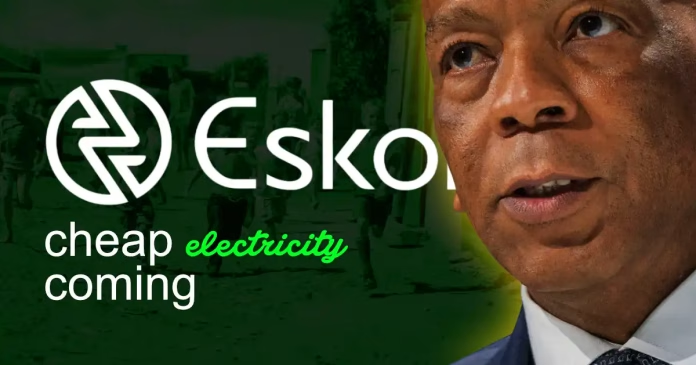
PRETORIA – Electricity Minister Kgosientsho Ramokgopa has announced that the Eskom Green electricity initiative will fundamentally transform South Africa’s energy landscape by bringing down electricity prices for consumers and businesses. The ambitious renewable energy project represents a critical shift in the country’s power generation strategy, offering hope to millions of South Africans burdened by escalating electricity costs and years of crippling load shedding.
Speaking at a recent briefing, Ramokgopa outlined how the Eskom Green initiative will leverage renewable energy sources to provide cheaper electricity alternatives while simultaneously addressing the structural challenges that have plagued the state-owned power utility for over a decade. The announcement comes as South African households and businesses continue to grapple with electricity tariff increases that have far outpaced inflation, with some estimates suggesting cumulative increases exceeding 500% over the past fifteen years.
Understanding the Eskom Green Initiative
The Eskom Green electricity programme represents a strategic pivot towards renewable energy generation, marking a departure from the utility’s traditional reliance on coal-fired power stations. According to Ramokgopa, this initiative will establish a separate renewable energy entity under the Eskom umbrella, specifically designed to procure, generate, and distribute power from wind, solar, and other clean energy sources at substantially lower costs than conventional thermal generation.
The structural design of Eskom Green addresses several critical inefficiencies inherent in the current system. By creating a dedicated renewable energy division, the government aims to streamline procurement processes, reduce bureaucratic bottlenecks, and attract private sector investment into South Africa’s energy sector. This approach mirrors successful renewable energy transitions implemented in countries such as Germany and Denmark, where dedicated green energy entities have facilitated rapid expansion of renewable capacity while simultaneously driving down consumer prices.
Industry analysts suggest that the cost advantages of renewable energy have become increasingly compelling. Solar and wind power generation costs have decreased by approximately 90% and 70% respectively over the past decade, according to Reuters reporting on global energy trends. South Africa’s abundant solar resources and extensive coastline provide ideal conditions for renewable energy development, positioning the country to capitalise on these technological advances.
Economic Impact on South African Households
The promise of reduced electricity prices through Eskom Green electricity could not come at a more critical time for South African consumers. Recent statistics from Statistics South Africa indicate that electricity prices have become one of the primary drivers of household inflation, with energy costs consuming an increasingly large proportion of disposable income, particularly among lower and middle-income families.
Ramokgopa’s announcement suggests that renewable energy tariffs under the Eskom Green framework could be structured significantly below current Eskom standard tariffs, potentially offering savings of 20-40% for consumers who opt into green energy programmes. Such reductions would provide substantial relief to households already strained by economic pressures including high unemployment, stagnant wage growth, and persistent inflation across essential goods and services.
| Energy Source | Current Cost (R/kWh) | Projected Eskom Green Cost (R/kWh) | Potential Savings (%) |
|---|---|---|---|
| Coal-fired generation | R1.85 | N/A | N/A |
| Current Eskom tariff | R2.06 | N/A | N/A |
| Solar PV (utility scale) | N/A | R1.20-R1.45 | 30-40% |
| Wind power | N/A | R1.15-R1.40 | 32-44% |
The economic multiplier effects of reduced electricity prices extend far beyond immediate household savings. Lower energy costs would enhance the competitiveness of South African manufacturing, potentially revitalising industries that have struggled under the dual burden of high electricity prices and unreliable supply. This could translate into job creation, increased foreign investment, and improved economic growth trajectories for a country that has experienced anaemic GDP expansion in recent years.
Technical Implementation and Infrastructure Requirements
The successful deployment of Eskom Green electricity requires substantial infrastructure development and grid modernisation. Ramokgopa acknowledged that the initiative necessitates significant investment in transmission infrastructure, energy storage systems, and smart grid technologies to effectively integrate variable renewable energy sources into the national grid.
South Africa’s existing transmission network, much of which was constructed during the apartheid era, requires extensive upgrades to accommodate distributed renewable generation. The minister indicated that the government is exploring various financing mechanisms, including public-private partnerships, development finance institution loans, and climate finance instruments, to fund the estimated R150-200 billion infrastructure investment required over the next five to seven years.
Energy storage represents a particularly critical component of the Eskom Green strategy. Battery storage systems and pumped hydro facilities will be essential for managing the intermittent nature of solar and wind power, ensuring stable electricity supply even when renewable generation fluctuates. According to Bloomberg’s analysis of global energy storage trends, battery costs have declined sufficiently to make grid-scale storage economically viable, particularly when paired with low-cost renewable generation.
Regulatory Framework and Market Structure
The implementation of Eskom Green electricity requires comprehensive regulatory reforms to create an enabling environment for renewable energy development. The National Energy Regulator of South Africa (NERSA) will play a pivotal role in establishing tariff structures, licensing frameworks, and market rules that facilitate the transition while protecting consumer interests and ensuring grid stability.
Ramokgopa emphasised that the regulatory framework would be designed to encourage competition and private sector participation while maintaining appropriate oversight. This approach contrasts with Eskom’s historical monopoly structure, which critics have long argued stifled innovation and efficiency. By opening renewable energy generation to competitive procurement, the government aims to harness market forces to drive down costs and improve service delivery.
Key regulatory considerations include:
- Establishment of transparent, competitive procurement processes for renewable energy projects
- Development of wheeling tariffs that allow private generators to sell directly to consumers using Eskom’s transmission network
- Creation of standardised power purchase agreement templates that reduce transaction costs and accelerate project development
- Implementation of grid connection protocols that streamline the integration of new renewable capacity
- Design of time-of-use tariffs that incentivise consumption patterns aligned with renewable generation profiles
The regulatory evolution reflects broader trends across African energy markets, where countries including Kenya, Morocco, and Ghana have successfully attracted substantial renewable energy investment through progressive policy frameworks. South Africa’s established financial markets and legal institutions provide a solid foundation for similar initiatives, potentially positioning the country as a regional leader in renewable energy development.
Challenges and Critical Perspectives
Despite the promising vision articulated by Ramokgopa, the Eskom Green electricity initiative faces significant implementation challenges that warrant careful consideration. Sceptics point to Eskom’s troubled history of project delays, cost overruns, and governance failures, questioning whether the organisation possesses the institutional capacity to successfully execute such an ambitious transformation.
The financial viability of Eskom itself remains a fundamental concern. The utility’s debt burden exceeds R400 billion, with government guarantees representing a substantial contingent liability for the fiscus. Critics argue that without comprehensive resolution of Eskom’s existing financial crisis, including debt restructuring and operational reforms, the Eskom Green initiative risks becoming yet another unfulfilled promise in South Africa’s energy saga.
Labour considerations present another complex dimension. South Africa’s coal mining industry employs tens of thousands of workers, many in communities with limited economic alternatives. The transition to renewable energy, while environmentally and economically beneficial in aggregate, threatens to displace coal workers and devastate mining-dependent regions. Ramokgopa has acknowledged the need for a “just transition” that provides retraining, alternative employment opportunities, and social support for affected workers and communities, though specific implementation plans remain under development.
Technical experts have also raised questions about grid stability during the renewable energy transition. While South Africa has successfully integrated renewable energy through the Renewable Energy Independent Power Producer Procurement Programme (REIPPPP), scaling up to much higher renewable penetration levels requires sophisticated grid management capabilities and substantial investment in flexibility resources. Load shedding experiences have already demonstrated the consequences of inadequate system planning and maintenance.
Regional and Continental Implications
The success or failure of Eskom Green electricity carries implications far beyond South Africa’s borders. As the continent’s most industrialised economy and largest electricity consumer, South Africa’s energy transition will influence regional power markets and continental climate strategies. The Southern African Power Pool (SAPP) facilitates electricity trading across the region, meaning South African renewable energy development could provide clean power to neighbouring countries while creating new revenue streams for Eskom.
African nations collectively face enormous energy access challenges, with hundreds of millions of people lacking reliable electricity. The continent’s abundant renewable energy resources offer a pathway to address energy poverty while avoiding the carbon-intensive development trajectories followed by industrialised nations. South Africa’s experience with Eskom Green could provide valuable lessons for other African countries designing their own energy transitions.
International climate commitments add further urgency to South Africa’s renewable energy agenda. The country recently secured an $8.5 billion Just Energy Transition Partnership with the United States, European Union, United Kingdom, France, and Germany to support decarbonisation efforts. Eskom Green represents a crucial mechanism for deploying these resources effectively and demonstrating meaningful progress toward emissions reduction targets articulated in South Africa’s Nationally Determined Contributions under the Paris Agreement.
For readers interested in broader energy developments affecting South Africa, additional analysis is available at NeoScribe’s South African news section, which provides ongoing coverage of the country’s energy transition and economic reforms.
Timeline and Implementation Roadmap
Minister Ramokgopa outlined an ambitious but phased implementation timeline for the Eskom Green electricity initiative. The first phase, expected to commence within the next six to twelve months, will focus on establishing the legal and institutional framework, including the formal creation of the Eskom Green entity as a subsidiary or division with appropriate governance structures and operational autonomy.
The second phase involves procurement of initial renewable energy projects, likely through competitive bidding processes similar to the REIPPPP model that has successfully delivered over 7,000 MW of renewable capacity since 2011. Government officials suggest that Eskom Green will target an additional 10,000-15,000 MW of renewable capacity over the next seven years, substantially expanding South Africa’s clean energy generation base.
Critical to the timeline is the resolution of grid connection bottlenecks that have historically delayed renewable energy projects. Eskom has acknowledged that transmission infrastructure upgrades must proceed in parallel with generation development to avoid stranded assets and ensure that new renewable capacity can actually deliver power to consumers. The minister indicated that fast-tracking transmission projects represents a key priority, with streamlined approval processes and dedicated project management resources being deployed.
Consumer access to Eskom Green electricity is expected to roll out gradually, beginning with pilot programmes in select municipalities before expanding nationwide. This phased approach allows for testing of billing systems, customer service protocols, and grid management procedures before full-scale implementation. Early indications suggest that consumers may be able to opt into green energy tariffs within 18-24 months, subject to regulatory approval and infrastructure readiness in their areas.
Conclusion: Cautious Optimism Amid Persistent Uncertainty
The Eskom Green electricity initiative represents a potentially transformative approach to South Africa’s intractable energy crisis. By leveraging the declining costs of renewable energy technology and creating dedicated institutional capacity for clean energy development, the programme offers a credible pathway toward lower electricity prices, improved supply reliability, and reduced carbon emissions—outcomes that would benefit virtually all South Africans.
However, realising this promise requires overcoming substantial institutional, financial, and political obstacles. Eskom’s track record inspires limited confidence, while the complexity of energy transitions worldwide demonstrates that ambitious targets frequently encounter implementation challenges. South Africans have endured years of unfulfilled promises regarding electricity supply, creating understandable scepticism about yet another government initiative.
Nevertheless, the fundamental economics of renewable energy have shifted decisively in favour of solar and wind power. Unlike previous energy proposals that required subsidies or cross-subsidisation, Eskom Green electricity appears financially viable based on generation costs alone. If the government can execute effectively—establishing appropriate regulations, attracting necessary investment, and managing the transition competently—Minister Ramokgopa’s promise of lower electricity prices could finally materialise.
The coming months will prove critical as detailed implementation plans emerge and initial projects move forward. South Africans, businesses, and international partners will be watching closely to determine whether Eskom Green represents genuine transformation or merely another addition to the country’s collection of well-intentioned but ultimately unsuccessful energy reforms. For a nation that has suffered through years of load shedding and economic stagnation partly attributable to electricity constraints, the stakes could hardly be higher.

