
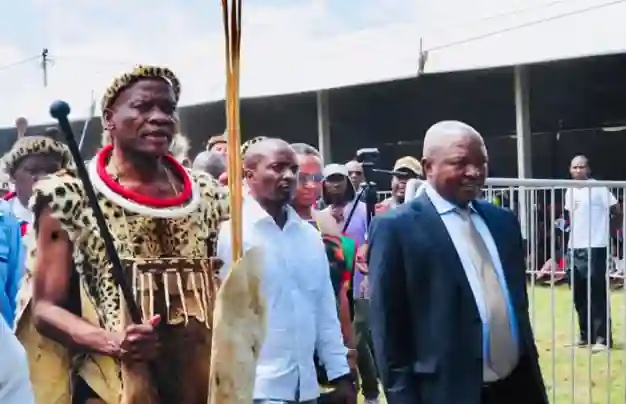
HARARE – The Zimbabwean government has bestowed a Special Official Funeral Category 1 upon the late King Mabhena, acknowledging his monumental contribution to Southern African music and cultural preservation. The King Mabhena funeral will stand as a testament to a life dedicated to celebrating and elevating indigenous musical traditions across the region, impacting audiences from Johannesburg to Lusaka.
This prestigious recognition places the beloved musician alongside Zimbabwe’s most revered national heroes, cementing his legacy as a cultural ambassador who transcended borders and generations. For South African audiences familiar with his collaborations and performances across the Limpopo, this honour resonates deeply within the broader context of regional cultural solidarity.
Understanding Special Official Funeral Category 1 Status
Zimbabwe’s funeral classification system represents the nation’s structured approach to honouring citizens who have made exceptional contributions to national development. The Special Official Funeral Category 1 designation represents one of the highest forms of state recognition, reserved for individuals whose impact extends beyond ordinary achievement into the realm of transformative national influence.
According to Al Jazeera‘s coverage of Zimbabwean state protocols, this category involves full government support for funeral arrangements, national mourning periods, and extensive media coverage. The decision reflects deliberations by cabinet officials and cultural ministry representatives who assess the deceased’s lifetime contributions.
Key elements of Special Official Funeral Category 1 include:
- State-funded funeral arrangements and logistics coordination
- National flag flown at half-mast at designated government buildings
- Broadcasting of funeral proceedings on national television and radio
- Official government representation at memorial services
- Permanent recognition in national archives and cultural institutions
- Potential establishment of commemorative projects or foundations
For regional observers, this honour system parallels South Africa’s own Special Official Funeral categories, demonstrating shared cultural values across Southern African nations regarding the recognition of artistic and cultural excellence.
King Mabhena’s Musical Legacy and Regional Impact
Born in Bulawayo, Zimbabwe’s second-largest city, King Mabhena emerged as a pioneering force in preserving and modernising traditional Ndebele music. His innovative approach blended ancestral rhythms with contemporary arrangements, creating a distinctive sound that resonated throughout Southern Africa’s diverse cultural landscape.
Throughout his career spanning over four decades, Mabhena released numerous albums that achieved commercial success while maintaining cultural authenticity. His work documented historical narratives, social commentary, and spiritual traditions that might otherwise have faded from collective memory. According to BBC archives on African music, his influence extended well beyond entertainment into the realm of cultural preservation and education.
South African music enthusiasts will recognise Mabhena’s collaborations with local artists and his frequent performances at cultural festivals in Gauteng, Limpopo, and Mpumalanga provinces. His ability to bridge linguistic and ethnic divides made him a unifying figure during periods of regional tension and transformation.
Cultural Significance for South Africa and the Region
The King Mabhena funeral carries profound implications for South Africa’s relationship with its regional neighbours. Cultural exchanges between South Africa and Zimbabwe have historically enriched both nations’ artistic landscapes, with musicians, dancers, and storytellers crossing borders to share traditions and innovations.
Mabhena’s work documented the shared historical experiences of Southern African peoples, including migration patterns, colonial resistance, and post-independence nation-building. His lyrics often referenced the interconnected histories of Ndebele, Zulu, and other ethnic groups whose territories span modern political boundaries.
South African cultural institutions have long recognised this connection. The Market Theatre in Johannesburg hosted several of Mabhena’s performances, while the University of Cape Town’s Centre for African Studies included his recordings in ethnomusicological research programs. These institutional relationships demonstrate the academic and cultural value assigned to his artistic output.
For more insights into regional cultural developments, readers can explore South African news coverage examining cross-border artistic collaborations and their impact on national identity formation.
Government Response and Public Mourning
Zimbabwe’s Minister of Home Affairs and Cultural Heritage announced the Special Official Funeral Category 1 designation during a press conference attended by family members, fellow musicians, and cultural stakeholders. The announcement emphasised Mabhena’s role as a “custodian of our collective memory” and a “bridge between generations.”
President Emmerson Mnangagwa reportedly expressed condolences to the Mabhena family, highlighting the musician’s contributions to national unity and cultural pride. Government statements indicated that funeral arrangements would involve consultations with traditional leaders, family representatives, and cultural organisations to ensure appropriate ceremonial protocols.
Public response has been overwhelming, with social media platforms flooded with tributes, shared memories, and recordings of Mabhena’s performances. Zimbabweans living in South Africa’s major cities organised memorial gatherings in Johannesburg, Pretoria, and Cape Town, reflecting the diaspora’s emotional connection to cultural figures from their homeland.
According to Reuters reporting on regional reactions, South African government officials extended official condolences, recognising Mabhena’s influence on the broader Southern African cultural ecosystem. The South African Department of Sport, Arts and Culture issued a statement acknowledging his contributions to regional artistic development.
The Broader Context of Cultural Preservation in Southern Africa
King Mabhena’s life work represents a critical component of Southern Africa’s ongoing struggle to preserve indigenous knowledge systems and cultural practices in an era of rapid globalisation. His approach to music-making combined rigorous respect for tradition with creative innovation, demonstrating that cultural preservation need not mean cultural stagnation.
This balance resonates particularly strongly in South Africa, where post-apartheid cultural policy has emphasised the recovery and celebration of previously marginalised artistic traditions. The National Heritage Resources Act and various provincial cultural policies reflect similar commitments to protecting intangible cultural heritage while allowing for contemporary expression and evolution.
Ethnomusicologists studying Southern African musical traditions have documented how artists like Mabhena serve as living repositories of historical knowledge. Through song lyrics, performance practices, and instrument-making techniques, these cultural practitioners transmit information about social structures, ecological knowledge, spiritual beliefs, and historical events that might otherwise disappear.
The King Mabhena funeral thus represents not merely the passing of an individual artist but a moment of collective reflection on the value societies place on cultural continuity and artistic excellence. Educational institutions across the region face ongoing challenges in documenting and teaching indigenous musical traditions, making the work of pioneering artists like Mabhena invaluable for future generations.
Implications for Regional Cultural Policy and Recognition
Zimbabwe’s decision to honour Mabhena with a Special Official Funeral Category 1 raises important questions about how Southern African nations recognise and support artists during their lifetimes. While posthumous honours acknowledge past contributions, they also highlight the often-precarious economic circumstances facing cultural practitioners throughout the region.
Many traditional musicians struggle with inadequate intellectual property protections, limited access to recording facilities, and insufficient performance venues. Despite creating work of immense cultural value, they frequently face financial insecurity that contrasts sharply with the recognition they receive after death.
South African cultural policy experts have long advocated for comprehensive support systems that provide living artists with sustainable income opportunities, healthcare benefits, and pension provisions. The National Arts Council and provincial arts and culture departments administer various grant programs, but funding constraints and administrative challenges limit their reach and effectiveness.
Regional organisations like the Southern African Development Community (SADC) have established cultural protocols aimed at facilitating artistic exchange and protecting cultural heritage. However, implementation remains uneven across member states, with resource disparities affecting each nation’s capacity to support cultural sectors adequately.
The attention surrounding the King Mabhena funeral may catalyse renewed discussions about regional cultural cooperation and artist support mechanisms. His cross-border influence demonstrates the potential for cultural diplomacy to strengthen regional integration beyond purely economic or political dimensions.
Looking Forward: Preserving Mabhena’s Legacy
As Zimbabwe prepares for the King Mabhena funeral, discussions have already begun regarding permanent memorialisation and legacy preservation. Proposals include establishing a cultural centre in Bulawayo dedicated to traditional music education, creating scholarship programs for young musicians studying indigenous instruments, and digitising Mabhena’s extensive recording catalogue for archival preservation.
Family representatives have indicated interest in collaborating with regional institutions to ensure Mabhena’s work remains accessible to future generations. South African universities with strong ethnomusicology programs have expressed willingness to participate in preservation efforts, recognising the transnational significance of his artistic contributions.
For South African readers, Mabhena’s story offers valuable lessons about the importance of supporting living artists while celebrating cultural heritage. As the nation continues developing its own approaches to cultural preservation and artistic recognition, the example set by Zimbabwe’s honouring of this legendary musician provides both inspiration and cautionary reflection.
The King Mabhena funeral will undoubtedly draw attendance from across Southern Africa, with musicians, government officials, traditional leaders, and ordinary citizens gathering to celebrate a life dedicated to cultural excellence. In his passing, Mabhena leaves behind not merely a catalogue of recordings but a template for how artists can serve as bridges between past and future, tradition and innovation, local and regional identity.
His influence on South African music, though perhaps less formally acknowledged than his impact within Zimbabwe, remains significant among communities that share linguistic, cultural, and historical connections across political borders. As regional integration continues evolving, the cultural foundations laid by artists like Mabhena provide essential connective tissue binding Southern African peoples together in shared heritage and mutual appreciation.

