
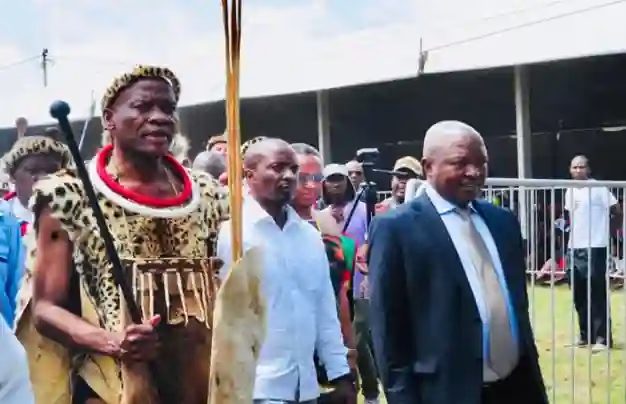
EASTERN CAPE – The King Makhosoke II death has sent ripples of mourning through South Africa’s traditional leadership community, with the revered AmaRharhabe monarch’s passing marking the end of an era for one of the nation’s most significant royal houses. The announcement, confirmed by the royal family on Wednesday, has prompted an immediate response from traditional leaders, government officials, and community members who recognised King Makhosoke II as a custodian of indigenous heritage and a bridge between customary law and modern governance.
King Makhosoke Sigcau, who ascended to the throne following a lineage that traces back centuries within the AmaRharhabe nation—a prominent subdivision of the amaXhosa people—leaves behind a legacy of cultural preservation during a period when traditional leadership structures have faced significant challenges in post-apartheid South Africa. His death raises immediate questions about succession, the continuation of traditional governance systems, and the broader role of customary authorities in contemporary South African society.
The Legacy of AmaRharhabe Traditional Leadership
The AmaRharhabe kingdom represents one of the most historically significant traditional leadership structures within the Eastern Cape province, with roots extending deep into pre-colonial Southern African history. King Makhosoke II served as the custodian of traditions that have survived colonialism, apartheid, and the dramatic social transformations of the democratic era.
Traditional leaders across South Africa have expressed profound grief at the King Makhosoke II death, recognising that his passing removes a senior voice from the Council of Traditional Leaders and diminishes the collective wisdom available to customary governance institutions. The king’s role extended beyond ceremonial functions; he served as a mediator in community disputes, a guardian of customary law, and an advocate for traditional communities within provincial and national policy frameworks.
According to the Congress of Traditional Leaders of South Africa (CONTRALESA), King Makhosoke II was instrumental in navigating the complex relationship between traditional authority and constitutional democracy. His leadership style emphasised collaboration with elected government structures while maintaining the integrity of customary practices that govern land allocation, cultural ceremonies, and community cohesion within traditional settings.
- Served as a senior member of the Eastern Cape House of Traditional Leaders
- Advocated for recognition of customary law within South Africa’s plural legal system
- Played a crucial role in land restitution processes affecting traditional communities
- Maintained cultural practices including initiation ceremonies and traditional courts
- Mediated between mining companies and traditional communities on development issues
Succession Protocols and Royal Transition
The King Makhosoke II death triggers established succession protocols within the AmaRharhabe royal family, a process governed by both customary law and the Traditional Leadership and Governance Framework Act of 2003. Unlike electoral processes in democratic governance, traditional succession follows patrilineal descent patterns, with the royal family identifying the rightful heir according to customary principles.
However, succession within South African traditional leadership has not been without controversy in recent decades. Multiple royal houses have experienced disputes over legitimate succession, sometimes requiring intervention by provincial governments or even court adjudication. The Zulu royal house, for instance, has faced protracted legal battles over succession rights, highlighting tensions between traditional protocols and modern legal frameworks.
The Eastern Cape provincial government, through its Department of Cooperative Governance and Traditional Affairs, will play a facilitative role in recognising the new king once the royal family completes its internal processes. This recognition carries significant implications, as only officially recognised traditional leaders receive government stipends and can exercise authority within the framework of South African law.
| Traditional Leadership Aspect | Customary Protocol | Legal Framework |
|---|---|---|
| Succession determination | Royal family according to customary law | Provincial government recognition required |
| Authority scope | Traditional community governance | Defined by Traditional Leadership Act |
| Land administration | Customary allocation systems | Subject to constitutional property rights |
| Dispute resolution | Traditional courts and mediation | Must align with Bill of Rights |
| Financial support | Community contributions and tributes | Government stipends for recognised leaders |
Traditional Leadership in Contemporary South Africa
The King Makhosoke II death occurs within a broader context of ongoing debates about the role and relevance of traditional leadership in 21st-century South Africa. The Constitution recognises customary law and traditional authorities, but tensions persist between democratic principles of elected representation and hereditary leadership structures.
Approximately 17 million South Africans—nearly one-third of the population—live under some form of traditional governance, primarily in rural areas of the Eastern Cape, KwaZulu-Natal, Limpopo, and Mpumalanga provinces. For these communities, traditional leaders provide essential governance functions, including land allocation, dispute resolution, and cultural continuity that connects present generations to ancestral heritage.
Critics, however, argue that traditional leadership systems can perpetuate patriarchal structures that marginalise women and youth, while defenders emphasise their role in preserving cultural identity and providing governance in areas where state capacity remains limited. The debate reflects broader tensions across Africa between modernisation and cultural preservation.
King Makhosoke II navigated these tensions throughout his reign, working to demonstrate that traditional leadership could adapt to constitutional democracy without abandoning core cultural values. His approach included engaging with gender equality advocates, supporting youth development initiatives, and ensuring that traditional governance structures complemented rather than contradicted democratic institutions.
Economic and Development Implications
Beyond cultural and governance dimensions, the King Makhosoke II death has implications for economic development within traditional communities. Traditional leaders play crucial roles in negotiating with mining companies, facilitating land access for development projects, and ensuring that communities benefit from economic activities on traditional land.
The Eastern Cape, where the AmaRharhabe kingdom holds significant influence, faces substantial development challenges including high unemployment, limited infrastructure, and persistent poverty. Traditional leaders serve as intermediaries between communities and investors, with their cooperation often essential for project success.
Research by development economists suggests that effective traditional leadership can accelerate rural development by reducing transaction costs, building trust between communities and external actors, and ensuring equitable benefit distribution. Conversely, leadership vacuums during succession periods can delay projects and create uncertainty for investors.
The mining sector, particularly significant in the Eastern Cape’s northeastern regions, requires positive relationships with traditional authorities for social licence to operate. King Makhosoke II established precedents for community benefit agreements that balanced economic development with environmental protection and social cohesion—a legacy his successor will inherit.
Mourning Protocols and Cultural Significance
Following the King Makhosoke II death, the AmaRharhabe nation has entered a mourning period governed by customary protocols that reflect the spiritual and social significance of kingship within African traditional societies. These protocols include specific mourning rituals, restrictions on certain activities, and preparations for funeral ceremonies that will bring together traditional leaders from across South Africa and neighbouring countries.
Traditional funerals for senior leaders are not merely personal farewells but communal events that reaffirm social bonds, transmit cultural knowledge to younger generations, and demonstrate the continued vitality of indigenous traditions. The funeral will likely feature traditional music, praise poetry (izibongo), ceremonial dress, and rituals that connect the living community with ancestral spirits.
Government officials, including provincial and potentially national leaders, typically attend such funerals, reflecting the official recognition of traditional leadership within South Africa’s governance architecture. President Cyril Ramaphosa has previously attended funerals of senior traditional leaders, recognising their constitutional status and political significance.
- Extended mourning period observed by the AmaRharhabe community
- Traditional leaders from other kingdoms paying condolence visits
- Funeral arrangements coordinated between royal family and provincial government
- Cultural rituals performed according to AmaRharhabe customs
- Community gatherings for collective mourning and remembrance
Future of Traditional Leadership Governance
The King Makhosoke II death prompts reflection on the future trajectory of traditional leadership in South Africa. Younger generations of traditional leaders face the challenge of maintaining cultural authenticity while adapting to rapidly changing social, economic, and technological realities.
The Traditional and Khoi-San Leadership Act of 2019 attempted to provide clearer frameworks for traditional governance, including provisions for greater inclusivity and accountability. However, implementation has been uneven, and debates continue about how to balance respect for customary law with constitutional principles, particularly regarding gender equality and democratic participation.
Some progressive traditional leaders have embraced reforms including establishing traditional councils with elected components, ensuring women’s representation in decision-making structures, and adopting transparent financial management systems. The extent to which King Makhosoke II’s successor continues this reform trajectory will significantly impact the AmaRharhabe kingdom’s relationship with government and civil society.
Traditional leadership developments remain central to South Africa’s broader governance landscape, affecting millions of citizens whose daily lives intersect with both traditional and democratic institutions. The succession process following King Makhosoke II’s passing will test the resilience of these dual governance systems and their capacity to coexist productively.
Condolences and National Response
In the days following the King Makhosoke II death announcement, condolence messages have poured in from across South Africa’s political spectrum. The Eastern Cape provincial government issued an official statement recognising the king’s contributions to traditional governance and cultural preservation, while opposition parties expressed respect for traditional institutions and sympathy for the royal family.
The Congress of Traditional Leaders of South Africa (CONTRALESA) described King Makhosoke II as “a pillar of traditional governance whose wisdom and leadership will be sorely missed.” The organisation emphasised his role in advocating for traditional communities within national policy debates and his efforts to ensure that customary law receives appropriate recognition within South Africa’s plural legal system.
Community members within the AmaRharhabe traditional area have expressed both grief at the loss of their leader and determination to honour his legacy through continued respect for cultural traditions. Traditional leaders from neighbouring kingdoms, including representatives from the amaXhosa royal houses and other Eastern Cape traditional authorities, have made condolence visits to the royal household.
Analysis by governance experts suggests that King Makhosoke II’s death represents a generational transition within traditional leadership, with implications extending beyond the AmaRharhabe kingdom to broader questions about indigenous governance in modern African states. His leadership during a transformative period in South African history provided a model for how traditional authorities could maintain cultural integrity while engaging constructively with democratic institutions.
As South Africa mourns the passing of King Makhosoke II, attention now turns to succession processes, funeral preparations, and the longer-term question of how traditional leadership will continue evolving within the nation’s constitutional democracy. His legacy as a cultural custodian and governance innovator will shape the AmaRharhabe kingdom and influence traditional leadership discourse for years to come.
The royal family has indicated that further details regarding funeral arrangements will be announced following consultations with traditional advisors and government officials, in accordance with both customary protocols and contemporary logistical requirements for an event of national significance.

