
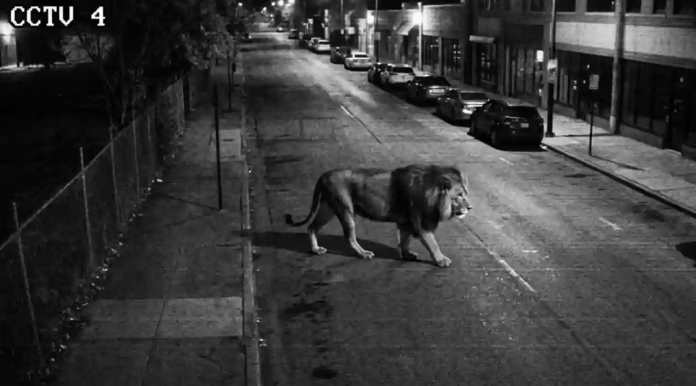
DURBAN – A confirmed lion sighting KZN has sent shockwaves through northern KwaZulu-Natal communities as wildlife authorities scramble to locate and monitor a big cat reportedly roaming outside designated conservation areas. The sighting, confirmed by the KwaZulu-Natal Department of Economic Development, Tourism and Environmental Affairs (EDTEA), has prompted urgent safety advisories for residents in the affected region as South Africa grapples with escalating human-wildlife conflict.
The incident marks the latest in a concerning pattern of wildlife encroachment into populated areas across KwaZulu-Natal, raising critical questions about conservation fence integrity, habitat pressure, and community safety protocols in a province where rural settlements frequently border game reserves and protected areas.
Details of the Northern KZN Lion Sighting
According to provincial wildlife officials, the lion was spotted in the northern regions of KwaZulu-Natal, though authorities have withheld specific location details to prevent public panic and unnecessary confrontation with the animal. Early reports suggest the big cat may have escaped from a private game reserve or traversed damaged conservation fencing following recent severe weather events that have battered the province.
EDTEA spokesperson Musa Mntambo confirmed that specialised tracking teams comprising conservation officers, experienced game rangers, and wildlife veterinarians have been deployed to locate and assess the lion’s condition and potential threat level. “We are treating this matter with the utmost seriousness,” Mntambo stated. “Residents in the affected areas have been advised to remain vigilant, keep children and livestock secured, and report any sightings immediately to our emergency hotline.”
The lion sighting KZN incident follows established protocols for dangerous game management outside conservation boundaries, which typically involve tranquilisation and relocation rather than lethal intervention unless the animal poses an immediate threat to human life. However, the operation’s complexity increases significantly when big cats enter areas with dense human populations, limited visibility terrain, and multiple potential hiding locations.
Human-Wildlife Conflict Intensifies Across South Africa
This latest lion sighting underscores a broader national challenge facing South Africa’s conservation model. As wildlife populations recover from historical declines—a conservation success story—the pressure on habitat boundaries intensifies, particularly in provinces like KwaZulu-Natal where conservation areas are fragmented among private reserves, communal lands, and commercial agricultural operations.
According to Reuters reporting on African wildlife conflict, incidents involving dangerous game outside protected areas have increased by approximately 34% across southern Africa over the past five years, with lions, elephants, and leopards accounting for the majority of reported cases.
Key factors driving this escalation include:
- Climate change impacts reducing natural prey availability and forcing predators to expand hunting territories
- Ageing and deteriorating conservation fencing infrastructure requiring costly maintenance beyond many reserves’ budgets
- Urban expansion encroaching on traditional wildlife corridors and buffer zones
- Livestock farming practices that inadvertently attract predators seeking easy prey
- Fragmented habitat preventing natural animal movement and gene flow between populations
- Extreme weather events damaging protective barriers and creating temporary escape routes
Dr. Sarah Nkosi, a wildlife ecologist at the University of KwaZulu-Natal, explains that lions are particularly challenging when they leave protected areas. “Unlike smaller predators, lions require substantial territories—typically 20 to 400 square kilometres depending on prey density. When they cross conservation boundaries, they’re often young males seeking to establish territories or prides displaced by dominant coalition takeovers. They don’t recognise human boundaries and will continue hunting behaviour wherever they find themselves.”
Safety Protocols for Communities Near Wildlife Areas
With the lion sighting KZN dominating local concerns, authorities have issued comprehensive safety guidelines for residents in northern KwaZulu-Natal and surrounding districts. These protocols draw from decades of conservation experience and are designed to minimise confrontation risk while allowing tracking teams to operate effectively.
| Safety Measure | Implementation Details | Rationale |
|---|---|---|
| Movement Restrictions | Avoid unnecessary outdoor activity during dawn, dusk and night hours | Lions are crepuscular hunters, most active during low-light periods |
| Livestock Security | Move animals into secure enclosures before nightfall; use bright lighting | Prevents opportunistic predation that may habituate lion to human settlements |
| Child Supervision | Maintain constant adult supervision; prohibit solo outdoor activities | Children’s size and behaviour may trigger predatory response |
| Noise Awareness | Create noise when moving outdoors; travel in groups | Lions typically avoid confrontation with groups of humans |
| Emergency Response | Report sightings immediately; do not approach or attempt photography | Enables rapid professional response; prevents dangerous encounters |
Community liaison officers have been deployed to rural settlements to conduct safety briefings and distribute emergency contact information. The provincial government has also activated its wildlife emergency hotline, which residents can access 24/7 to report sightings or seek guidance on protective measures.
Traditional leaders in the affected areas have played a crucial role in disseminating safety information through established community structures, ensuring even remote homesteads receive current updates on the tracking operation’s progress.
Conservation Fence Integrity Under Scrutiny
The lion sighting KZN incident has renewed focus on the state of conservation fencing across South Africa’s extensive network of public and private reserves. Industry experts estimate that maintaining predator-proof fencing costs between R35,000 and R85,000 per kilometre annually, creating significant financial pressure for smaller reserves operating on constrained budgets.
Recent assessments by the BBC Africa conservation unit revealed that approximately 40% of South Africa’s private game reserve fencing fails to meet current safety standards for dangerous game containment, with many sections compromised by flood damage, elephant pressure, or simple deterioration through age.
Johan van der Merwe, chairman of the KwaZulu-Natal Game Reserves Association, acknowledges the challenge: “Conservation fencing is our first line of defence in preventing human-wildlife conflict, but it’s extraordinarily expensive to maintain properly. A single elephant can destroy hundreds of metres of fencing in minutes. Severe weather events create breaches that require immediate repair, often in remote, difficult-to-access locations. Many reserves are struggling to keep up with maintenance demands.”
The provincial government has committed R127 million over the next three years specifically for conservation infrastructure upgrades, including fence maintenance, early warning systems, and community wildlife response training. However, conservationists argue this funding falls short of actual requirements, estimating that comprehensive fence rehabilitation across KwaZulu-Natal alone would require investment exceeding R500 million.
Economic Impact of Wildlife Conflict on Rural Communities
Beyond immediate safety concerns, the lion sighting KZN highlights significant economic pressures facing rural communities adjacent to conservation areas. Livestock losses to predation represent substantial financial blows for smallholder farmers operating with minimal margins, while fear of dangerous game restricts movement, affects school attendance, and limits agricultural activities during vulnerable periods.
Government compensation schemes exist for verified livestock losses to protected species, but claim processing typically takes months, and compensation rates often fail to reflect animals’ true value to subsistence farmers. This creates resentment toward conservation efforts and occasionally results in retaliatory killing of predators, undermining broader wildlife protection goals.
According to data from the National Department of Forestry, Fisheries and the Environment, predator-related livestock losses in KwaZulu-Natal cost rural farmers an estimated R34 million annually, with lions, leopards, and caracals responsible for the majority of incidents. However, economic modeling suggests that ecotourism revenue generated by these same predator populations contributes approximately R2.8 billion to the provincial economy, creating a complex cost-benefit dynamic that requires careful management.
Progressive conservation models now emphasise benefit-sharing arrangements where communities neighbouring reserves receive direct financial returns from wildlife tourism, creating economic incentives for tolerance and protection rather than conflict. Several KwaZulu-Natal reserves have implemented such programmes with measurable success in reducing retaliatory killings and improving community attitudes toward conservation.
Long-term Solutions and Conservation Innovation
As tracking teams continue searching for the lion at the centre of the current alert, conservation strategists are examining longer-term solutions to prevent similar incidents and reduce human-wildlife conflict across South Africa’s conservation landscape.
Innovative approaches being tested or implemented include:
- Predator early warning systems using GPS collars and community-based spotters to track dangerous game movements near boundaries
- Ecological corridors connecting fragmented habitats to allow natural wildlife movement without human settlement interface
- Livestock protection programmes providing predator-proof enclosures and trained guardian animals to reduce losses
- Community wildlife rangers employed from local populations to monitor boundaries and respond to incidents
- Advanced fencing technologies incorporating solar-powered electric systems with intrusion detection capabilities
- Compensation fund reforms enabling rapid, fair settlement of verified predation claims
International models from countries like Botswana and Kenya, where community-based conservation has reduced conflict, are being adapted for South African contexts. These approaches recognise that sustainable conservation requires communities to benefit tangibly from wildlife presence rather than bearing costs without compensation.
Dr. Nkosi emphasises the importance of integrated approaches: “We cannot fence wildlife into ever-smaller islands of habitat and expect sustainable outcomes. Conservation in the 21st century requires landscape-level planning that accommodates both human livelihoods and wildlife populations. That means wildlife corridors, buffer zones with appropriate land use, rapid response capabilities, and genuine partnership with rural communities who share space with these animals.”
The current lion sighting KZN incident, while concerning, also represents an opportunity to test and refine response protocols that will inevitably face increasing demand as climate change, habitat pressure, and human population growth intensify wildlife conflict scenarios across southern Africa.
Monitoring the Situation and Public Safety
As of the latest updates from EDTEA, tracking teams have identified spoor and other evidence confirming the lion’s general location, though the animal has not yet been visually confirmed by ground teams. Aerial surveillance using drones equipped with thermal imaging is supplementing ground tracking efforts, while veterinary teams remain on standby with tranquilisation equipment should the lion be located.
Authorities emphasise that public cooperation remains critical to successful resolution. Residents are urged to report any sightings, unusual livestock disturbances, or tracks immediately through the emergency hotline rather than attempting to investigate independently. False alarms are considered preferable to delayed reporting that could endanger communities or complicate tracking efforts.
For ongoing updates on this developing situation and other conservation news affecting South Africa, readers can follow NeoScribe’s South African news coverage for comprehensive reporting.
The lion sighting KZN serves as a stark reminder that South Africa’s conservation success—recovering wildlife populations from historical lows—creates new challenges requiring adaptive management, adequate resources, and genuine partnership between conservation authorities and the communities who share landscapes with Africa’s magnificent but potentially dangerous wildlife.
As the search continues, the incident underscores fundamental questions about South Africa’s conservation future: How do we balance wildlife protection with community safety and livelihoods? Who bears the costs and reaps the benefits of conservation? And how can we create systems that make coexistence sustainable for both human and animal populations in an increasingly crowded landscape?
These questions extend far beyond a single lion in northern KwaZulu-Natal, touching on the future of conservation across Africa as human populations grow, climate patterns shift, and the space available for wildlife continues to shrink. The answers we develop will determine whether Africa’s iconic wildlife survives the 21st century not just in protected reserves, but as part of functional ecosystems that support both biodiversity and human development.

