
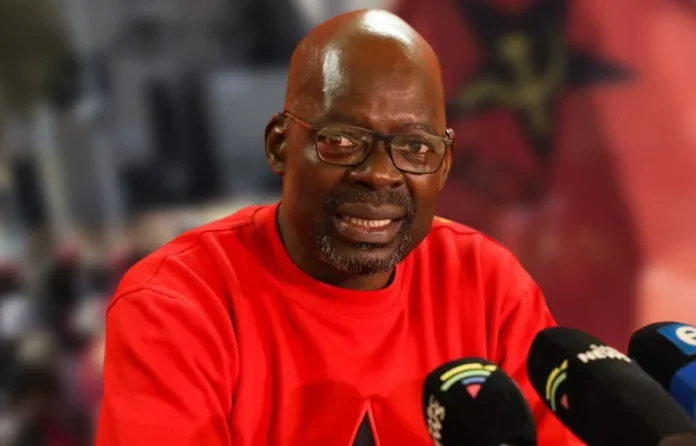
JOHANNESBURG – In an unexpected declaration that has sent ripples through South Africa’s left-wing political establishment, South African Communist Party (SACP) General Secretary Solly Mapaila has categorically stated that he does not want to occupy political office, preferring instead to focus on building the party’s ideological and organisational strength outside the direct corridors of governmental power.
The announcement comes at a critical juncture for the Tripartite Alliance, as tensions between the SACP, the African National Congress (ANC), and the Congress of South African Trade Unions (COSATU) reach new heights following the ANC’s controversial Government of National Unity (GNU) with the Democratic Alliance and other parties. Mapaila’s political office stance represents a significant positioning within South Africa’s complex political landscape, where the boundaries between party activism and governmental responsibility have increasingly blurred.
A Principled Stand Against Careerism
During a recent address to party members, Mapaila elaborated on his decision to eschew political office, framing it as a principled stance against the careerism that has plagued South African politics. “The SACP’s role is not to become another vehicle for individuals seeking government positions, but to be the ideological conscience of the working class,” Mapaila stated, according to those present at the gathering.
This position distinguishes Mapaila from many contemporary political leaders who have used party positions as springboards to lucrative government appointments. The SACP General Secretary’s commitment to remaining outside formal political office reflects a return to classical communist party doctrine, where the party serves as a vanguard organisation rather than a direct participant in bourgeois democratic structures.
Political analyst Dr. Lwazi Lushaba from the University of Cape Town noted that Mapaila’s stance represents “a fascinating ideological purity in an era when most political leaders see party positions merely as stepping stones to state power.” This approach contrasts sharply with the trajectory of numerous SACP leaders who have transitioned into ANC government positions over the past three decades.
Historical Context of SACP Leadership in Government
The relationship between SACP membership and government office has been contentious throughout South Africa’s democratic history. Notable SACP members who have occupied significant political office include:
- Joe Slovo, who served as Minister of Housing in Nelson Mandela’s cabinet
- Blade Nzimande, current Minister of Higher Education and Training
- Jeremy Cronin, who served as Deputy Minister of Public Works
- Rob Davies, former Minister of Trade and Industry
- Thulas Nxesi, current Minister of Employment and Labour
According to BBC reporting on South African politics, this dual membership has created persistent tensions about where loyalties ultimately lie – with the SACP’s socialist programme or the ANC’s more pragmatic governance approach. The question of whether SACP members in government advance communist ideology or become absorbed into capitalist state structures has generated decades of internal debate.
Implications for the Tripartite Alliance
Mapaila’s rejection of political office carries significant implications for the already strained Tripartite Alliance. The SACP has been increasingly vocal in its criticism of the ANC’s policy directions, particularly regarding economic transformation, land reform, and the recent GNU arrangement that brought the DA into government.
By remaining outside government, Mapaila positions himself and potentially the SACP as an external critic with moral authority – unburdened by the compromises and contradictions that come with wielding state power. This could either strengthen the party’s ideological credibility or further marginalise it from practical policy-making processes.
“There is a strategic calculation here,” explained Professor Susan Booysen, a political scientist specialising in South African party politics. “Mapaila recognises that the SACP’s influence has diminished precisely because its leaders became absorbed into ANC structures. By staying outside, he can build an independent political identity.”
The timing of this declaration is particularly significant given the SACP’s ongoing discussions about potentially contesting elections independently of the ANC. As reported by Reuters coverage of South African political developments, the party has been conducting extensive internal consultations about breaking away from the Alliance and standing candidates under its own banner.
Mapaila’s Vision for SACP Independence
Central to Mapaila’s political office refusal is his broader vision for SACP independence and relevance. Under his leadership, the party has emphasised grassroots organising, ideological education, and building working-class institutions outside the state apparatus. This approach mirrors strategies employed by communist parties in countries like India and Nepal, where strong extra-parliamentary organisation has maintained ideological coherence.
Mapaila has articulated a vision where the SACP functions as a “movement of movements” – coordinating labour unions, community organisations, and social movements rather than seeking to directly control state institutions. This model prioritises social power over state power, a distinction with profound implications for socialist strategy in contemporary South Africa.
The SACP General Secretary has been particularly critical of what he terms “parliamentary cretinism” – the belief that fundamental social transformation can be achieved primarily through legislative processes. Instead, Mapaila advocates for building counter-hegemonic institutions that can challenge capitalist logic from outside formal political structures.
For more context on South African political developments, readers can explore additional coverage at NeoScribe’s SA News section.
Challenges and Contradictions
Despite the principled nature of Mapaila’s stance, it raises practical questions about political influence and effectiveness. Critics argue that remaining outside political office may render the SACP irrelevant to actual policy-making, relegating it to symbolic opposition without material power to implement its programme.
Furthermore, the position contains an inherent contradiction: while Mapaila himself refuses political office, other SACP members continue serving in government, including General Secretary Blade Nzimande. This creates potential confusion about whether Mapaila’s stance represents personal principle or emerging party policy.
Professor Raymond Suttner, a former SACP underground operative and political analyst, noted that “the question isn’t whether communist party members should be in government, but whether being in government advances or retards the socialist project. Mapaila’s position suggests he believes the latter.”
According to Al Jazeera analysis of South African left politics, the SACP faces an existential crisis as working-class support increasingly fragments between the ANC, the Economic Freedom Fighters (EFF), and emerging formations like the uMkhonto weSizwe Party (MKP).
International Communist Party Precedents
Mapaila’s approach has precedents in international communist party history. The Italian Communist Party (PCI) under Antonio Gramsci developed theories of hegemony that emphasised cultural and ideological work over immediate seizure of state power. Similarly, the Communist Party of India (Marxist) has maintained a distinction between party leadership and governmental responsibility in states where it governs.
However, these models have produced mixed results. While they have sometimes preserved ideological integrity, they have also created coordination problems and limited the parties’ ability to implement transformative programmes when opportunities arose.
In the South African context, where the SACP has never governed independently and has always existed in alliance with the larger ANC, the question of maintaining separate identity while pursuing shared objectives has been particularly acute. Mapaila’s political office refusal can be understood as an attempt to resolve this tension by creating clearer boundaries between party and state.
The Road Ahead for South Africa’s Left
As South Africa approaches the 2026 local government elections and looks toward the 2029 general elections, Mapaila’s stance on political office will be tested against political realities. If the SACP does eventually contest elections independently, the party will need candidates willing to occupy political office should they win seats.
The broader question concerns the future of left politics in South Africa. With economic inequality remaining among the world’s highest, unemployment exceeding 32%, and service delivery challenges persisting, there is theoretically space for a renewed left political project. Whether the SACP under Mapaila’s ideological leadership can fill that space without directly contesting for state power remains uncertain.
What is clear is that Mapaila’s rejection of political office represents more than personal choice – it signals a strategic reorientation toward building social power as the foundation for eventual political transformation. Whether this approach proves more effective than the Alliance’s historical strategy of working within ANC structures will only become apparent in the years ahead.
For South African voters and political observers, Mapaila’s declaration offers a reminder that politics encompasses more than electoral competition and government positions. The work of building ideological movements, organising communities, and articulating alternative visions remains essential to democratic vitality, regardless of who occupies the offices of state.

