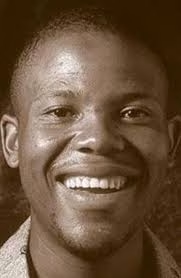
To his bandmates he was simply Moss. To South African jazz lovers and critics alike, he was one of the finest young voices the country had ever produced on a saxophone. Moses Khumalo did not have a sprawling social media presence or a celebrity brand. What he had was tone — a sound so distinctly his own that, according to Bassline venue owner Brad Holmes, a journalist from the London Times once watched him play and declared that a new Basil Coetzee had been born.
That is not a small thing to say about a man still in his twenties.
Moses Khumalo was a South African jazz saxophonist from Meadowlands, Soweto, whose brief career produced two studio albums, a South African Music Award, and one of the most quietly devastating tribute compositions in local jazz history. He died on 4 September 2006 at just 27 years old. He left behind music that still breathes.
Important note for readers: Moses Khumalo the saxophonist should not be confused with Moses Taiwa Molelekwa, the celebrated South African jazz pianist who was Khumalo’s mentor and artistic inspiration. The two were distinct artists, though their lives were bound together by music, mentorship, and ultimately by tragedy.
Early Life & Background
Moses Khumalo, the son of Pauline and John Khumalo, was born in Soweto on 30 January 1979. He grew up in Meadowlands, one of Soweto’s older residential neighbourhoods, in a country that was still, for much of his childhood, under apartheid. The cultural soil of Soweto, however, was extraordinarily rich — this was the township that had produced Hugh Masekela, Miriam Makeba, and a lineage of jazz musicians who used music as both protest and prayer. For a boy growing up in that environment, the music was never far away.
Khumalo attended Thobeka Primary School and completed his matric at Pace Community College in 1993. He then enrolled at Manu Technical College, where his formal musical education began. During his first year at Manu, he studied piano, and in February 1995 he took up his primary instrument — the saxophone. That switch would define everything that followed.
The saxophone chose him as much as he chose it. Within months of picking up the instrument, he was performing publicly. His first public performance was at the Grahamstown National Arts Festival in 1995, alongside the Soweto Youth Jazz Band. He was sixteen years old. He would go on to earn a diploma in music theory, music history, oral studies including songwriting and ensemble work, as well as performance in both saxophone and piano.
Moses Khumalo Biography: Rise Through the Ranks of South African Jazz
The turning point in the Moses Khumalo biography came when he joined the band of Moses Taiwa Molelekwa, widely regarded as one of the greatest jazz pianists South Africa had ever produced. Molelekwa was already a giant: by 1996 he had gained widespread attention as a solo artist, winning two FNB South African Music Awards for traditional jazz, and was heralded as the successor to the great Marabi piano tradition, following in the footsteps of Abdullah Ibrahim.
For young Moss, playing alongside Molelekwa was an apprenticeship inside a masterclass. Brad Holmes, director of Newtown’s Bassline venue, recalled meeting Khumalo during this period. “I met him in 1996. He was still very young. He came to our jam sessions. He and Moses Molelekwa entertained us a lot. When they played, everybody listened,” Holmes said.
As a member of Molelekwa’s band, Khumalo rose through the ranks of the South African jazz scene, performing both locally and abroad. He shared the stage with stars such as Hugh Masekela, Sibongile Khumalo, Themba Mkhize and Paul Hanmer, and played alongside many other renowned South African musicians, including Khaya Mahlangu, Vusi Khumalo and Prince Lengoasa.
Then, in February 2001, Moses Taiwa Molelekwa died by suicide. The loss was seismic for the South African jazz community. For Khumalo, it was the loss of a mentor, a musical father figure, and a namesake. After Molelekwa’s death, Khumalo signed a solo deal with Sheer Sound. What he did next revealed the depth of his artistry.
His debut album, Mntungwa, was released in 2002 and stands as one of the most emotionally layered debut recordings in South African jazz. The tracklist tells its own story: among songs like Township Tempo, Celebrate Mzansi, and Kgotso Africa sits a track titled “Hymn for Taiwa” — a heartfelt, soul-stirring homage to his mentor and namesake Moses Taiwa Molelekwa. It was Khumalo the composer speaking directly, saying in music what grief resists in words: thank you, I learned from you, I carry you forward. Allaboutjazz.com described the album as “noteworthy jazz under the leadership of a mercurially talented fellow.”
The album earned Khumalo the best newcomer trophy at the 2003 South African Music Awards. He was 24 years old.
His second album, Ibuyile, followed in 2005. Sheer Sound described it as “a fantastically spiced and flavourful Afro-jazz album with pop elements,” signalling that Khumalo was not content to be defined by any single sound. He was pushing toward something broader, something that could hold both the intimacy of a jazz club and the energy of a township street corner.
Before his death, he had been performing as part of Moses Khumalo and Friends at clubs in and around Johannesburg.
Personal Life, Relationships & Tragedy
The details of Moses Khumalo’s private life were never widely reported during his lifetime — he was known for his music far more than for any tabloid presence. He had been living by himself in Honeydew, west of Johannesburg.
On the evening of 4 September 2006, Khumalo was found by his girlfriend, who last saw him on Friday, hanging by a rope in his townhouse at Durbanville Complex in Honeydew. West Rand police confirmed they opened a case of suicide. No note was left behind.
The tragedy was eerily parallel to that of his mentor: Khumalo’s death was strikingly similar to that of Moses Molelekwa, who had also died by suicide five years earlier. Two Moses’s. Two extraordinary musicians. Two lives cut short in almost identical circumstances. The South African jazz world was stunned.
Sheer Sound released a statement saying: “His prominence in jazz circles came at an early age and he always had a spark of energy and drive. He defied the myth that this beautiful art form was only meant for the consumption of the very old-timers. His enthusiasm was contagious and his drive had allowed him to come through many tough times.”
Public Image & Cultural Identity
Moses Khumalo was, above everything, a musician’s musician. His public profile was built in clubs and on festival stages rather than in celebrity columns. As a composer, musician and songwriter, Khumalo was regarded as one of South Africa’s finest developing artists.
What made him distinctive was tone. Holmes articulated it simply and perfectly: most importantly for a musician, Khumalo had his own tone. In jazz, tone is identity. It is the thing that separates a technician from an artist. Khumalo, by his mid-twenties, already had it.
He embodied a particular strand of Soweto cultural identity: deeply rooted in the township jazz tradition, trained enough to hold his own in formal settings, but never losing the street-level warmth that made people feel the music rather than just hear it. He performed not as a showman but as a communicator — someone who had something to say and chose the saxophone as his language.
Legacy & Why Moses Khumalo Is a Big Deal
Here is why Moses Khumalo matters, for anyone who has not heard his name: he was a young Black man from Soweto who walked into one of South Africa’s most demanding and historically rich musical traditions and was immediately recognised by its greatest players as a peer. He shared stages with Hugh Masekela. He earned the endorsement of jazz venues and international press. He won a SAMA. And he composed “Hymn for Taiwa” — a piece that demonstrates not just technical ability but emotional intelligence of the highest order.
Khumalo had been dubbed “one of South Africa’s most promising young saxophonists.” The tragedy is not only that he died young, but that the work he was clearly building toward — a body of music that would have deepened with every year — never arrived.
His legacy sits at the intersection of grief and inspiration. He is a reminder that South African jazz has always produced artists of world-class stature, and that the country does not always give them the time or conditions to fully bloom. He is also a reminder that musicians carry their influences not just in their technique but in their compositions. “Hymn for Taiwa” is Khumalo saying that Moses Molelekwa mattered. That act of artistic gratitude is itself a kind of legacy.
Giving Back: Humanitarian Work
Moses Khumalo’s career was too brief and too focused on his music for any formal humanitarian work to have been established or publicly recorded. What he gave back was his art: music rooted in Soweto, performed in Johannesburg clubs, that carried the township’s spirit to international ears. As of his death in 2006, no foundation or charity work had been formally documented, though his investment in the South African jazz scene — performing, mentoring, and keeping the tradition alive at Bassline and other venues — was itself a form of cultural stewardship.
Death, the Name, and the Uncanny Synchronicity
There is a thread running through the story of Moses Khumalo that goes beyond biography. It touches something older, stranger, and harder to explain in purely factual terms. It is a thread woven from a shared name, a shared fate, and a silence where music should have been.
Begin with the most haunting fact: both men named Moses in this story died by hanging, alone, in the same city, five years apart. Moses Taiwa Molelekwa was found hanged on 13 February 2001, with his wife Florence Mtoba lying strangled nearby. The circumstances of their deaths were never fully resolved, and as News24 later reported, the case remains unsolved, and the mystery surrounding the circumstances still casts a dark cloud over his short life. Five years later, Moses Khumalo was found hanging by a rope in his townhouse in Honeydew. The tragedy was eerily similar to that of his mentor and namesake. Two Moseses. Two hangings. Both jazz musicians of extraordinary promise. Both gone before 30.
The South African jazz community felt this as more than coincidence. It felt like a pattern. A curse. A frequency.
Quick Facts
| Full Name | Moses Khumalo |
| Date of Birth | 30 January 1979 |
| Date of Death | 4 September 2006 |
| Birthplace | Meadowlands, Soweto, South Africa |
| Nationality | South African |
| Profession | Jazz saxophonist, composer, musician |
| Known Aliases | Moss |
| Instruments | Saxophone (primary), Piano |
| Record Label | Sheer Sound |
| Education | Pace Community College (matric); Manu Technical College (diploma, 1994–1998) |
| Discography | Mntungwa (2002), Ibuyile (2005) |
| Awards | SAMA Best Newcomer (2003) |
| Mentor | Moses Taiwa Molelekwa (pianist) |
| Notable Collaborators | Hugh Masekela, Sibongile Khumalo, Paul Hanmer, Themba Mkhize, Khaya Mahlangu |
| Net Worth | Not publicly recorded |
| Marital Status | Not married; was in a relationship at the time of his death |
Moses Khumalo lived 27 years and left behind two albums, a SAMA, and a piece of music — “Hymn for Taiwa” — that captures what it means to love a mentor enough to turn that love into art. He was not yet finished. That is the hardest part to sit with.
But perhaps the real question is not what Moses Khumalo achieved in the years he had, but what those years reveal about how South Africa treats its most gifted creative voices — and whether we are, even now, creating the conditions for the next Moss to survive long enough to show us everything he has.
Note: This article deals with the subject of suicide. If you or someone you know is struggling, please reach out to the South African Depression and Anxiety Group (SADAG) on their 24-hour helpline: 0800 456 789, or SMS 31393.