
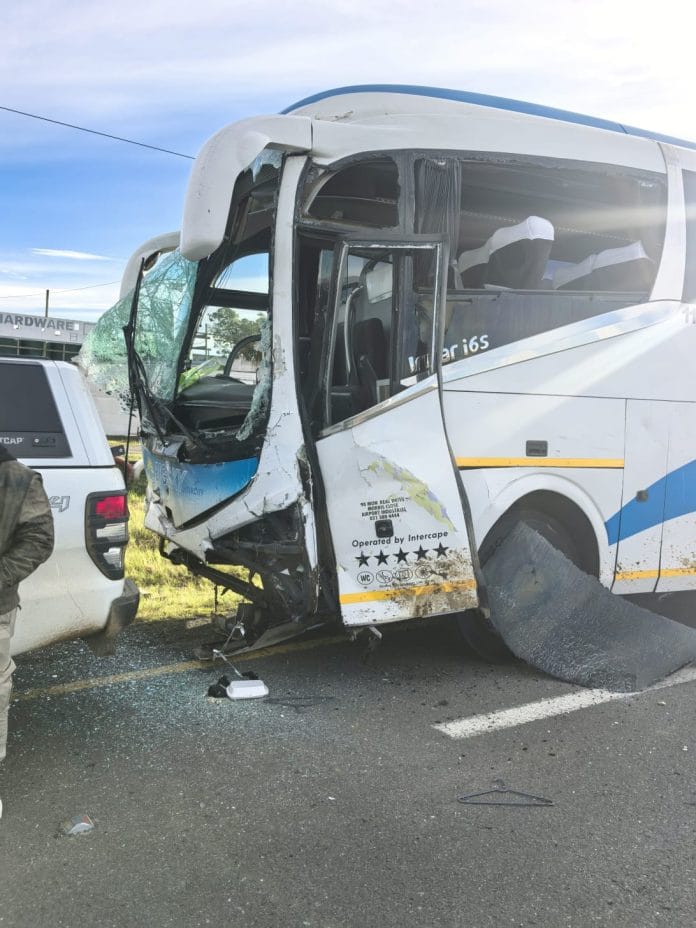
EASTERN CAPE – The death toll from a horrific N2 bus crash in the Eastern Cape has risen to five, with multiple others injured in what authorities are describing as one of the province’s deadliest road accidents in recent months. The collision between a passenger bus and a bakkie occurred on the N2 highway, a critical arterial route connecting the Eastern Cape to other provinces and serving as a lifeline for thousands of commuters daily.
Emergency services and traffic authorities have confirmed that the accident involved a bus carrying an estimated 30 to 40 passengers and a light delivery vehicle. The crash has once again thrust South Africa’s deteriorating road safety record into the spotlight, with the country consistently ranking among the world’s most dangerous for motorists.
Details of the Fatal N2 Bus Crash Emerge
According to the Eastern Cape Department of Transport, the collision occurred during the early morning hours when both vehicles were travelling in opposite directions on the N2. Preliminary investigations suggest that one of the vehicles may have veered into the oncoming lane, though the exact cause remains under investigation by traffic authorities and the South African Police Service.
The bus, operated by a regional transport company, was reportedly travelling from the Eastern Cape towards the Western Cape when the collision occurred. Witnesses at the scene described a chaotic aftermath, with debris scattered across both lanes of the highway and emergency responders working frantically to extract trapped passengers from the wreckage.
“We received the distress call at approximately 05:30 and immediately dispatched multiple ambulances and rescue vehicles to the scene,” said a spokesperson for the provincial emergency medical services. “Upon arrival, we found multiple casualties, with some passengers trapped inside the bus. Our teams worked alongside fire and rescue services to extract victims and provide emergency medical care.”
The injured passengers, numbering at least 15 according to initial reports, were transported to nearby hospitals including Livingstone Hospital in Gqeberha and smaller facilities closer to the accident scene. Several remain in critical condition, and authorities have warned that the death toll may still rise.
Eastern Cape’s Troubling Road Safety Record
The N2 bus crash adds to the Eastern Cape’s alarming road accident statistics, which have been escalating over the past several years. The province consistently records some of the highest road fatality rates in South Africa, with the N2 highway being a particular hotspot for serious accidents.
According to the Road Traffic Management Corporation’s latest annual report, the Eastern Cape recorded over 1,800 road fatalities in the previous reporting period, representing approximately 14% of the national total. The N2, which stretches over 2,000 kilometres from Cape Town to Ermelo, accounts for a disproportionate number of these deaths.
Road safety experts attribute the Eastern Cape’s poor record to several factors, including inadequate road maintenance, poorly lit highways, a lack of visible law enforcement, and high levels of driver fatigue among long-distance commercial vehicle operators. The province’s rural nature and long distances between major centres also mean that when accidents do occur, emergency response times are often prolonged, potentially contributing to higher fatality rates.
National Crisis: South Africa’s Road Safety Challenge
The latest N2 bus crash underscores a national crisis that claims thousands of South African lives annually. According to World Health Organization data, South Africa has one of the highest road traffic death rates globally, with approximately 25.9 deaths per 100,000 population – substantially higher than the global average of 16.7 per 100,000.
Transport Minister Sindisiwe Chikunga has repeatedly called for enhanced road safety measures, including stricter enforcement of traffic laws, improved vehicle roadworthiness testing, and comprehensive driver education programmes. However, implementation has been inconsistent across provinces, with budget constraints and capacity challenges hampering progress.
The festive season and long weekends typically see spikes in road fatalities, prompting authorities to deploy additional traffic officers and launch awareness campaigns. Yet the problem persists throughout the year, with commercial transport accidents involving buses and taxis being particularly deadly due to the high passenger numbers involved.
“Every single road death is preventable,” said a road safety advocate from the Automobile Association of South Africa. “We have the knowledge, the technology, and the legal frameworks needed to reduce fatalities dramatically. What we lack is the political will and resources to implement these measures consistently and comprehensively.”
Bus Safety Standards Under Scrutiny
Following the N2 bus crash, questions are being raised about the safety standards and regulatory oversight of South Africa’s bus industry. The country’s passenger bus fleet includes vehicles of varying ages and conditions, from modern, well-maintained coaches to ageing buses that may not meet contemporary safety standards.
The National Land Transport Act requires all public transport vehicles to undergo regular roadworthiness inspections and operators to maintain valid operating licences. However, enforcement of these regulations has been criticised as inconsistent, with some operators allegedly continuing to run services with vehicles that should have been taken off the road.
Key safety concerns in South Africa’s bus industry include:
- Inadequate maintenance schedules and poor record-keeping by some operators
- Driver fatigue due to excessive working hours and insufficient rest periods
- Lack of mandatory safety technologies such as electronic stability control and collision avoidance systems
- Insufficient driver training, particularly for defensive driving and emergency response
- Overloading of passengers beyond the vehicle’s certified capacity
- Operating licences granted without rigorous safety assessments
According to BBC reporting on African transport safety, commercial vehicle accidents account for a disproportionate number of road fatalities across the continent, with buses and minibus taxis being involved in some of the deadliest incidents.
Transport economist Dr. Thabo Molefi from the University of Johannesburg explained: “The bus industry operates under significant economic pressure, with thin profit margins and intense competition. This can create perverse incentives where safety takes a back seat to cost-cutting. We need a regulatory environment that ensures safety compliance is non-negotiable, with meaningful penalties for violations that actually deter unsafe practices.”
Community Impact and Government Response
The human toll of the N2 bus crash extends far beyond the immediate victims. Families have been left devastated, with many rushing to hospitals to check on loved ones. Community organisations in the Eastern Cape have mobilised to provide support to affected families, many of whom face not only emotional trauma but also financial hardship from medical expenses and funeral costs.
The Eastern Cape provincial government has promised a full investigation into the circumstances surrounding the accident. Premier Oscar Mabuyane expressed his condolences to the bereaved families and pledged that authorities would leave no stone unturned in determining the cause of the crash and holding any responsible parties accountable.
“We cannot continue to lose precious lives on our roads,” Mabuyane stated in a press release. “This tragedy demands not just our sympathy but concrete action. We will be reviewing our road safety strategies and working with law enforcement to ensure that our highways are safe for all users.”
The South African Police Service has opened a culpable homicide investigation, standard procedure for fatal road accidents. Investigators will examine multiple factors including vehicle condition, driver fitness and qualifications, road conditions, visibility, and whether any traffic violations contributed to the collision.
For more context on road safety issues in South Africa, visit our comprehensive coverage at NeoScribe SA News.
Calls for Urgent Road Safety Intervention
Road safety advocacy groups are using the N2 bus crash as a rallying point to demand urgent government intervention. The Justice Project South Africa has called for an emergency road safety summit involving all stakeholders, including transport operators, vehicle manufacturers, law enforcement, and civil society organisations.
“We’ve been having the same conversations for years while the body count continues to rise,” said a spokesperson for the organisation. “South Africans deserve roads where they can travel without fearing for their lives. This requires investment in infrastructure, technology, enforcement, and a fundamental shift in how we approach road safety as a society.”
Specific interventions being proposed include:
- Mandatory installation of speed limiters and GPS tracking on all commercial vehicles
- Implementation of point-demerit systems for traffic violations with automatic licence suspension
- Increased visible policing on high-risk routes including the N2
- Road infrastructure improvements including better lighting, clearer signage, and barrier installations
- Stricter penalties for operators who allow unroadworthy vehicles on the road
- Public awareness campaigns targeting driver behaviour and pedestrian safety
- Emergency response capacity enhancement in rural areas
According to research published by the Reuters African desk, countries that have successfully reduced road fatalities have typically implemented comprehensive, multi-faceted approaches combining engineering solutions, enforcement, and education – the so-called “three E’s” of road safety.
Sweden’s “Vision Zero” approach, which aims to eliminate all traffic fatalities and serious injuries, has been held up as a model that could be adapted for South African conditions. The strategy involves designing roads to account for human error and vulnerability, rather than simply placing all responsibility on driver behaviour.
As investigations into the N2 bus crash continue, the incident serves as a stark reminder of the fragility of life on South Africa’s roads and the urgent need for systematic interventions that go beyond reactive responses to individual tragedies. For the families of the five victims, no investigation or policy change can undo their loss, but ensuring that such accidents become increasingly rare would represent a meaningful legacy.
The coming weeks will reveal more details about what caused this particular collision, but the broader pattern is already clear: South Africa’s roads are claiming too many lives, and only sustained, comprehensive action can reverse this deadly trend.

