
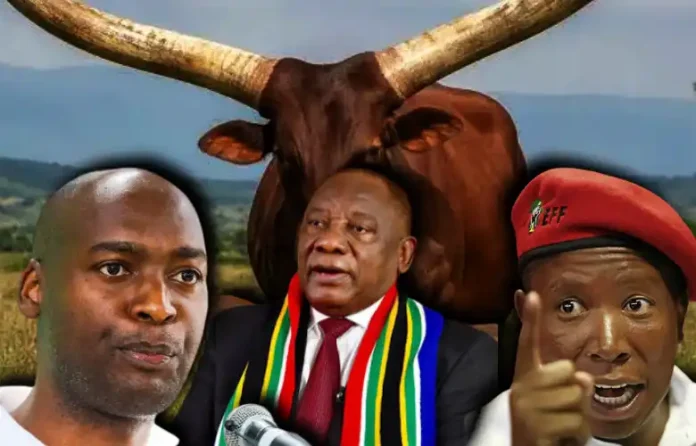
CAPE TOWN – President Cyril Ramaphosa has launched an urgent legal bid to halt impeachment proceedings against him, filing court papers that seek to interdict the beginning of what would be South Africa’s first-ever presidential impeachment process. The Ramaphosa impeachment interdict application has thrust the country into uncharted constitutional territory, with legal experts divided on the merits of the president’s challenge and the potential implications for South Africa’s democratic institutions.
The unprecedented legal manoeuvre comes as tensions between the executive and legislative branches of government reach a critical juncture, with Parliament poised to initiate formal impeachment proceedings stemming from allegations related to the Phala Phala farm scandal. Ramaphosa’s legal team argues that the process is fundamentally flawed and unconstitutional, setting the stage for a high-stakes courtroom battle that could define the boundaries of presidential accountability in South Africa’s constitutional democracy.
Legal Grounds for the Impeachment Interdict
According to sources familiar with the court application, Ramaphosa’s legal team has advanced several key arguments in support of the Ramaphosa impeachment interdict. The papers reportedly challenge the procedural validity of the parliamentary process, arguing that the National Assembly has not followed constitutionally mandated procedures for initiating impeachment proceedings against a sitting president.
Constitutional law expert Professor Pierre de Vos from the University of Cape Town noted that the legal challenge raises fundamental questions about the separation of powers. “The president is essentially asking the courts to scrutinise Parliament’s internal processes, which traditionally have been considered beyond judicial review,” De Vos explained to BBC News. “This creates a constitutional tension between parliamentary sovereignty and judicial oversight.”
The interdict application specifically targets several procedural aspects:
- The composition and impartiality of the Section 89 independent panel that initially investigated the Phala Phala allegations
- Alleged irregularities in how evidence was gathered and presented to Parliament
- Questions about whether proper legal thresholds for impeachment have been met
- Concerns about potential political motivation behind the impeachment drive
- Arguments that the president was not afforded adequate opportunity to respond to allegations
Legal analysts suggest that Ramaphosa’s strategy appears designed to delay proceedings while challenging the foundational legitimacy of the impeachment process itself. The approach mirrors legal tactics employed in other jurisdictions where executives have faced removal proceedings, though South Africa’s specific constitutional framework presents unique challenges and opportunities for both sides.
Parliamentary Response and Constitutional Implications
Parliament’s leadership has responded cautiously to the Ramaphosa impeachment interdict, with National Assembly Speaker Nosiviwe Mapisa-Nqakula indicating that the institution would robustly defend its constitutional prerogatives. In a statement released through Parliament’s communications office, Mapisa-Nqakula emphasised that the National Assembly has a constitutional obligation to hold the executive accountable, including through impeachment when warranted.
“Parliament cannot and will not be intimidated in the execution of its constitutional mandate,” the statement read. “We are confident that our processes have been conducted in accordance with the Constitution and applicable legislation. We will vigorously oppose any attempt to undermine parliamentary sovereignty through litigation.”
The standoff has created a constitutional dilemma that South Africa’s courts have never before confronted. Section 89 of the Constitution provides for the removal of a president on grounds of serious violation of the Constitution or law, serious misconduct, or inability to perform the functions of office. However, the Constitution provides limited guidance on the specific procedures Parliament must follow, creating interpretive space that both sides are now exploiting.
Political analyst Dr Somadoda Fikeni from the University of South Africa suggested that the legal challenge reflects deeper tensions within the governing African National Congress (ANC). “This is not just a legal battle; it’s a proxy war for control of the ANC and, by extension, the state,” Fikeni told Reuters. “Ramaphosa is fighting for his political survival, and he’s using every tool at his disposal, including the courts.”
The Phala Phala Scandal Background
The impeachment proceedings stem from the controversial Phala Phala farm incident, in which a substantial sum of foreign currency was allegedly stolen from Ramaphosa’s private game farm in Limpopo province in February 2020. The scandal erupted into public view in June 2022 when former State Security Agency director-general Arthur Fraser laid criminal charges against the president, alleging money laundering, corruption, and failure to report a crime.
The controversy centres on questions about the source of the money, why it was kept in cash at the farm, and whether proper procedures were followed in investigating the theft. Ramaphosa has maintained that the funds—estimated at $580,000—represented proceeds from legitimate sale of buffalo to a Sudanese buyer, and that the matter was being handled through appropriate channels.
However, an independent panel chaired by former Chief Justice Sandile Ngcobo found in December 2022 that there was prima facie evidence that Ramaphosa may have violated the Constitution and his oath of office. The panel’s findings created the constitutional pathway for impeachment proceedings, which Parliament subsequently voted to pursue before Ramaphosa survived a crucial ANC internal challenge at the party’s national conference.
The Ramaphosa impeachment interdict application now seeks to unravel that process, arguing that the panel’s work was legally defective and that Parliament cannot rely on fundamentally flawed findings as the basis for impeachment. Legal sources indicate that the court papers run to several hundred pages and include affidavits from constitutional law experts supporting the president’s position.
International Precedents and South African Exceptionalism
Ramaphosa’s legal strategy draws on international precedents where executives have challenged impeachment proceedings through the courts, though with mixed results. In Brazil, former President Dilma Rousseff unsuccessfully challenged her 2016 impeachment in the courts, with judges ruling that they could not interfere with a fundamentally political process. Similarly, attempts by former South Korean President Park Geun-hye to halt her impeachment through litigation proved unsuccessful.
However, South Africa’s constitutional framework differs significantly from these jurisdictions. The country’s Constitution is widely regarded as one of the most progressive and judicially enforceable in the world, with courts having demonstrated willingness to scrutinise executive and legislative actions for constitutional compliance. The Constitutional Court’s landmark 2016 ruling that then-President Jacob Zuma had violated the Constitution in the Nkandla matter established important precedents for presidential accountability.
“South Africa’s courts have shown they are not afraid to hold political power to account,” noted Professor Shadrack Gutto from the Centre for African Renaissance Studies. “The question is whether they will see impeachment as a purely political process beyond their jurisdiction, or whether they will scrutinise Parliament’s procedures for constitutional compliance. The answer will have profound implications for our democracy.”
International observers are closely watching the case as a test of South Africa’s democratic institutions. Al Jazeera reported that diplomatic sources from Western capitals view the legal challenge as both a positive demonstration of judicial independence and a concerning potential for executive overreach in constraining legislative accountability mechanisms.
Political Ramifications and Party Dynamics
The Ramaphosa impeachment interdict has intensified factional battles within the ANC, with different party groupings interpreting the legal move through starkly different lenses. Supporters of the president argue that he is defending the integrity of constitutional processes against a politically motivated witch-hunt orchestrated by rivals aligned with former President Jacob Zuma and the so-called Radical Economic Transformation (RET) faction.
Conversely, critics within the party contend that Ramaphosa is using his access to expensive legal representation and state resources to evade accountability that ordinary South Africans could never escape. This narrative has gained traction particularly among party members who feel that the president has failed to deliver on promises of economic transformation and has instead prioritised macroeconomic stability at the expense of redistribution.
The opposition Economic Freedom Fighters (EFF) and Democratic Alliance (DA) have adopted contrasting positions on the impeachment effort, with the EFF supporting the process as necessary accountability and the DA largely backing Ramaphosa as a bulwark against what they characterise as more destructive alternatives. This unusual alignment has created strange political bedfellows and complicated the parliamentary arithmetic surrounding any potential impeachment vote.
For comprehensive coverage of South African political developments, visit our SA News section.
What Happens Next: Timeline and Scenarios
The immediate focus now shifts to the courts, where the application for the Ramaphosa impeachment interdict will likely be heard on an urgent basis given the constitutional significance of the matter. Legal experts anticipate that whichever way the initial court rules, the matter will almost certainly be appealed to the Constitutional Court, South Africa’s highest judicial authority on constitutional matters.
Several possible scenarios now emerge:
- Interdict granted: If courts halt the impeachment process, Parliament would be blocked from proceeding unless and until the underlying constitutional issues are resolved through litigation, potentially taking months or years.
- Interdict denied: Parliamentary proceedings would continue, potentially leading to a full impeachment vote requiring a two-thirds majority in the National Assembly to remove Ramaphosa from office.
- Partial relief: Courts might grant limited relief, requiring Parliament to correct specific procedural defects while allowing the broader impeachment process to continue with modifications.
- Constitutional Court referral: Lower courts might refer the matter directly to the Constitutional Court given its significance, accelerating the ultimate resolution but extending the period of uncertainty.
Market analysts note that the political uncertainty is already affecting investor confidence, with the rand experiencing volatility and business confidence indices showing concern about political stability. Economic research firm Intellidex reported that foreign direct investment decisions are being delayed pending clarity on the political situation, potentially costing South Africa billions in lost investment opportunities at a time when economic growth remains anaemic.
“Political stability is a prerequisite for economic confidence,” explained economist Azar Jammine. “This kind of high-level constitutional uncertainty creates exactly the environment that makes investors nervous about committing capital to South Africa. We can ill afford this distraction when we should be focusing on structural economic reforms.”
Constitutional Democracy at a Crossroads
Beyond the immediate political implications, the Ramaphosa impeachment interdict case will likely establish important constitutional precedents about the relationship between South Africa’s branches of government. At stake are fundamental questions about the limits of parliamentary power, the scope of judicial review, and the mechanisms through which political leaders can be held accountable in a constitutional democracy.
Constitutional scholars note that South Africa’s relatively young democracy—now three decades old—is still developing the conventions and precedents that guide established democracies. The impeachment question represents uncharted territory that will test the robustness of the constitutional settlement reached in the negotiations that ended apartheid.
“Every constitutional democracy eventually faces these moments where the system is tested,” observed Professor Thuli Madonsela, former Public Protector and current law professor. “How we navigate this challenge will say a great deal about the maturity of our institutions and our collective commitment to constitutionalism over political expediency.”
The outcome may ultimately depend on how courts balance competing constitutional values: parliamentary sovereignty and accountability on one hand, and procedural fairness and executive stability on the other. The judicial reasoning in whatever decision emerges will likely be scrutinised for generations as South African constitutional law continues to evolve.
As the legal battle unfolds, South Africans across the political spectrum are watching closely, aware that the resolution of this crisis will shape not only Ramaphosa’s political fate but the fundamental architecture of accountability in their democracy. The coming weeks and months will reveal whether South Africa’s constitutional framework is sufficiently robust to navigate this unprecedented challenge while maintaining both the rule of law and democratic legitimacy.
The international community, meanwhile, observes with keen interest how one of Africa’s most important democracies handles this constitutional stress test, with implications that extend far beyond South Africa’s borders to questions of democratic governance across the continent and in developing democracies worldwide.

