

PRETORIA – The South African Department of Employment and Labour has announced an intensified undocumented workers crackdown, signalling a dramatic shift in enforcement policy as the country grapples with unemployment rates exceeding 32% and mounting tensions over irregular migration. The initiative, which comes amid growing public pressure and political debate, will see labour inspectors conducting unannounced workplace raids and imposing severe penalties on employers who circumvent immigration and labour laws.
The announcement represents one of the most significant enforcement campaigns in recent years, targeting industries where undocumented employment has become endemic. With South Africa’s unemployment crisis deepening and youth joblessness approaching 60%, the government faces increasing demands from labour unions, community organisations, and political parties to prioritise jobs for South African citizens and legal residents.
Scope and Scale of the Enforcement Initiative
The Labour Department’s undocumented workers crackdown will deploy teams of inspectors across multiple provinces, focusing initially on Gauteng, Western Cape, and KwaZulu-Natal where concentrations of undocumented employment are highest. According to departmental sources, the operation will target sectors including construction, agriculture, hospitality, manufacturing, and retail – industries where exploitation of undocumented workers has been most prevalent.
Labour Minister Thulas Nxesi outlined the enforcement strategy during a media briefing, emphasising that the initiative goes beyond immigration control to address broader labour market distortions. “Employers who hire undocumented workers undermine our labour laws, suppress wages for all workers, avoid paying proper taxes and contributions, and deprive South African citizens of employment opportunities,” Nxesi stated.
The crackdown will involve collaboration between the Department of Employment and Labour, the Department of Home Affairs, the South African Police Service, and the South African Revenue Service. This multi-agency approach aims to address not only immigration violations but also tax evasion, non-compliance with Unemployment Insurance Fund (UIF) and compensation fund requirements, and violations of occupational health and safety standards.
- Unannounced workplace inspections across targeted industries
- Verification of employment documentation and work permits
- Investigations into labour brokers and recruitment agencies
- Penalties including fines up to R300,000 and potential criminal prosecution
- Business closure orders for repeat offenders
- Coordination with Home Affairs for deportation proceedings
According to BBC reporting on South African labour issues, the country hosts an estimated 2-5 million undocumented migrants, though precise figures remain contested. Many work in precarious conditions, receiving wages below legal minimums and without access to labour protections or social security benefits.
Economic and Labour Market Context
The undocumented workers crackdown emerges against a backdrop of severe economic challenges. South Africa’s official unemployment rate stands at 32.1% according to Statistics South Africa’s latest quarterly labour force survey, with the expanded definition including discouraged work-seekers reaching 42.6%. Youth unemployment remains particularly acute, with nearly 60% of South Africans aged 15-24 unable to find work.
Labour economists present divergent views on how undocumented employment affects these statistics. Some argue that irregular migrants primarily fill positions that South Africans are unwilling to accept due to poor conditions and low wages, while others contend that the availability of exploitable undocumented workers depresses wages across entire sectors and reduces employment opportunities for citizens.
| Sector | Estimated Undocumented Workers | Impact on Wage Levels | Citizen Unemployment Rate |
|---|---|---|---|
| Construction | 18-22% | 15-25% wage suppression | 28% |
| Agriculture | 25-30% | 20-30% wage suppression | 32% |
| Hospitality | 12-18% | 10-18% wage suppression | 35% |
| Retail | 8-12% | 8-15% wage suppression | 30% |
| Manufacturing | 10-15% | 12-20% wage suppression | 26% |
Professor Collette Schulz-Herzenberg from Stellenbosch University’s School of Public Leadership notes that the undocumented workers issue intersects with broader governance failures. “The employment of undocumented workers thrives where regulatory enforcement is weak, where corruption facilitates document fraud, and where economic desperation on both sides – employers seeking cheap labour and migrants seeking survival – creates a shadow economy,” she explained.
The Congress of South African Trade Unions (COSATU) has welcomed the crackdown, arguing that undocumented employment represents unfair competition that undermines collective bargaining and workplace organisation. However, the federation has also called for simultaneous enforcement against exploitative labour practices affecting all workers, regardless of documentation status.
Legal Framework and Enforcement Mechanisms
The undocumented workers crackdown operates within a complex legal framework established by the Immigration Act of 2002, the Employment Services Act of 2014, and various sectoral determinations under the Basic Conditions of Employment Act. Current legislation makes it illegal for employers to hire foreign nationals without valid work authorisation, with penalties including fines and potential imprisonment.
Section 38 of the Immigration Act specifically prohibits employment of illegal foreigners and establishes penalty provisions. The Act empowers labour inspectors to demand production of identity documents, work permits, and employment contracts during workplace inspections. Employers found in violation face administrative penalties, criminal prosecution, and potential business closure.
Immigration attorney Sarah Mokwena from the African Centre for Migration & Society highlights implementation challenges. “The legal framework exists, but enforcement has historically been sporadic and inconsistent. Many employers have operated with impunity for years, calculating that the risk of inspection and penalty was minimal compared to the cost savings from exploiting undocumented workers,” she said.
The Department of Home Affairs has committed to streamlining work permit processing to complement the enforcement initiative. Currently, delays in permit adjudication – sometimes extending to 18 months or longer – create situations where employers and workers operate in legal grey zones. Reforms aim to reduce processing times to 60 days for standard work permits while maintaining security and verification protocols.
According to Al Jazeera’s coverage of South African migration issues, neighbouring countries have expressed concern about potential mass deportations resulting from the crackdown. Regional diplomatic efforts are underway to establish bilateral labour migration agreements that would provide legal pathways for workers while ensuring compliance with South African labour standards.
Social and Political Dimensions
The undocumented workers crackdown unfolds against a politically charged backdrop of xenophobic violence, economic nationalism, and electoral pressures. Operation Dudula and similar community-based movements have gained prominence by demanding stricter immigration enforcement and prioritisation of citizens in employment, sometimes through controversial tactics including vigilante-style raids on businesses and informal settlements.
Political parties across the spectrum have adopted increasingly hardline positions on immigration and employment. The Economic Freedom Fighters (EFF), despite its pan-Africanist ideology, has faced internal tensions between solidarity with African migrants and constituent demands for employment preference. The Democratic Alliance has emphasised rule of law and proper immigration processing, while the African National Congress government faces pressure from both labour allies and community organisations.
Human rights organisations have raised concerns about the potential for the crackdown to fuel xenophobic sentiment and enable abuses. The South African Human Rights Commission has called for enforcement that respects human dignity and distinguishes between employers who exploit workers and the workers themselves, who are often victims of trafficking, fraud, or desperate circumstances.
- Establishment of worker assistance centres to process voluntary regularisation applications
- Protection protocols for undocumented workers who report labour rights violations
- Training for labour inspectors on human rights-compliant enforcement
- Community education programmes to counter xenophobic narratives
- Whistle-blower mechanisms for reporting exploitative employers
Dr. Loren Landau from the University of Johannesburg’s African Centre for Migration & Society warns against simplistic narratives. “The evidence doesn’t support claims that removing undocumented workers will automatically create jobs for South Africans. Many sectors depend on these workers because structural issues – education quality, geographic mismatches, reservation wages, and working conditions – prevent citizen employment. Without addressing these fundamentals, enforcement alone will disrupt economic activity without solving unemployment.”
Research from the Southern African Migration Programme indicates that many undocumented workers in South Africa are entrepreneurial, creating economic activity rather than simply displacing citizens. The informal economy, where documentation status is most fluid, generates livelihoods for millions and provides essential services in under-served communities.
Implementation Challenges and Practical Realities
The Labour Department faces substantial operational challenges in implementing the undocumented workers crackdown at scale. With approximately 1,200 labour inspectors responsible for monitoring compliance across millions of workplaces nationwide, resource constraints limit enforcement capacity. The department has requested additional budget allocations and plans to recruit 500 additional inspectors over the next fiscal year.
Corruption represents another significant obstacle. Previous enforcement campaigns have been undermined by inspectors accepting bribes, employers receiving advance warning of inspections, and document fraud networks providing counterfeit work permits. The current initiative includes integrity measures such as randomised inspection assignments, body cameras for inspectors, and oversight mechanisms to detect corruption patterns.
Industry associations have expressed mixed reactions to the crackdown. AgriSA, representing commercial farmers, acknowledged the need for compliance but warned that sudden enforcement without transition periods could devastate agricultural operations during critical planting and harvesting seasons. The association has requested a phased implementation with opportunities for employers to regularise workers’ status before facing penalties.
According to Reuters reporting on African economic developments, South Africa’s enforcement approach contrasts with regularisation programmes implemented in countries like Portugal and Spain, which offered pathways to legal status for undocumented workers during labour shortages. Some economists advocate for sectoral work permit programmes that would legalise employment in industries facing genuine skills or labour shortages while ensuring compliance with wage and working condition standards.
The hospitality industry, still recovering from COVID-19 impacts, has lobbied for exemptions or grace periods. Tourism Business Council of South Africa CEO Tshifhiwa Tshivhengwa noted that many hotels and restaurants struggle to fill positions despite high unemployment, pointing to skills mismatches and geographic challenges. “We need enforcement that distinguishes between exploitation and legitimate employment where South African workers aren’t available or willing,” he argued.
Regional Implications and Cross-Border Dimensions
The undocumented workers crackdown has significant implications for regional labour migration patterns and Southern African Development Community (SADC) relations. South Africa has historically served as an economic magnet for workers from Zimbabwe, Mozambique, Lesotho, Malawi, and other neighbouring countries, many of whom face even more severe economic conditions at home.
Zimbabwe’s economic crisis has driven millions across the border, with estimates suggesting 1-3 million Zimbabweans currently in South Africa, many undocumented. Harare has expressed concern about the potential for mass deportations to overwhelm already strained social services and exacerbate economic instability. Similar concerns have been raised by Mozambican authorities.
SADC protocols on free movement of persons remain largely unimplemented, despite regional commitments to facilitate labour mobility. The African Continental Free Trade Area includes provisions for movement of business persons and workers, but member states have been reluctant to cede immigration control. South Africa’s enforcement approach may influence regional migration governance frameworks.
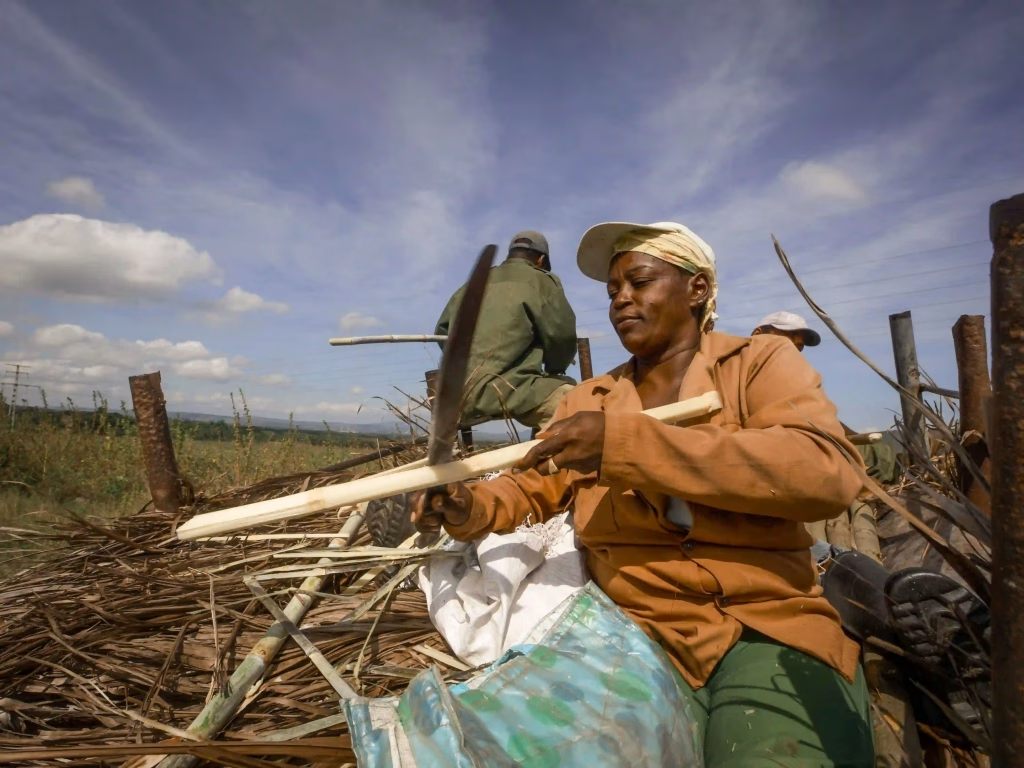
Remittances represent another critical dimension. Undocumented workers in South Africa send billions of rands annually to home countries, supporting families and contributing to economic stability in neighbouring states. Disruption of these flows through mass deportations could have cascading economic and social effects across the region.
International labour migration experts advocate for bilateral and multilateral agreements that would create legal pathways for workers while ensuring compliance with destination country labour standards. Such agreements could include portable social security benefits, skills recognition frameworks, and return and reintegration programmes. The current crackdown may create political pressure for such regional solutions.
Looking Ahead: Long-term Implications and Policy Directions
The undocumented workers crackdown represents more than an enforcement campaign; it reflects fundamental questions about South Africa’s economic model, regional relationships, and social compact. As the initiative unfolds over coming months, several scenarios may emerge depending on implementation approaches and stakeholder responses.
Optimistic projections suggest that consistent enforcement could level the playing field for compliant employers, reduce exploitation, increase tax and social security contributions, and create pressure for wage improvements in affected sectors. Combined with immigration reforms that provide legal pathways for needed workers, enforcement could evolve toward managed migration that serves economic needs while protecting workers’ rights.
Pessimistic scenarios warn of economic disruption in sectors dependent on undocumented labour,

