
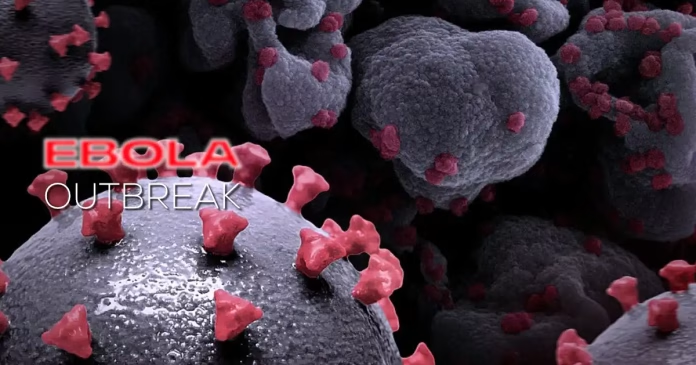
KINSHASA – The Democratic Republic of Congo Ebola outbreak has reached a critical threshold with 550 confirmed cases and 101 deaths, according to the latest World Health Organization (WHO) situation report. This alarming escalation in one of Africa’s most vulnerable health environments has triggered continent-wide concern, particularly among Southern African health authorities monitoring potential cross-border transmission routes that could affect regional stability and public health security.
The resurgence of Ebola in the DRC represents not merely a localized health emergency but a stark reminder of systemic vulnerabilities that plague healthcare infrastructure across developing nations. For South Africa, which maintains significant economic, diplomatic, and migration ties with Central Africa, the outbreak demands careful attention and proactive preparedness measures within the Southern African Development Community (SADC) framework.
Understanding the Current DRC Ebola Outbreak Trajectory
The current DRC Ebola outbreak, concentrated primarily in the eastern provinces of North Kivu and Ituri, has developed within a complex humanitarian context characterized by armed conflict, population displacement, and fragmented health service delivery. According to WHO epidemiological data, the case fatality rate currently stands at approximately 18.4%, significantly lower than historical Ebola outbreaks that have reached mortality rates exceeding 50% in previous episodes.
This relatively lower fatality rate reflects improved clinical management protocols, earlier case detection, and the deployment of therapeutic interventions including monoclonal antibody treatments and the rVSV-ZEBOV vaccine. However, health experts warn against complacency, noting that the outbreak’s geographic spread and the challenging security environment create conditions conducive to accelerated transmission.
Dr. Matshidiso Moeti, WHO Regional Director for Africa, emphasized in recent statements that “the DRC Ebola outbreak occurs in one of the world’s most complex emergency settings, where insecurity, population movement, and community mistrust create formidable barriers to effective outbreak response.” These contextual factors differentiate the current situation from contained laboratory environments where Ebola therapeutics show optimal efficacy.
| Outbreak Metric | Current Status | Comparative Context |
|---|---|---|
| Confirmed Cases | 550 | 2018-2020 DRC outbreak: 3,481 cases |
| Confirmed Deaths | 101 | 2018-2020 DRC outbreak: 2,299 deaths |
| Case Fatality Rate | 18.4% | Historical average: 50% |
| Geographic Spread | North Kivu, Ituri provinces | Previous: spread to Uganda, affecting 9 countries historically |
| Vaccinations Delivered | Estimated 180,000+ | Ring vaccination strategy deployed |
Cross-Border Transmission Risks for Southern Africa
While geographic distance provides some natural buffer between the DRC outbreak epicenter and South Africa, epidemiologists caution against dismissing transmission risks entirely. The contemporary African landscape features unprecedented population mobility driven by economic migration, cross-border trade, and displacement from conflict zones. South Africa, as the continent’s most industrialized economy, attracts significant migration flows from across the continent, including Central African nations.
The National Institute for Communicable Diseases (NICD) in South Africa has activated enhanced surveillance protocols at ports of entry, particularly OR Tambo International Airport, which receives regular flights from Central African hubs. Dr. Michelle Groome, Head of the NICD’s Division of Public Health Surveillance and Response, confirmed that thermal screening and traveler health declarations have been intensified for passengers originating from or transiting through DRC and neighboring countries.
Historical precedent demonstrates the realistic nature of these concerns. During the 2014-2016 West African Ebola epidemic—the largest in history with over 28,000 cases—the virus spread across multiple international borders, reaching Nigeria, Senegal, Mali, and eventually resulted in cases in Europe and North America. According to research published in the BBC Health section, inadequate initial response and delays in international mobilization contributed significantly to that outbreak’s catastrophic scale.
Key transmission risk factors relevant to Southern Africa include:
- Air travel connectivity between Kinshasa, Lubumbashi, and Johannesburg, Cape Town, and Durban
- Informal cross-border movement along the extensive land borders within SADC member states
- Mining sector employment patterns that involve significant Central African workforce participation
- Refugee and asylum-seeker populations from DRC residing throughout Southern Africa
- Trade corridor activity along transport routes connecting Central and Southern African economic zones
Healthcare Infrastructure Preparedness Challenges
The DRC Ebola outbreak exposes systemic vulnerabilities in African healthcare infrastructure that resonate with South Africa’s own public health challenges. Despite being Africa’s most developed healthcare system, South Africa’s public health sector struggles with resource constraints, infrastructure degradation, and human resource shortages that would be severely tested by a viral hemorrhagic fever outbreak requiring isolation facilities and specialized clinical protocols.
Provincial health departments across South Africa have conducted Ebola preparedness drills periodically since the 2014 West African epidemic, yet expert assessments reveal concerning gaps. A 2023 audit by the South African Medical Research Council identified that only 43% of designated isolation facilities at provincial hospitals met minimum standards for viral hemorrhagic fever management, with particular deficiencies noted in ventilation systems, waste management protocols, and availability of personal protective equipment stockpiles.
The Western Cape Department of Health has demonstrated relative preparedness leadership, establishing dedicated isolation units at Tygerberg Hospital and Groote Schuur Hospital with specialized training for clinical staff in Ebola case management. However, significant disparities exist between provinces, with rural and under-resourced regions—particularly in Eastern Cape, Limpopo, and parts of KwaZulu-Natal—facing substantial preparedness deficits.
For broader context on South African health system challenges, readers can explore additional analysis at NeoScribe’s SA News section, which provides ongoing coverage of public health infrastructure issues.
International Response and Coordination Mechanisms
The international health community’s response to the current DRC Ebola outbreak reflects lessons learned from previous epidemics, particularly the delayed mobilization that characterized early stages of the 2014-2016 West African crisis. WHO activated its Emergency Response Framework within weeks of outbreak confirmation, deploying technical experts, laboratory support, and coordination mechanisms to support DRC’s Ministry of Health.
The African Centres for Disease Control and Prevention (Africa CDC), established in 2017 partly in response to continental vulnerabilities exposed by Ebola, has coordinated regional surveillance enhancement and cross-border communication protocols. Director General Dr. Jean Kaseya emphasized that “African solutions to African health challenges” must prioritize continental capacity rather than dependence on external intervention, though international support remains essential for resource-constrained environments.
Vaccination campaigns utilizing the rVSV-ZEBOV vaccine—which demonstrated approximately 97.5% efficacy in clinical trials—have been deployed using ring vaccination strategies. This approach involves vaccinating confirmed cases’ contacts and contacts of contacts, creating protective immunological barriers around transmission chains. According to Reuters Africa reporting, over 180,000 vaccine doses have been administered in affected areas, though insecurity and community resistance have impeded optimal coverage in some localities.
Financing mechanisms for outbreak response continue to present challenges. The WHO’s Contingency Fund for Emergencies has allocated initial funding, while the World Bank’s Pandemic Emergency Financing Facility—though criticized for delayed activation during previous outbreaks—has been engaged. However, sustainable financing for health security infrastructure in fragile states like DRC remains inadequate relative to documented needs.
Lessons for South African Pandemic Preparedness
The DRC Ebola outbreak provides critical insights for South Africa’s own pandemic preparedness architecture, particularly following experiences during the COVID-19 pandemic that exposed both strengths and vulnerabilities in national health emergency response systems. The National Department of Health’s Disaster Management framework includes provisions for viral hemorrhagic fever outbreaks, yet implementation consistency across provinces remains problematic.
Key preparedness priorities that the DRC situation highlights include:
- Enhancement of laboratory diagnostic capacity for rapid pathogen identification at provincial level
- Standardization of isolation facility specifications and regular infrastructure audits
- Continuous training programs for healthcare workers in high-consequence infectious disease management
- Community engagement strategies to address misinformation and build trust in public health interventions
- Cross-border health security coordination through SADC health protocols
- Strategic stockpiling of personal protective equipment and clinical supplies
Professor Salim Abdool Karim, one of South Africa’s leading epidemiologists, has advocated for “proactive rather than reactive” approaches to emerging infectious disease threats, arguing that investments in surveillance, laboratory capacity, and rapid response capabilities deliver substantial returns by preventing small outbreaks from becoming large-scale epidemics requiring exponentially greater resource deployment.
The economic implications of inadequate preparedness are substantial. Modeling by the World Bank suggests that a major viral hemorrhagic fever outbreak in South Africa could result in GDP contraction of 2-4% annually during the acute phase, with cascading effects on tourism, trade, and investor confidence. These projections underscore that pandemic preparedness represents not merely a health sector concern but a fundamental economic security imperative.
Regional Solidarity and Continental Health Security
Beyond immediate preparedness concerns, the DRC Ebola outbreak reinforces arguments for strengthened continental health security architecture. The African Union’s Africa CDC represents institutional progress, yet chronic underfunding limits operational capacity. South Africa, as a G20 member and continental economic leader, bears particular responsibility for advocating and contributing to robust regional health security mechanisms.
The SADC Health Ministers’ meetings have produced protocols for cross-border disease surveillance and information sharing, yet implementation remains inconsistent. Experts advocate for binding commitments with accountability mechanisms rather than aspirational frameworks lacking enforcement capacity. The European Union’s health security coordination provides potential models, though adaptation to African contexts requires consideration of resource constraints and sovereignty sensitivities.
Civil society organizations have emphasized that health security cannot be divorced from broader development challenges. Poverty, food insecurity, inadequate water and sanitation infrastructure, and weak governance create conditions conducive to disease emergence and impede effective outbreak response. Addressing these structural determinants requires integrated approaches that link health investments with broader development strategies.
As the DRC Ebola outbreak continues to evolve, South African health authorities maintain vigilant monitoring while balancing realistic risk assessment against unnecessary alarm. The situation serves as a reminder that in an interconnected world, health security is inherently collective—outbreaks anywhere represent potential threats everywhere, particularly within regions characterized by substantial population movement and economic integration.
The coming weeks will prove critical in determining whether containment efforts in eastern DRC successfully interrupt transmission chains or whether the outbreak expands geographically. For South Africa and the broader Southern African region, preparedness remains the most prudent strategy, ensuring that if transmission does occur across borders, response systems are capable of rapid detection, isolation, and treatment before localized cases become widespread community transmission.
Related: Ebola Outbreak Containment: WHO Issues Urgent Global Warning

