
JOHANNESBURG – Amnesty International has released a comprehensive report alleging ethnic cleansing in Gaza, a development that significantly bolsters South Africa’s genocide case against Israel at the International Court of Justice (ICJ) and reinforces the African continent’s stance on Palestinian human rights.
The 296-page report, published by the London-based human rights organisation, documents what it describes as a systematic campaign to permanently displace Palestinian civilians from large areas of Gaza through destruction of homes, infrastructure, and essential services. For South Africa, which has positioned itself at the forefront of international efforts to hold Israel accountable, this report provides substantial evidentiary support for its legal arguments at The Hague.
Amnesty’s Core Allegations of Ethnic Cleansing in Gaza
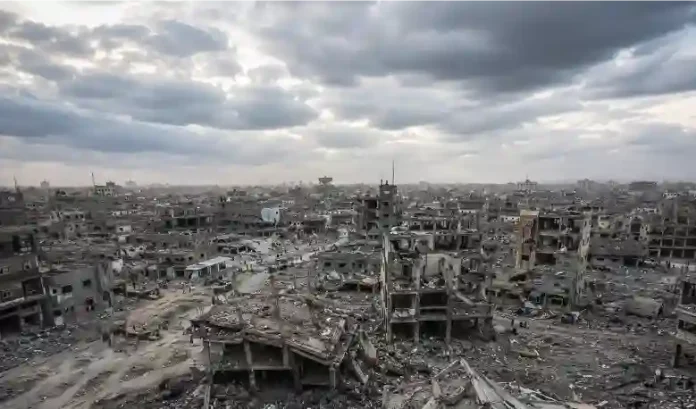
The Amnesty International investigation alleges that Israeli authorities have committed acts amounting to ethnic cleansing in Gaza since October 2023. The report details forced displacement of approximately 1.9 million Palestinians – nearly 90% of Gaza’s population – many of whom have been displaced multiple times as designated “safe zones” came under attack.
According to the report, the ethnic cleansing in Gaza involves several interconnected practices:
- Systematic destruction of residential areas, agricultural land, and water infrastructure
- Creation of expanded “buffer zones” along Gaza’s borders, rendering significant territory uninhabitable
- Demolition of entire neighbourhoods in northern Gaza to establish permanent military corridors
- Restrictions on return of displaced persons to their original homes and communities
- Destruction of cultural heritage sites, educational institutions, and medical facilities
The organisation’s Secretary General, Agnès Callamard, stated that the evidence points to “a deliberate, systematic campaign to render large parts of Gaza uninhabitable and to force the permanent displacement of Palestinian residents.” These findings align closely with the legal definition of ethnic cleansing established in international humanitarian law.
Implications for South Africa’s ICJ Genocide Case
South Africa’s landmark case at the International Court of Justice, filed in December 2023, accuses Israel of violating the 1948 Genocide Convention. The Amnesty report on ethnic cleansing in Gaza provides crucial documentation that supports several of South Africa’s legal arguments, particularly regarding the intent element required to prove genocide.
South African Minister of International Relations and Cooperation, Ronald Lamola, has consistently emphasised that the country’s ICJ application stems from its constitutional commitment to human rights and international law. The South African government has argued that the scale and nature of destruction in Gaza indicates an intent to destroy Palestinians as a group, in whole or in part.
The Amnesty report strengthens this argument by documenting patterns of behaviour that suggest systematic planning rather than isolated incidents of military excess. Legal experts note that evidence of ethnic cleansing can support genocide allegations, as both crimes share the element of intent to permanently remove a population group from specific territory.
| Legal Element | Genocide Convention Requirement | Amnesty Documentation |
|---|---|---|
| Protected Group | National, ethnic, racial or religious group | Palestinian population in Gaza |
| Prohibited Acts | Killing, causing harm, imposing conditions of destruction | Over 44,000 deaths, widespread destruction, displacement |
| Intent | Intent to destroy group in whole or in part | Systematic patterns suggesting deliberate planning |
| Scope | Substantial part of the group | 90% of population displaced, entire communities destroyed |
African Continental Response and Solidarity
South Africa’s leadership on the Palestinian issue reflects broader African solidarity with liberation movements and opposition to colonialism. The African Union has backed South Africa’s ICJ case, with numerous member states expressing support for the legal action against Israel.
This continental stance is rooted in shared historical experiences of colonisation, apartheid, and struggles for self-determination. Many African leaders have drawn explicit parallels between Israeli policies in Gaza and the apartheid system that once governed South Africa, noting similarities in territorial fragmentation, movement restrictions, and discriminatory legal frameworks.
Namibia, which itself experienced apartheid under South African rule until 1990, has been particularly vocal in supporting the ICJ case. President Nangolo Mbumba has stated that “Africa knows occupation and oppression when it sees it,” referencing the continent’s colonial history.
The Amnesty report on ethnic cleansing in Gaza has reinforced these continental perspectives, providing documented evidence that validates African concerns about systematic human rights violations. Several African countries have now indicated they may join South Africa’s case as intervening parties, which would strengthen the legal challenge significantly.
International Legal Framework and Ethnic Cleansing
While “ethnic cleansing” is not defined as an independent crime under international law, it encompasses acts that constitute crimes against humanity, war crimes, and potentially genocide. The United Nations has defined ethnic cleansing as “a purposeful policy designed by one ethnic or religious group to remove by violent and terror-inspiring means the civilian population of another ethnic or religious group from certain geographic areas.”
The Amnesty report on ethnic cleansing in Gaza documents acts that fall under several categories of international crimes:
- Forced displacement: Violations of Article 49 of the Fourth Geneva Convention, which prohibits forcible transfer of protected persons
- Destruction of property: War crimes under the Rome Statute when carried out extensively without military necessity
- Persecution: Crimes against humanity involving severe deprivation of fundamental rights on discriminatory grounds
- Apartheid: Systematic oppression and domination by one racial group over another, recognised as a crime against humanity
International law expert Professor John Dugard, a South African who served as UN Special Rapporteur on Palestine, has noted that ethnic cleansing often serves as evidence of genocidal intent. “When you see systematic patterns of destruction designed to make an area uninhabitable for a particular population group, you must examine whether this indicates an intent to destroy that group,” Dugard explained in recent commentary.
Evidence Collection Methodology and Credibility
Amnesty International’s investigation into ethnic cleansing in Gaza involved extensive fieldwork, satellite imagery analysis, and verification of over 200 testimonies from displaced Palestinians. The organisation deployed researchers to Egypt and conducted remote interviews with witnesses inside Gaza, medical personnel, humanitarian workers, and human rights defenders.
The methodology included analysis of satellite imagery showing the progression of destruction across Gaza’s neighbourhoods, verification of video footage, and cross-referencing of witness testimonies with publicly available data. Amnesty also reviewed statements by Israeli officials and military personnel to assess policy intent.
This rigorous approach strengthens the report’s credibility in legal proceedings. The ICJ has previously accepted Amnesty International documentation as evidence, recognising the organisation’s established reputation for thorough, impartial investigations. For South Africa’s legal team, having this independently verified evidence available strengthens their case considerably.
International observers note that the Amnesty report’s release timing – while the ICJ case proceeds – may influence the court’s consideration of provisional measures and eventual judgment on the merits of South Africa’s genocide allegations.
Challenges to the Ethnic Cleansing Allegations
Israeli authorities have rejected the Amnesty report’s findings, characterising them as biased and failing to account for security considerations. The Israeli government maintains that its operations in Gaza target Hamas military infrastructure and that civilian displacement results from Hamas’s use of civilian areas for military purposes.
Israeli officials argue that warnings issued to civilians before military operations demonstrate adherence to international humanitarian law and disprove allegations of ethnic cleansing in Gaza. They contend that the scale of destruction reflects the extent of Hamas’s military embedding within civilian infrastructure rather than systematic targeting of the Palestinian population.
However, Amnesty’s report addresses these counterarguments by documenting cases where designated safe zones were subsequently attacked, where evacuation routes were bombed, and where the scope of destruction far exceeded what could be justified by military necessity. The organisation argues that the pattern and scale of destruction indicate objectives beyond legitimate military targeting.
South African Public and Political Response
The Amnesty report has been received with significant attention across South African society, where the Palestinian cause enjoys broad public support. Civil society organisations, trade unions, and religious groups have intensified calls for the South African government to maintain its principled stance at the ICJ.
The South African Jewish Board of Deputies has expressed concern about what it views as one-sided characterisation of the conflict, while progressive Jewish organisations like Jews for Palestinian Justice have supported South Africa’s ICJ case and welcomed the Amnesty documentation.
Political parties across the spectrum have largely supported the government’s position, though with varying emphases. The Economic Freedom Fighters and the African Christian Democratic Party have called for complete severance of diplomatic ties with Israel, while the Democratic Alliance has urged a more balanced approach that maintains dialogue channels.
Professor William Gumede, political analyst at the University of the Witwatersrand, notes that South Africa’s position on Gaza has “unusual cross-party support, reflecting deep historical identification with struggles against oppression and a constitutional commitment to human rights that transcends partisan politics.”
Future Implications for International Justice
The Amnesty report on ethnic cleansing in Gaza represents a potentially significant development in international accountability mechanisms. If the ICJ rules in favour of South Africa’s genocide allegations, it would establish important legal precedents regarding state responsibility for mass atrocities and the application of the Genocide Convention.
For developing nations, including South Africa and its African partners, a successful ICJ case would demonstrate that international law can be enforced against powerful states, not merely against weaker nations. This would represent a departure from historical patterns where international criminal justice has been criticised for selective application primarily against African and developing world defendants.
The case also tests the effectiveness of international institutions in addressing ongoing conflicts. Unlike historical genocide cases that came before courts years or decades after the events, South Africa’s application seeks to halt alleged genocide while it is occurring – a novel use of the ICJ’s provisional measures jurisdiction.
Legal scholars are closely watching how the court handles evidence of ongoing crimes, including the Amnesty documentation of ethnic cleansing in Gaza. The court’s approach may influence future efforts to use international legal mechanisms for real-time intervention in mass atrocity situations.
As the ICJ proceedings continue, the Amnesty International report provides substantial documentation that will inform not only the legal case but also international public discourse about accountability, human rights, and the application of international law. For South Africa, the report validates its decision to pursue legal action and strengthens its position as a voice for international justice and human rights on the global stage.

