
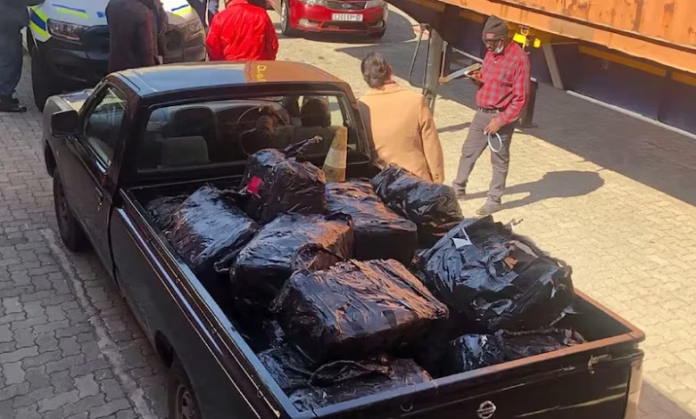
JOHANNESBURG – A bombshell allegation has emerged in the ongoing Aeroton drug bust case, with a key witness claiming to have been offered a career promotion in exchange for altering crucial testimony. The explosive testimony, delivered in a Johannesburg court, has raised serious questions about the integrity of South Africa’s law enforcement agencies and the lengths to which corrupt officials may go to obstruct justice in high-profile drug trafficking cases.
The witness, whose identity remains protected under court order, testified that a senior official approached them with the offer shortly after their initial statement was recorded. The Aeroton drug bust, which took place in the industrial area south of Johannesburg, resulted in one of the largest narcotics seizures in Gauteng’s recent history, with an estimated street value exceeding R50 million.
Details of the Alleged Bribery Attempt
According to court documents and testimony heard this week, the witness alleges that the promotion offer was made during what was described as an “informal meeting” at a location outside the official police premises. The witness claims the official suggested that a revised statement – one that would contradict key elements of the original testimony – would result in immediate career advancement and additional benefits.
“The witness was allegedly told that cooperation would be ‘remembered’ and that their career trajectory could be significantly improved,” prosecutor Advocate Thembeka Ngcobo stated in court proceedings. “This represents not merely an attempt at witness tampering, but a systemic corruption that threatens the very foundation of our criminal justice system.”
The allegations include:
- An explicit offer of promotion to a higher rank within the South African Police Service
- Promises of transfer to a “more desirable” station location
- Suggestions that failure to cooperate could result in career stagnation or disciplinary action
- Assurances that the revised statement would “better serve everyone’s interests”
The witness reportedly refused the offer and immediately reported the incident to the Independent Police Investigative Directorate (IPID), which has now launched a parallel investigation into the alleged corruption. Corruption within law enforcement agencies remains a critical challenge for South Africa’s criminal justice system.
The Original Aeroton Drug Bust Operation
The Aeroton drug bust occurred approximately eight months ago when a multi-agency task force raided a warehouse complex in the industrial area. The operation, which involved SAPS, the Hawks, and elements of the Johannesburg Metro Police Department, uncovered sophisticated drug manufacturing equipment, large quantities of finished narcotics, and evidence of international trafficking networks.
| Drug Type | Quantity Seized | Estimated Street Value |
|---|---|---|
| Methamphetamine (Crystal Meth) | 127 kg | R25.4 million |
| Cocaine | 43 kg | R17.2 million |
| Heroin | 28 kg | R8.4 million |
| Mandrax tablets | 15,000 units | R750,000 |
Seven suspects were arrested during the initial raid, including two individuals believed to be connected to international drug syndicates operating across Southern Africa. The case has been described by the National Prosecuting Authority as one of the most significant drug trafficking prosecutions in recent years, with potential links to organized crime networks spanning multiple countries.
The witness at the centre of the current allegations played a crucial role in the initial operation, providing testimony that established the chain of custody for evidence and corroborated intelligence that led to the raid. Any alteration to this testimony could potentially undermine the entire prosecution case, which may explain the alleged motivation for the bribery attempt.
Systemic Corruption Concerns in SAPS
This latest allegation adds to mounting concerns about corruption within the South African Police Service. According to Reuters reporting on African governance issues, South Africa has struggled with police corruption for decades, with regular reports of officers involved in everything from petty bribery to active participation in criminal enterprises.
IPID’s most recent annual report revealed alarming statistics about police misconduct:
- Over 5,600 cases of alleged police criminality were reported in the previous financial year
- Corruption-related complaints increased by 14% compared to the previous year
- Only 38% of investigated cases resulted in disciplinary action or prosecution
- Witness intimidation and tampering cases involving police officers rose by 22%
Dr. Gareth Newham, head of the Justice and Violence Prevention Programme at the Institute for Security Studies, argues that the Aeroton drug bust allegations reflect deeper institutional problems. “What we’re seeing is not isolated incidents of individual bad actors, but evidence of networks within law enforcement that actively work to subvert justice,” Newham explained in a recent interview. “When senior officials are allegedly involved in witness tampering, it suggests a level of organization and confidence that should alarm every South African.”
The Democratic Alliance’s Shadow Minister for Police, Andrew Whitfield MP, has called for Parliamentary hearings into the matter. “These allegations, if proven true, demonstrate that criminal syndicates have infiltrated our law enforcement agencies at senior levels. We cannot allow this cancer to spread further,” Whitfield stated in a press release.
Legal Implications and Ongoing Proceedings
Legal experts suggest that the alleged bribery attempt could have far-reaching consequences for the original drug trafficking case and potentially dozens of other cases in which the implicated officials were involved. Advocate Willem Breytenbach, a senior prosecutor not involved in the case, noted that any proven corruption could necessitate a review of all cases handled by the implicated parties.
“The problem with corruption at this level is that it casts doubt on every action taken by the implicated individuals,” Breytenbach explained. “Defence attorneys in multiple cases will rightfully question the integrity of evidence and testimony where these officials were involved. The damage extends far beyond this single case.”
The National Prosecuting Authority has assured the public that the Aeroton drug bust prosecution will proceed despite the allegations. NPA spokesperson Advocate Mthunzi Mhaga stated that “the integrity of our evidence remains intact, and we have multiple corroborating witnesses and forensic evidence that supports the charges. This alleged corruption attempt, if anything, demonstrates the desperation of those who wish to see this prosecution fail.”
The accused in the original drug trafficking case remain in custody, with bail having been denied due to flight risk and the severity of the charges. Their trial is scheduled to continue next month, though defence attorneys have indicated they may seek a postponement pending the outcome of the corruption investigation.
IPID Investigation and Police Response
The Independent Police Investigative Directorate has confirmed that it is treating the witness’s allegations with “the utmost seriousness” and has assigned a dedicated team to investigate. IPID spokesperson Lizzy Suping stated that the investigation would examine not only the specific promotion offer but also whether there is evidence of a broader pattern of witness tampering in drug-related cases.
“We are looking at communications, financial records, and career progression patterns to establish whether this was an isolated incident or part of systematic corruption,” Suping explained. “We are also interviewing other witnesses in this and related cases to determine if similar approaches were made.”
The South African Police Service has issued a carefully worded statement acknowledging the allegations while emphasizing that they remain unproven. “SAPS takes any allegation of corruption extremely seriously and will cooperate fully with IPID’s investigation,” the statement read. “However, we must caution against rushing to judgment before all facts are established. Our members deserve due process, just as any citizen would.”
The statement notably did not address questions about whether any officials have been suspended pending the investigation’s outcome, nor whether internal disciplinary proceedings have been initiated. Sources within SAPS, speaking on condition of anonymity, suggest that at least two senior officers have been placed on administrative leave, though this has not been officially confirmed.
South African news developments continue to highlight the challenges facing the country’s criminal justice system as it attempts to combat both organized crime and internal corruption simultaneously.
Broader Impact on Drug Enforcement Efforts
The allegations come at a particularly critical time for South Africa’s anti-narcotics efforts. The country has become a significant transit point for international drug trafficking, with syndicates using South African ports and airports to move narcotics between South America, Asia, and European markets. Domestic drug manufacturing has also increased dramatically, with methamphetamine production emerging as a particularly serious concern.
According to Al Jazeera’s coverage of African security issues, South Africa’s strategic location and relatively sophisticated infrastructure make it attractive to international drug cartels. However, successful enforcement depends critically on law enforcement integrity – precisely what these allegations call into question.
Professor Chandre Gould, a senior researcher at the Institute for Security Studies specializing in organized crime, warns that corruption in high-profile cases sends a devastating message to criminal networks. “When drug traffickers see that they can compromise investigations through bribing officials, it emboldens them,” Gould explained. “It also discourages honest police officers and witnesses who see that corruption is rewarded while integrity is punished.”
The South African Narcotics Bureau has reported that drug-related arrests have increased by 31% over the past three years, but conviction rates remain stubbornly low at approximately 42%. Corruption and compromised investigations are frequently cited as contributing factors to the gap between arrests and successful prosecutions.
Community activists in areas affected by drug trafficking have expressed frustration at the latest allegations. Yusuf Abramjee, a prominent anti-crime activist, stated that “communities are caught between criminal syndicates on one side and corrupt police on the other. How can ordinary citizens trust the system when those meant to protect us are allegedly for sale?”
The Path Forward
As the investigation unfolds, attention is turning to what systemic reforms might prevent similar incidents. Proposals under discussion include:
- Mandatory rotation of officers working on major drug cases to prevent long-term relationships with criminal elements
- Enhanced financial disclosure requirements for officers in sensitive positions
- Improved witness protection programmes with oversight independent of SAPS
- Stricter vetting procedures for promotions within specialized units
- Regular integrity testing and lifestyle audits for senior officers
Minister of Police Bheki Cele has scheduled a media briefing for next week, where he is expected to address the allegations and outline any policy responses. Sources suggest the Minister is under significant pressure from both civil society and within government to demonstrate decisive action against police corruption.
The witness at the centre of the allegations continues to receive protection, though the adequacy of current witness protection measures has itself become a subject of debate. Legal representatives for the witness have expressed concern about the resources allocated to protection, particularly given that the alleged corruption involves senior police officials who would have knowledge of protection protocols.
As South Africa grapples with these latest revelations, the Aeroton drug bust case has become emblematic of broader challenges facing the country’s criminal justice system. The outcome of both the corruption investigation and the original drug trafficking prosecution will likely have implications far beyond the immediate parties involved, potentially influencing public trust in law enforcement and the perceived viability of cooperating with authorities in major criminal investigations.
The court proceedings in the main case are scheduled to resume on the 18th of next month, with prosecutors indicating they have additional witnesses prepared to testify. Whether the corruption allegations will delay proceedings or result in other legal complications remains to be seen, but the case has already captured national attention as a test of South Africa’s commitment to rooting out corruption within its law enforcement agencies.

