
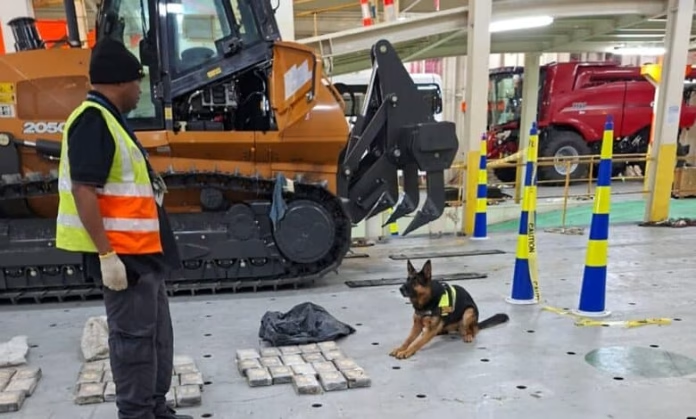
Durban’s Port of Durban has become the centre of a major law enforcement operation after customs officials intercepted what is being described as one of the most brazen drug smuggling attempts seen at the facility in recent years. A Durban Port cocaine bust carried out in the early hours of Saturday morning by the South African Revenue Service revealed approximately 90 large bricks of a substance preliminarily confirmed as pure cocaine, concealed inside the cavities of two heavy duty excavators imported from South America. The Hawks, working alongside SARS Customs and Excise officials, have since seized the haul and placed a combined estimated street value of R36 million on the drugs pending full laboratory verification.
Key facts at a glance:
- Approximately 90 bricks of suspected cocaine were found hidden inside two excavators
- The shipment originated from South America
- The preliminary street value is estimated at R36 million
- SARS detector dogs first alerted officials to the concealed parcels
- The South African Police Service secured the scene and took over the criminal investigation
- The Hawks are involved in the ongoing probe
- Exact weight, confirmed street value, and intended destination are pending laboratory results
- SARS Commissioner Johnstone Makhubu confirmed the operation was intelligence led
Durban Port Cocaine Bust: How the Operation Unfolded
The operation was anything but routine. Acting on risk assessments and advanced cargo profiling intelligence, SARS Customs and Excise officials identified the two excavators as high risk before they could clear the port. The machinery had arrived from South America, a continent that has become synonymous with cocaine production and export routes targeting Southern African ports. What makes this interception particularly significant is the ingenuity of the concealment method: smugglers embedded the drug packages deep within the body cavities of the excavators, apparently banking on the sheer bulk and mechanical complexity of the machinery to deter thorough inspection.
That gamble failed spectacularly. SARS detector dogs, deployed as part of the customs team’s standard operating protocol, alerted handlers to suspicious packages buried within both machines. Officials carefully extracted approximately 90 large bricks from the two excavators before subjecting them to preliminary on site testing using a SARS mobile drug detection kit. The results confirmed the presence of cocaine. The South African Police Service then secured the scene, formally seizing the consignment for handover to the Hawks and subsequent forensic laboratory analysis. Final confirmation of weight, purity, and street value is expected once those results are returned.
SARS Modernisation and Intelligence Led Enforcement Pay Off
SARS Commissioner Johnstone Makhubu was quick to frame the seizure as a direct product of the revenue service’s ongoing modernisation drive. Speaking after the operation, Makhubu said that advanced cargo profiling systems, non intrusive inspection technology, and data driven risk assessment tools had enabled officials to identify the shipment with precision while allowing compliant trade to continue unimpeded. This is not mere bureaucratic language. The ability to flag a specific container of heavy machinery arriving from South America, amid the thousands of containers processed at the Port of Durban daily, reflects a genuine leap in customs intelligence capability.
Makhubu described the operation as evidence that SARS is restoring the integrity of South Africa’s border environment, noting that illicit financial flows linked to drug trafficking actively erode the domestic economy and undermine legitimate traders. He praised the customs officials and partner law enforcement agencies involved, calling their vigilance “watchful and commendable.” For a revenue service that spent years battling internal corruption and capacity constraints, this kind of high profile, well executed interception is both operationally significant and reputationally important. The SARS modernisation programme has drawn considerable attention for its use of data analytics and technology investment, and Saturday’s result is a tangible demonstration of that strategy yielding real world results.
Port of Durban’s Growing Role in South Africa’s Drug Trade
Saturday’s seizure does not exist in a vacuum. The Port of Durban has been steadily emerging as one of the primary maritime entry points for cocaine entering South Africa, a trend that law enforcement and investigative journalists have been tracking for years. Daily Maverick investigative journalist Caryn Dolley, who has written extensively on the narco trafficking trade through Durban, has noted that the interceptions that make headlines represent only the tip of the iceberg. The volume of cocaine moving through the harbour, she has argued, is unprecedented in scale, and the trafficking route linking the Port of Santos in Brazil directly to Durban has been known to the Hawks for at least two decades.
The United Nations Global Report on Cocaine has identified South Africa as both a primary global transit hub and a rapidly growing domestic consumer market for the drug, a dual designation that places enormous pressure on ports of entry. Explosive testimony at the ongoing Madlanga Commission of Inquiry, which is probing widespread police corruption, has only deepened public concern. Evidence before the commission has alleged that corrupt police commanders actively facilitated the movement of narco traffickers through the Port of Durban. In 2021, a haul of 541 kilograms of cocaine worth more than R200 million was seized at the port, only for the drugs to subsequently be stolen from an unsecured Hawks storage facility in a suspected inside job. It is against this troubling backdrop that Saturday’s Durban Port cocaine bust must be understood.
Statistical Context: Drug Seizures at Durban Port
The following table provides context for the scale of recent cocaine related interceptions linked to the Port of Durban and South African law enforcement more broadly.
| Year | Seizure Details | Estimated Value | Agency Involved |
|---|---|---|---|
| 2021 | 541 kg of cocaine at Port of Durban | R200 million+ | Hawks / SAPS |
| 2026 (June) | 90 bricks in 2 excavators, Port of Durban | R36 million (preliminary) | SARS / Hawks / SAPS |
| Ongoing | Madlanga Commission evidence of systematic port infiltration | Unquantified | Judicial inquiry |
| Global benchmark | SA identified as primary cocaine transit hub | N/A | UN Office on Drugs and Crime |
These figures underscore a disturbing pattern. South Africa is not merely a transit country where drugs pass through on their way elsewhere. The domestic market for cocaine is growing, and ports like Durban serve as critical chokepoints where international criminal networks intersect with local distribution networks. Every kilogram that slips through represents not only a failure of border enforcement but a contribution to the gangsterism, violence, and socioeconomic decay that plagues communities across KwaZulu Natal and beyond. The fact that a significant portion of what enters is never detected makes each successful interception simultaneously a victory and a reminder of how much remains at stake.
What This Means for Organised Crime Networks Targeting South Africa
The concealment method used in this Durban Port cocaine bust tells investigators something important about the sophistication and resourcefulness of the criminal networks involved. Hiding narcotics inside heavy construction machinery is not a rudimentary operation. It requires coordination across supply chains, access to industrial facilities capable of modifying large equipment, and knowledge of shipping routes, documentation processes, and inspection protocols at destination ports. These are not amateur smugglers. The use of South American sourced excavators as a vehicle for drug trafficking points toward organised international syndicates with the financial muscle and logistical capacity to experiment with increasingly complex concealment strategies.
This matters for South Africa because it raises the question of what else is passing through that has not yet been detected. For South Africans concerned about organised crime and its links to political corruption, the Madlanga Commission testimony has already made clear that the problem extends far beyond the harbour fence. If corrupt elements within law enforcement have historically provided cover for trafficking operations, then the effectiveness of any interception effort depends fundamentally on the integrity of the officials conducting it. Saturday’s operation, which involved multiple agencies working in apparent coordination, is an encouraging sign. But it is one operation, and the networks it has disrupted will adapt.
What Comes Next for the Investigation and South Africa’s Port Security
With the consignment now in the hands of the Hawks and SAPS forensic investigators, the immediate priority will be laboratory confirmation of the substance, final quantification of the haul, and tracing the full chain of custody from the point of origin in South America to its intended destination within South Africa. Investigators will be working to identify who arranged the shipment, who was meant to receive it, and whether any South African based individuals or companies are implicated in the smuggling network. Given the value of the haul and the sophistication of the concealment, it is unlikely that this was a one off attempt, and law enforcement sources will almost certainly be looking for links to prior seizures and ongoing investigations.
For South Africa’s broader port security architecture, this case is both a validation and a challenge. SARS has demonstrated that its investment in intelligence led customs enforcement can yield results, and the cooperation between SARS, SAPS, and the Hawks on Saturday points toward the kind of inter agency collaboration that experts have long argued is essential to disrupting narco trafficking at ports of entry. The Port of Durban handles a massive share of South Africa’s import and export volumes, and its importance to the national economy makes it an attractive target for criminal exploitation. Strengthening the legal, technological, and human intelligence frameworks that protect it is not optional. As Saturday’s Durban Port cocaine bust has once again demonstrated, the stakes could hardly be higher.

